The Lady Vanishes

May Witty as Miss Froy

Hitchcock and trains, Hitchcock and trains – even the words seem to run on rails. The Lady Vanishes is the British director’s take on the 1930s craze for the murder mystery on the move. And though Hitchcock could have lent on Agatha Christie’s Murder on the Orient Express – published in 1933 to instant acclaim – he was in fact working from Ethel Lina White’s The Wheel Spins, a 1936 best-seller from a fellow British writer who hasn’t weathered as well. But White has something here – the notion of gaslighting. The Wheel Spins turns on the determination of its central character to resist the dominant narrative while everyone around her, for various … Read more

Number Seventeen

Vagrant Ben and cop Barton

So here’s Number Seventeen, a Hitchcock film that’s almost never mentioned when Hitchcock is up for discussion. “A disaster,” is how the man himself described it, having been forced into directing it by his studio. But then who remembers Rich and Strange (great title) which came before, or Waltzes from Vienna, which came after? In the silent era Hitchcock had already hit his stride with The Lodger, but when the talkies came in it’s as if he had to re-learn everything. By 1934 and The Man Who Knew Too Much, the process was complete. But here, in 1932, he’s only halfway there. That said, there’s lots of good stuff here. The opener, for … Read more

The Trouble with Harry

Little Arnie, with his toy gun, finds the body

A wag rather than a humourist, Alfred Hitchcock generally ran into trouble when he tried to make a funny film. Case in point: The Trouble with Harry, an arch confection notable for two things: it was the first time Hitchcock worked with composer Bernard Herrmann; and was also Shirley MacLaine’s screen debut. There are two conceits at work in this movie. Number one is the body that won’t stay buried. Number two is the nonchalance of the citizens of a white-picket American town who stumble across it, one way or another. That starts with Arnie, a boy roaming the countryside near his home who hears a commotion and a shot and then discovers … Read more

Jamaica Inn

Charles Laughton

Hitchcock’s last movie before he decamped from Britain to the USA is a nearly great adaptation of Daphne Du Maurier’s novel Jamaica Inn, set in Cornwall where smuggler gangs lure ships onto the rocks, loot their cargos and kill their crews. The towering presence in it is Charles Laughton as local lord Sir Humphrey Pengallan, a charming psychopath who runs the notorious gang through his trusty lieutenant Joss Merlyn (Leslie Banks), landlord of the Jamaica Inn, from which the gang operates, a place so feared that coaches will not stop there. Arriving one dark and stormy night – poor orphaned Irish colleen Mary Yellan (Maureen O’Hara), looking up her aunt after the death … Read more

Secret Agent

Madeleine Carroll and John Gielgud as the Ashendens

Anyone for the fifth best British film of 1936, as voted for by the readers of the defunct Film Weekly? Secret Agent is one of a run of spy thrillers Alfred Hitchcock made in the 1930s. Sandwiched between The 39 Steps and Sabotage it’s the least compelling of the three, a misfire in many ways. There are two reasons for that, both Hitchcock’s fault. But let’s get to that later. First, you need to know that it stars John Gielgud as Edgar Brodie, a successful novelist recruited by the British secret service, given the spy moniker Ashenden (the title of the Somerset Maugham book on which the film’s based) and sent to Switzerland. … Read more

Sabotage

Oscar Homolka as the saboteur

Graham Greene didn’t like the films of Alfred Hitchcock, but he did like Sabotage. The novelist was a film critic in his early years and was regularly on Hitchcock’s case for what he described as “inconsistencies, loose ends, psychological absurdities.” Tough room. But, as I say, Sabotage got the Greene seal of approval. Which is odd because it’s not top-flight Hitchcock, though it is worth staying around for the film’s famous sequence towards the end, when Hitchcock sacrifices a character in scenes audiences in 1936 found shocking and Hitchcock himself was uneasy about. It’s based on the Conrad novel The Secret Agent, but since Hitchcock’s previous film had been Secret Agent, the original … Read more

My Name Is Alfred Hitchcock

Hitchcock with his fingers splayed

Mark Cousins’s documentary My Name Is Alfred Hitchcock steers a careful course between low and high culture, the crass, “did you know” approach to the great director and the earnest film studies route. Hitchcock understood the importance of fun. The result is an engaging, interesting, entertaining and enlightening 120 minutes, not the last word in Hitchcock, but a lively addition to a library which, in my view, could not get full enough. “A showman, a daredevil, a fun fair,” says Hitch in a film entirely written and narrated by him, or so it’s claimed at the outset. In fact that’s all a bit of a lie. Cousins wrote the script that impressionist Alistair … Read more

Suspicion

Johnnie and Lina

Anxiety was the fashionable diagnosis if you went to see a shrink in the 1940s. Suspicion is the anxiety movie, the story of a prim spinster swept off her feet by a handsome chap who then starts wondering what he saw in her. Her money is the obvious answer, though Joan Fontaine looks like a prize worth having in Alfred Hitchcock’s fraught little melodrama halfway stranded between the gothic of Wilkie Collins and Sigmund Freud’s psychoanalyst’s couch. Cary Grant plays the raffish Johnnie, the bounder who whirls into the life of wealthy wallflower Lina (Fontaine), quickly marries her and then reveals that he hasn’t a penny to his name. He’ll work, he says, … Read more

Young and Innocent

Nova Pilbeam and Derrick De Marney in a car

Minor Hitchcock but a major surprise (to me at least), 1937’s Young and Innocent is terribly, terribly British and also terribly, terribly entertaining, a near-comedy that’s bright, sunny, fast, brilliantly made and very grin-inducing. Made two years after The 39 Steps it is basically the same film again, but with more comedy, less jeopardy and English rural locations standing in for the wilds of Scotland. Its stars don’t look too unlike Robert Donat and Madeleine Carroll either. Derrick De Marney plays Robert, the square-headed decent chap accused of a murder he didn’t commit and Nova Pilbeam is Erica, the pretty blonde who helps him out. She’s not shackled to him, as Carroll was … Read more

The Wrong Man

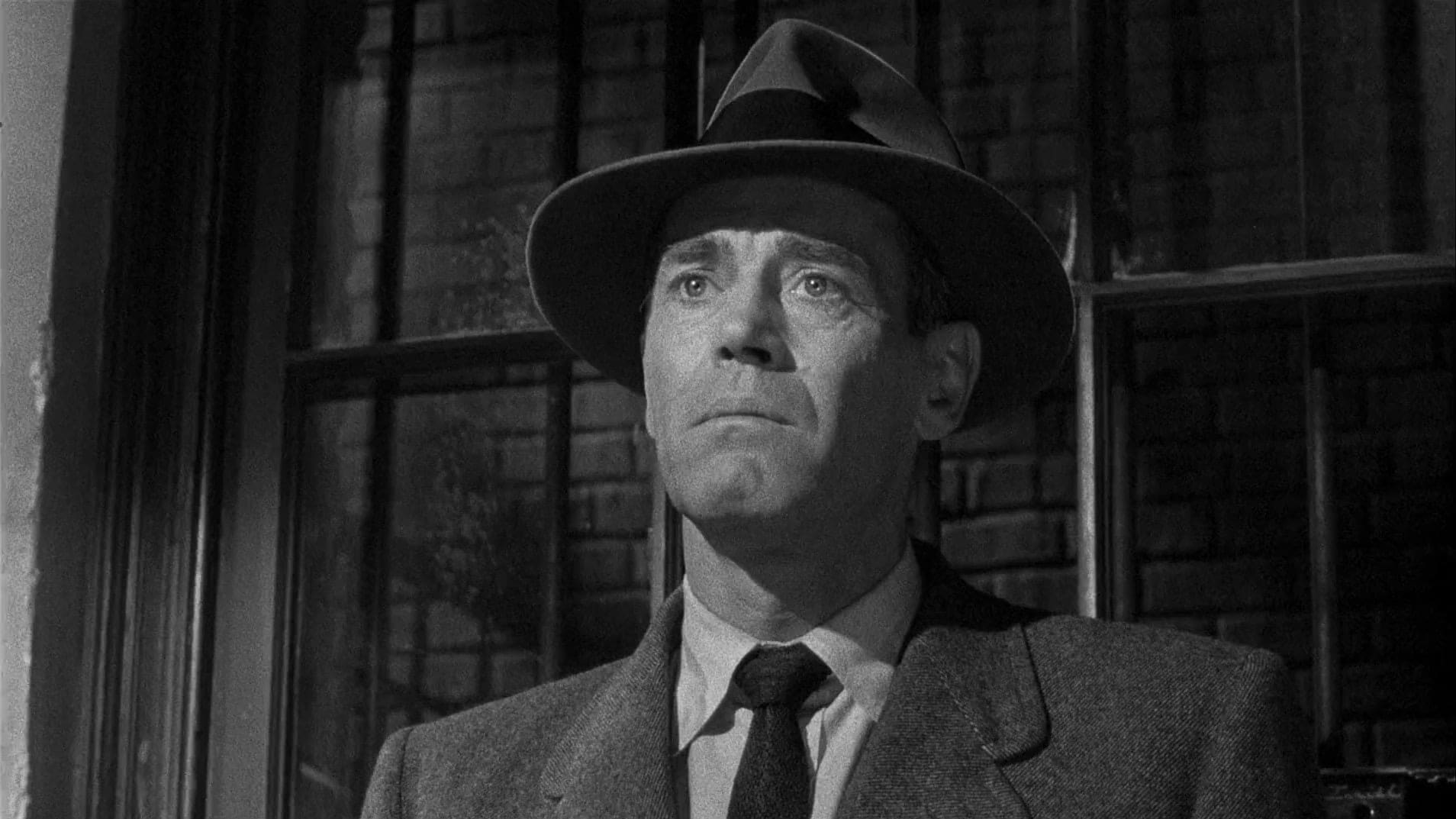
Henry Fonda in hat

Atypical and yet very typical, 1956’s The Wrong Man is Alfred Hitchcock’s tilt at those noirish ripped-from-the-headlines crime dramas that were all the rage when people still said “all the rage”, films sold on authenticity and with a dedication to telling it how it was. That’s what’s behind Hitchcock dropping his usual comedy cameo early in this movie and settling instead on a moody, backlit intro in which the man himself informs us that what we are about to see is stranger than all the films he’s made before, and yet… “this is a true story. Every bit of it.” He is pretty much as good as his word. This is the story … Read more

Popular Posts

Steve Jobs The Lost Interview

Steve Jobs The Lost Interview

The Zoom call begins to go wrong

Host

Tashiana Washington and Ty Hickson in Gimme the Loot

2 September 2013-09-02