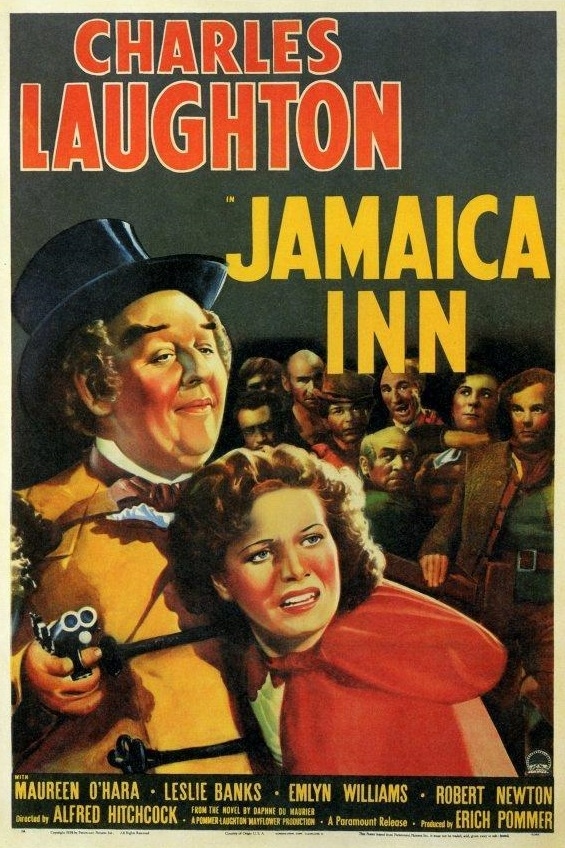
Hitchcock’s last movie before he decamped from Britain to the USA is a nearly great adaptation of Daphne Du Maurier’s novel Jamaica Inn, set in Cornwall where smuggler gangs lure ships onto the rocks, loot their cargos and kill their crews.
The towering presence in it is Charles Laughton as local lord Sir Humphrey Pengallan, a charming psychopath who runs the notorious gang through his trusty lieutenant Joss Merlyn (Leslie Banks), landlord of the Jamaica Inn, from which the gang operates, a place so feared that coaches will not stop there.
Arriving one dark and stormy night – poor orphaned Irish colleen Mary Yellan (Maureen O’Hara), looking up her aunt after the death of her mother and appalled to find her relative terrorised by husband Joss. Into this stew an undercover customs man, Jem Trehearne (Robert Newton), posing as a gang member and hoping to expose Sir Humphrey, who, as far as Mary is concerned, is the fount of all goodness.
Laughton was both the film’s star and its producer, which gave him the power to insist on script rewrites to increase the role of his character. This had the effect of exposing what Hitchcock wanted to save for much later on – that Sir Humphrey is the bad guy. When the film failed to be as big a hit as earlier films like Sabotage and The Lady Vanishes Hitchcock blamed the film’s relative lack of success on Laughton’s changes.

Thematically, Jamaica Inn contains echoes of The 39 Steps. At one point Mary and Jem are shackled together, a reminder of Robert Donat and Madeleine Carroll in handcuffs hoofing it over the windswept moors. Joss and meek wife Mary remind us of the dour crofter and his timid wife Donat and Carroll met en route. The bad guys in this movie are authority figures, as they were in the 1935 classic.
Misaligned loyalties abound – Mary to Sir Humphrey, her aunt to her awful husband – but mostly this is a platform for Laughton to demonstrate his performative prowess. His playing of Sir Humphrey is coolly brilliant, the epitome of “what what” British aristocracy, bibulous and self-important, faintly camp. But beneath that another layer: cold, lacking in empathy, godlike in his self-regard and his treatment of other humans as creatures to be played with – and disposed of – at will.
There is a lot of talent here. As well as Laughton, there’s O’Hara in her first film, Robert Newton before playing another Cornish man, Long John Silver, made him a big star (no trace of the piratical accent here), Leslie Banks as the bloodthirsty Joss. Behind the camera, Sidney Gilliat, Joan Harrison and JB Priestley all contributed to the screenplay, while the editor is Robert Hamer, who’d go on to be a great director himself.
Technically Hitchcock isn’t quite in the room with them all. There is a scrappiness here, it’s a touch haphazard. But there’s another reason why it isn’t quite hitting the bullseye. In Hitchcock’s best films we are on side with the good guy, who is being subjected to one trial or another. Here the emphasis is firmly with the bad guy, which is all Laughton’s doing, and ultimately undoes the film. There is just not enough for O’Hara and Newton to do, Leslie Banks even less, Marie Ney barely anything at all.
Hitchcock’s head was already halfway over the Atlantic where, on his next film, Rebecca – another Du Maurier adaptation – he’d have a similar fight with his next producer, David O Selznick. Who’s in charge? You want it to be Hitchcock, don’t you. In Jamaica Inn it wasn’t, not quite. Hitchcock wasn’t going to let that happen again.
Jamaica Inn – Watch it/buy it at Amazon
I am an Amazon affiliate
© Steve Morrissey 2026