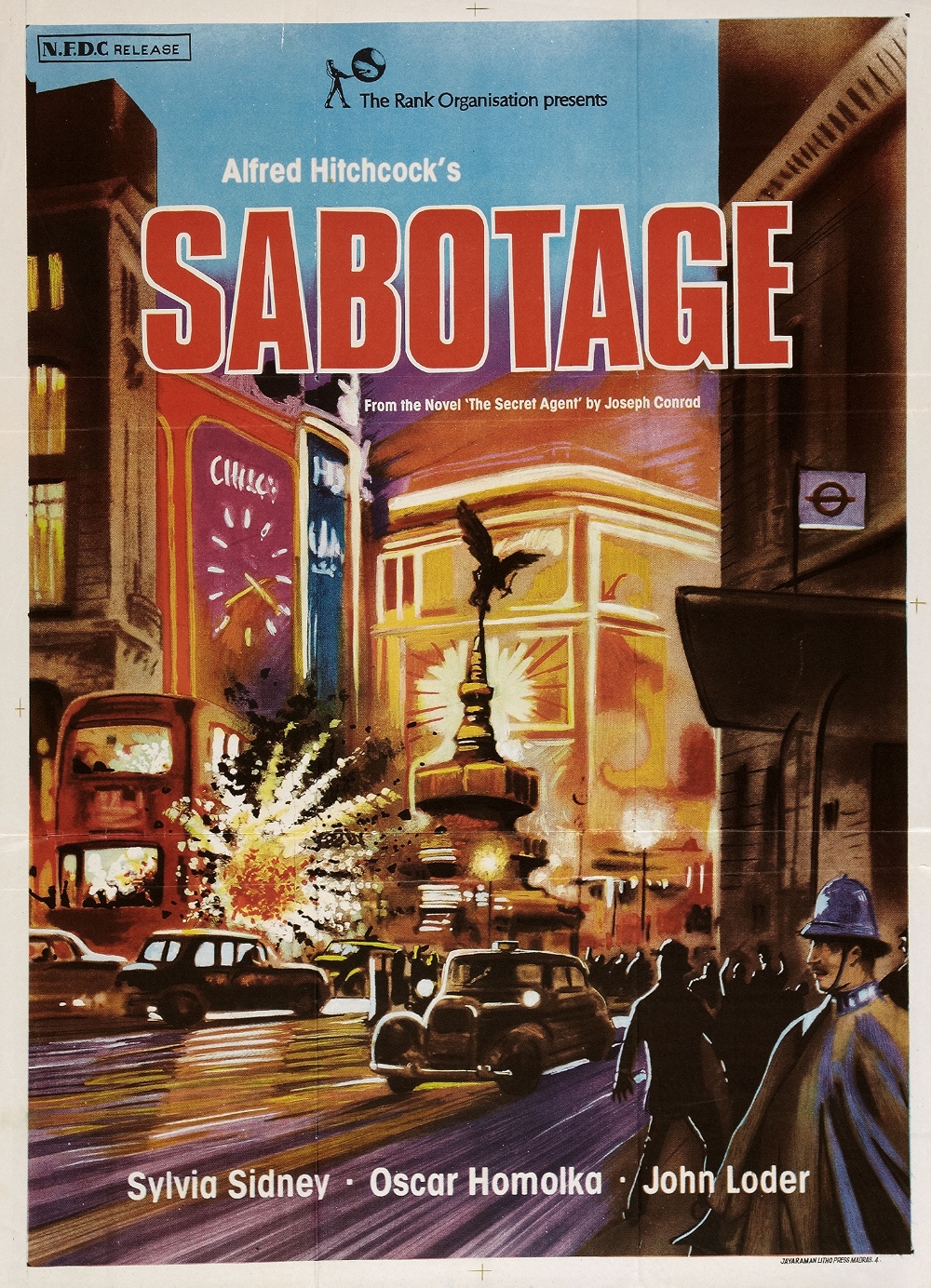
Graham Greene didn’t like the films of Alfred Hitchcock, but he did like Sabotage. The novelist was a film critic in his early years and was regularly on Hitchcock’s case for what he described as “inconsistencies, loose ends, psychological absurdities.” Tough room.
But, as I say, Sabotage got the Greene seal of approval. Which is odd because it’s not top-flight Hitchcock, though it is worth staying around for the film’s famous sequence towards the end, when Hitchcock sacrifices a character in scenes audiences in 1936 found shocking and Hitchcock himself was uneasy about.
It’s based on the Conrad novel The Secret Agent, but since Hitchcock’s previous film had been Secret Agent, the original title was never going to be used. So Sabotage it is, a term possibly not in everyone’s everyday lexicon – otherwise why give us the opening shot of the dictionary definition?
Then on to a story about a foreign agent causing havoc in London, starting with a power outage (sand in the bearings of the generators) and escalating to a bomb designed to kill, maim and terrorise.
Who? Why? We don’t know. Oscar Homolka plays the malefactor, a foreigner of murky European origin whose cover is the cinema he runs with Winnie (Sylvia Sidney), the loving wife who’s also a devoted sister to younger brother Stevie (Desmond Tester).
Though Karl Verloc (Homolka) doesn’t know it, the authorities are already on to him, in the shape of Detective Sergeant Ted Spencer, working undercover in the greengrocer’s next door to the cinema and very keen to get closer to Mrs Verloc, for reason that are not entirely professional.
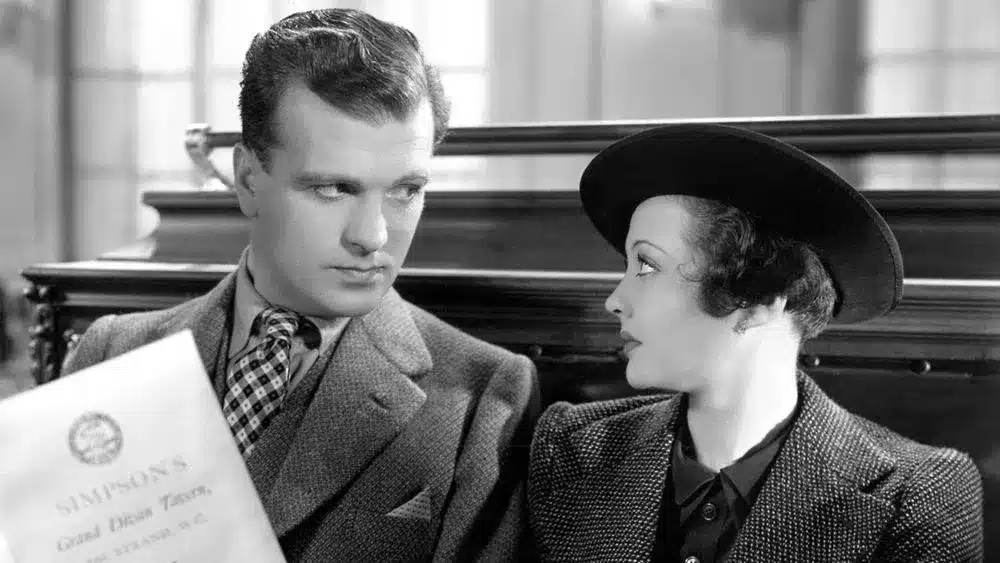
Hitchcock wanted Robert Donat for this role but instead had to make do with John Loder, whose playing of Spencer is one of the reasons the film does not sparkle – Donat would have brought bouncy charm; Loder comes across as unctuous, aggressive and supercilious and every encounter with Mrs V feels entirely wrong. He’s trying to romance her? And she’s yielding to it? No no no, wrong wrong wrong.
Sylvia Sidney’s cupid’s bow lips never curl and she keeps her end of the bargain as the wife, sister and prospective love interest, as does Homolka as the agent whose instructions to escalate his activities take him right out of his comfort zone. Also crucial is Tester’s performance as Stevie, a cute kid who will at one point be asked to take two canisters of film across London. What Stevie doesn’t know is that the “film” is actually a bomb, and it’s here that Hitchcock works his magic, in “master of suspense” mode, in a technically and dramatically remarkable display of camerawork and montage in the Eisenstein style.
It’s the second half of the film where the good stuff happens, and Sidney gets her chance to shine in scenes that are incredibly touching. Hitchcock’s camera romances her face – the big eyes, the moist lips – in scenes that are, for him, unusually sentimental.
That frisson you often get with Hitchcock, with transgression of one sort or another lurking around every corner, is largely absent – not helped by the fact that the only real source of it, the potential romance between the cop and Mrs Verloc, clanks like crazy. And it is all in all a fairly staid affair, a bit too talky, not exactly bursting with the trademark set pieces. But there is humour in side characters, like the pet shop owner dealing with a customer whose canary will not sing. And it bursts with chirpy London street atmosphere.
The Criterion version is the one to go for if you want a decent-looking and sounding film. The restoration has removed a layer of haze and the tones are rich, the sound thick (for the 1930s).
Minor Hitchcock but good all the same, it also goes by the title of The Woman Alone, suggesting it is Sidney’s film, which it is.
Sabotage – Watch it/buy it at Amazon
I am an Amazon affiliate
© Steve Morrissey 2025