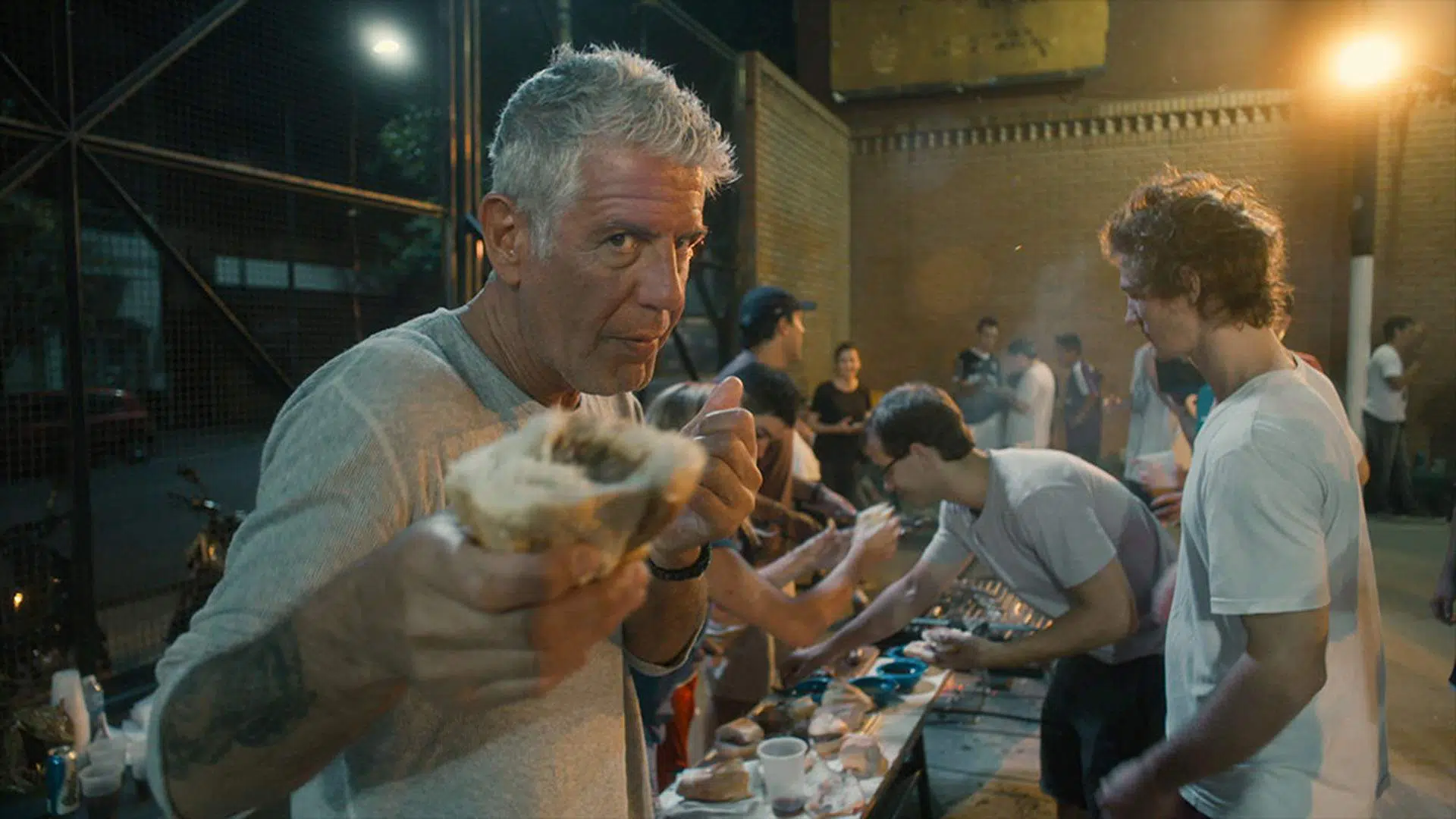
As a film about a person never at ease with himself, Roadrunner: A Film about Anthony Bourdain sketches a compelling if depressing picture – of a man who at first didn’t have it all and was unhappy, and then did have it all and was still unhappy.
Bourdain died in 2018 and had been famous since his 2000 memoir Kitchen Confidential turned him into a celebrity at a global level. “It was literally overnight,” he remembers in archive footage. Roadrunner begins his story about there, barely touching on his years as a heroin addict, a vital piece of the Bourdain jigsaw.
Merely alluding to the bookish child with a rebellious streak who’d wound up a junkie in New York, the “no footage, no story” aspect of the film reflects the fact that it’s produced by the people who made Bourdain’s TV shows. They pick up the story as Kitchen Confidential propels Bourdain into the limelight. The drugs are dispensed with in a sentence (“I was done with that by 88”) as is the arc of his career trajectory (“dishwasher to cook to chef”).
It all started with Bourdain banging out an email to a writer friend back home, full of excitement about what culinary delights he was seeing on a trip to Japan. The friend showed the “sensational” email to his wife, a publisher. She asked Bourdain if he’d ever thought of writing a book. He said yes. And so Kitchen Confidential was born. In the blink of an eye Brad Pitt is being talked of to play Bourdain in a movie adaptation. Bourdain is on Letterman. Oprah wants to talk to him. Craggily handsome, wiry like a rock star, a gifted speaker as well as writer, he’s feted on book tours. Bourdain gets the full treatment.
A TV production company gets interested. And we learn from Lydia Tenaglia and Chris Collins, who Bourdain remained with to the end, that he was a fast learner. “We’re fucked,” was their verdict when they first toured Japan with the too-quiet Bourdain on his first TV show, an adaptation of his second book, A Cook’s Tour. But by the time the gang hit Vietnam, Bourdain had worked out that what Tenaglia and Collins wanted from him was not the real article but a version that would work on TV, a dish made from the ingredients he had at hand – he obliged.

Bourdain admitted he was never a great chef, but he was great at being this TV version of himself. Roadrunner runs through some of his defining moments – eating a live cobra heart on TV (“It pumps on the way down too” he reports), getting caught in a war in Lebanon in 2006, and later in the Congo, and many many shots of Bourdain walking, walking, walking the streets of whatever far-flung place the team were all in that week. TV food/travel crossovers often feature chefs, but none of them walk as much as Bourdain, or look as good doing it.
All this interwoven with footage from his private life. Marriage number one gives way under the pressure of the fame. He meets Ottavia, another tough, feisty, big-hearted woman. He marries her and is surprised to find himself a father for the first time aged 41. Married life suits him in the way it suits all road warriors, as an idealised place to return to and then depart from. The marriage had finished long before Bourdain and Ottavia got divorced. Restless.
And then on to his relationship with Asia Argento, a rocker and a rebel like him, a fellow restless soul. There is some tutting and many a hint of a head shaken in sorrow here from long-term friends and colleagues but on the whole it’s what’s not said about Argento that’s more telling than what is: silence. This is boggy terrain – while she was with Bourdain, Argento accused Harvey Weinstein of rape from the stage at the Cannes film festival and was later herself accused of sexual harassement. Wisely, this film stays a way back. Perhaps lawyers?
He dies, having hanged himself aged 61 shortly after Argento had turned up in a pap shot in a magazine, holding hands with some other man. He was found by Éric Ripert, a chef he admired who became a firm friend.
Ripert will not speak about anything to do with the suicide in what seemed, to all concerned, like something that could easily not have happened. In an almost funny, slightly ghoulish montage of TV moments Bourdain is shown joking about killing himself. If only somehow he had weathered the storm.
But also, yes, the general surmise is that it was always on the cards.
This is a good film, if about 15 minutes too long, and it speaks to most of the right people (though neither his first wife, Nancy, nor Asia Argento), Bourdain’s brother Chris and longtime collaborators, road warriors like himself. Because there is a lot of footage of Bourdain himself, at certain points it’s almost as if he’s narrating his own life story. At others it teeters on the edge of becoming a documentary about the making of TV food/travelogues rather than a film about a character rooted in a romantic late-1970s zeitgeist, where the Ramones and Apocalypse Now both drink from the same well of druggy chic.
Bourdain remained an addict all his life. If it wasn’t drugs, it was cooking, or martial arts, or travelling and writing. He was restlessly energetic, always seeking the thing that would help him scratch an itch others didn’t seem to feel. Unease taken to the point of dis-ease. In a late clip on a windy beach in the New Jersey town he grew up in but couldn’t wait to leave, he shakes his head, looks around and asks – “What the hell was I so angry about. This was… you know… paradise.”
Roadrunner: a Film about Anthony Bourdain – Watch it/buy it at Amazon
I am an Amazon affiliate
© Steve Morrissey 2021

