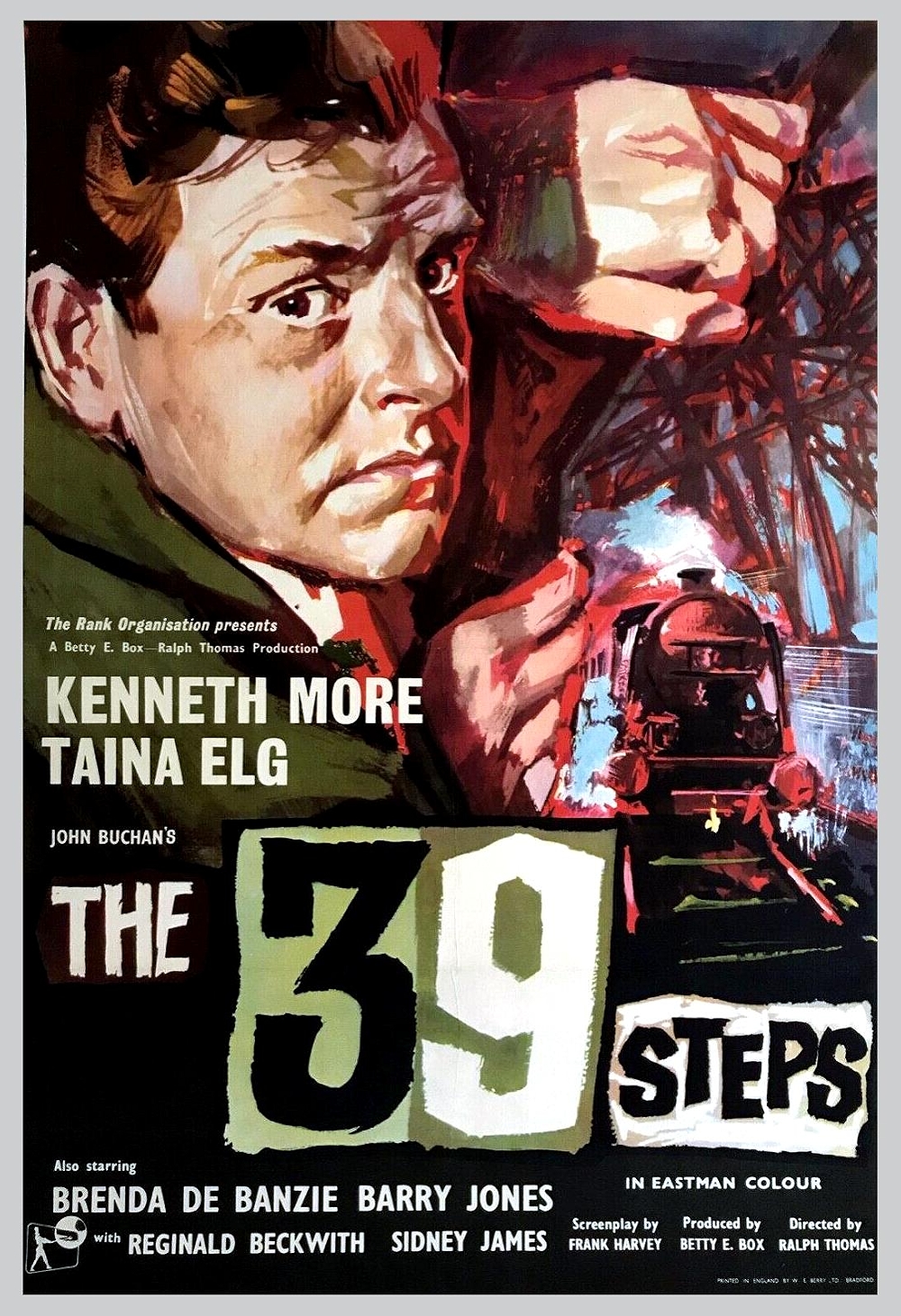
In a world where the excellent is often the enemy of the good, what about The 39 Steps? Not Hitchcock’s 1935 classic, but the 1959 remake starring Kenneth More?
So often compared to the original, so often reviled – especially in its native UK – the 1959 version is actually a pretty good stab at an adaptation of John Buchan’s rattling thriller and a decent film in its own right. But thanks to the Hitchcock version it struggles to get a hearing. To watch it, it’s probably best to mentally lock Hitchcock’s version away, though there is also something to be said for watching it as a compare and contrast.
Same plot more or less. Dashing, decent Richard Hannay is the innocent man wanted by the police for a murder he didn’t commit. The only way he can prove his innocence is to go on the run and try and track down the spy ring actually responsible, which leads him from London to Scotland and then back to London again. Where the story ends as it began, in a theatre where a music-hall turn, Mr Memory, will be decisive in unmasking the spies, thus proving Hannay’s innocence.
En route a daredevil sequence on the Forth Rail Bridge and some romantic capering with a prim teacher, Miss Fisher (Taina Elg).
Everyone involved in the 1959 film has digested Hitchcock. Director Ralph Thomas sticks with some of Hitchcock’s set pieces, while Frank Harvey’s rewrite of Buchan’s book also largely follows Hitchcock, who adapted the life out of the novel and invented both the female love interest, the music hall opening and closing scenes and the bit set in a crofter’s cottage. The crofting scenes – poignant in the 1935 version – Harvey rewrites as a bawdy sequence set in a roadside cafe, where a randy matron with a gay husband tries to get Hannay to satisfy her sexual needs. All done in 1950s code and featuring a great performance by Brenda de Banzie, who is at least 50 per cent panting gusset.
Harvey seems wary about wholeheartedly endorsing Hitchcock’s invention of the handcuffs that locked Hannay and his hostage together in the 1939 version. This time around they’re only yoked together for a few scenes before they are set free again.

The biggest break with Hitchcock is tonal. Light comedy is what this 39 Steps is all about. Ralph Thomas was best known for directing films like Doctor in the House, about the larks that junior doctors get up to. Kenneth More, meanwhile, had made his name six years before in the airy comedy Genevieve. At this point he was the country’s biggest male star.
Neither is off his home turf here, Thomas delivering larky derring-do. More, with an eyebrow half raised, dry and brisk as the pipe-smoking decent chap with an accent to etch glass. “Good day to you, shepherd,” he hail-fellows a passing yokel in Scotland at one point, who complains bitterly to the “Sassenach” that he’s not a shepherd, then later has to correct Hannay again.
Unlike Hitchcock, Thomas shot most of it in Scotland, where the weather did not let him down. The sun is shining, and this really helps with the film’s other departure – it’s in colour, and thanks to cinematographer Ernest Steward they’re gloriously unnatural hues that makes everything look like a seaside postcard of the era.
Elg, like the film itself, often gets criticised because she’s not Madeleine Carroll, female star of the 1935 film. She is not a Hitchcock blonde and not carnally cryptic enough, but she is likeable, plausible… nice.
It is all a bit like that, 1959’s The 39 Steps. Highly likeable, a bit unlikely but it gets the job done efficiently and with more flair than you might expect.
The 39 Steps – Watch it/buy it at Amazon
I am an Amazon affiliate
© Steve Morrissey 2024