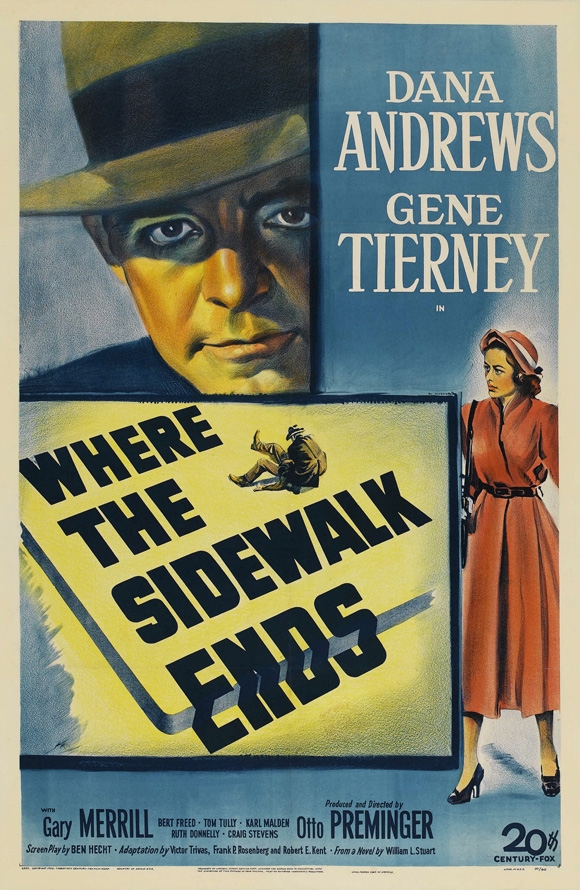
Not the best Otto Preminger film but a very good example of what he was about, Where the Sidewalk Ends is a film noir directed with maximum economy that re-teams Laura‘s golden pairing of Gene Tierney and Dana Andrews, he again impassive as you like, she almost unbearably long-suffering.
It’s not much of a role for her, as Laura wasn’t in fact (her character was literally dead for most of it and for the rest of it represented ideal womanhood). But for Andrews it’s a great example of his abilities inside the noir genre, where minimalism is generally the best option. No one was more minimal than Andrews.
He’s Dirty Harry before Dirty Harry, the cop who thinks with his fists, which gets him into trouble right at the outset, when he punches a suspect to get information out of him and kills the man in the process. It was an accident, but because Mark Dixon (Andrews) is already on notice by his newly appointed straight-edge lieutenant (Karl Malden), he’s certain he’ll be charged with murder.
Unless he conceals the crime. Fate, working initially with and later against him, will dog Dixon’s attempts to dispose of the body, first giving him an easy run as he gets the corpse out of the dead man’s apartment without too much trouble, but then throwing grit into Dixon’s bearings as he tries to pin the murder on local gangster Tommy Scalise (Gary Merrill).
Because he’s a cop, Dixon is involved in the hunt for the murderer, which means he’s investigating himself. But when the crime seems about to be pinned on the father of a witness (Tierney) he’s recently interviewed – and clearly fallen for – Dixon is on the horns of a dilemma. Say nothing and condemn her innocent father or come clean.
Dixon is not a great example of law enforcement but Ben Hecht’s screenplay goes to lengths to paint him as a decent human being. Dixon’s dad was a thief and, as a dedicated cop, Dixon feels that keenly. There’s a good guy beneath the defensive carapace, which Hecht demonstrates in an extended scene where Dixon takes Tierney’s Morgan out for dinner. Instead of visiting a swish restaurant they go to a just-folks neighbourhood eatery where Dixon joshes good-naturedly with the owner, who obviously has a motherly interest in him (and his love life).

Hecht isn’t that interested in the investigation and on two separate occasions characters will join up dots that aren’t there to bounce the plot forwards. Nor is he particularly focused on the romance. But the incidentals are good, Hecht putting fast, tight dialogue into the mouths of side characters, while Preminger directs with a brilliance of economy that is something to watch. Edits are clearly for losers in this director’s book and with long, single takes and a gliding camera Preminger advances the action thriftily.
Andrews is something similar, giving a taut and economical performance with barely a move of the mouth. It’s all going on his his eyes, whether it’s feelings for Morgan or the worry that he’s about to be exposed as the killer.
Gary Merrill comes out of it well as Scalise, the gangster sniffing a benzedrine inhaler in most of his scenes, and it’s notable how well cast this movie is all the way through – Ruth Donnelly as Martha the matronly restaurateur, Neville Brand as a henchman (uncredited but effective), Tom Tully as Morgan’s blabbermouth but decent dad.
Tierney, as said, doesn’t get much to do apart from look like Gene Tierney. Her character is a fashion model, and though Hecht and Preminger give us one scene of her modelling high-end couture, they’re not really that interested in Morgan as much more than a goddess who’s somehow fallen to earth.
The film is not about her, though, it’s about him, a cop realising that his usual methods are not only not working but now backfiring, and being invited by the universe to reconsider his approach to life. It’s all quite cosmic, really, in a noirish 1940s way.
Where the Sidewalk Ends – Watch it/buy it at Amazon
I am an Amazon affiliate
© Steve Morrissey 2024