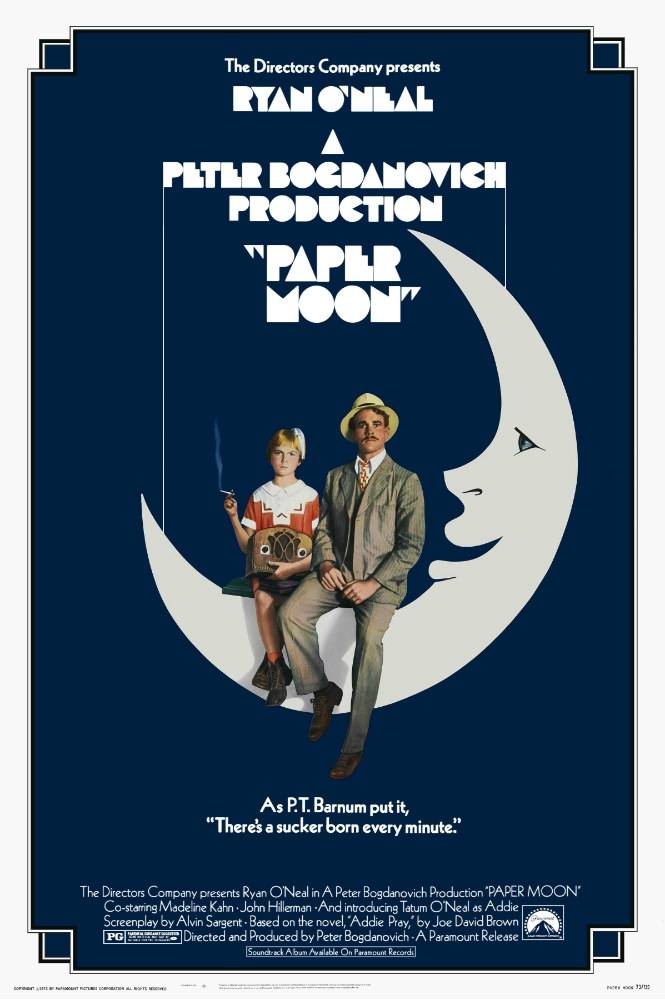
Stunt casting gave Paper Moon an extra publicity push when it came out in 1973. Ryan O’Neal and his nine-year-old daughter Tatum were the headline-grabbing coupling, and the PR machine was glowing white hot by the time of the 1974 Academy Awards, when Tatum won the Oscar for Best Supporting Actress. This propelled the movie back into the big picture palaces and shot Tatum into the record books as the youngest winner of a competitive Oscar.
Supporting actress schmupporting actress. As is entirely obvious from the first frame to the last, Tatum is obviously the lead in this movie. Madeline Kahn, who was in fact the supporting actress, said as much at the time. Stopwatches confirm it. O’Neal junior has more screen time than Kahn by a country mile. More, also, than her dad. The story goes that Ryan was so furious about his daughter’s Oscar win that it caused a breakdown in his relationship with his daughter. Actors, huh.
Gossip to one side, Ryan and Tatum play the grifter dad transporting the suddenly motherless girl he won’t admit is his daughter to her aunt’s place cross country, the two of them bonding when Moses (Ryan O’Neal) discovers en route that little Addie (Tatum) has even more of a gift for low-level chicanery than he has.
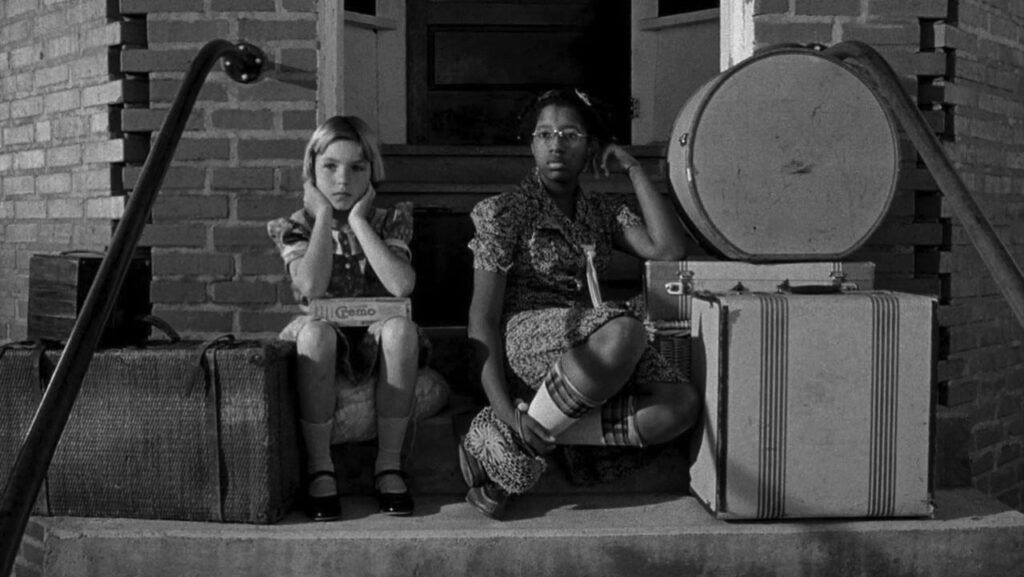
So, a road movie, really, though director Peter Bogdanovich does it as a homage to Old Hollywood, shooting in black and white and populating his soundtrack with the sounds and songs of the 1930s.
This is Depression-era America, but Bogdanovich doesn’t make it look too nasty, thanks in large part to the astonishing cinematography of László Kovács. His exposures nail the tones of the grey scale with an Ansel Adams precision. On top of that Kovács adds deep focus to rival Greg Toland’s (of Citizen Kane fame) for pin-sharp front-to-back clarity. You can watch this film for Kovács’s work alone.
Bogdanovich also does it as screwball, again a 1930s staple, and though the O’Neals don’t quite move at the speed of Cary Grant and Rosalind Rusell in His Girl Friday (a 1940 movie but made in 1939, if we’re quibbling about decades), their to-and-fro does zing. There have been suggestions that Tatum’s performance is manufactured in post-production, but look at the regular two-scenes, where the camera is locked on the pair of them. Her performance has not been edited together. She’s giving as good as she’s getting (though how many takes it took is another question).
Most of the main players in this movie are on something of a tear. Following on from The Last Picture Show and What’s Up, Doc, Bogdanovich here is in the process of cementing his position as the most nostalgic of the new pack of young Hollywood Turks including Scorsese, De Palma and all those guys. Ryan O’Neal here extends the hot streak that had started with 1970’s Love Story and would continue until 1978’s The Driver (it also includes What’s Up, Doc and Barry Lyndon, so not bad). After that it went a bit sideways, thanks to O’Neal’s increasing reliance on drugs. Kovács consolidates his position as one of the truly great cinematographers of the New Hollywood era. Which only leaves Tatum O’Neal, who wasn’t really on much of a tear at all. The unconventional lifestyle – more drugs – didn’t help.
But her performance here is exceptional, and seems to be styled on the 75-year-old Ruth Gordon’s in Harold and Maude. Eccentric, confrontational and knowing, it makes a kind of logical sense: it’s the kid who’s the real adult here, right down to smoking cigarettes in bed.
Bogdanovich and his writers (Joe David Brown, who wrote the original novel, Addie Pray, and screenwriter Alvin Sargent) go into some detail with the grifts, which range from the really smalltime to the quite audacious, and help propel the story along and keep at least one foot on the ground. It makes for a fascinating story, useful if you’re not charmed by Tatum, which you should be.
Paper Moon – Watch it/buy it at Amazon
I am an Amazon affiliate
© Steve Morrissey 2025