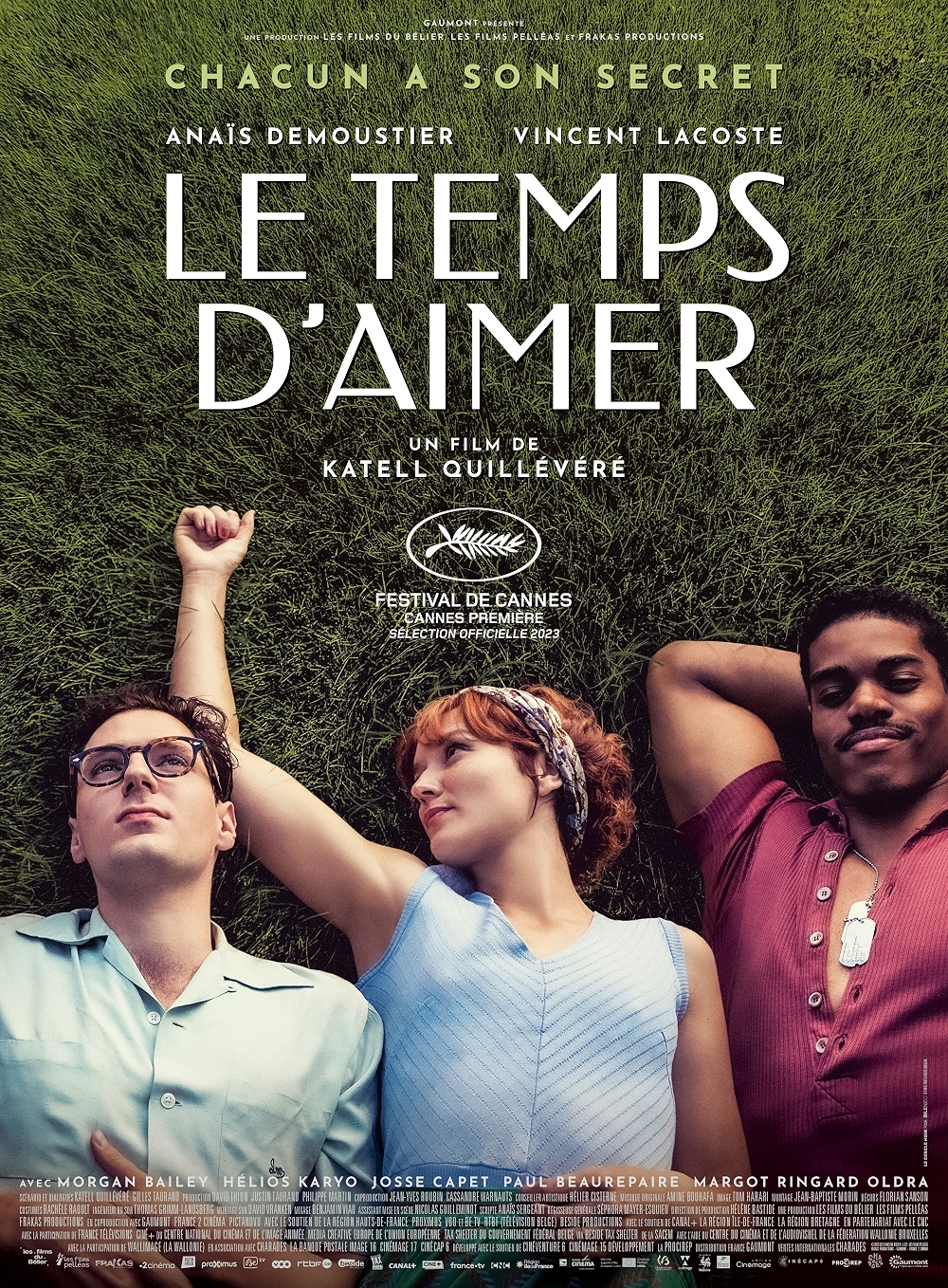
Katell Quillévéré’s follow-up to Heal the Living takes the bare bones of her own grandmother’s story – a Frenchwoman who had a relationship with a German soldier during wartime, wound up a single mother in the post-war years, then met the man who’d become her husband on a beach in Normandy – embroiders on it heavily and repurposes it as a decade-straddling tale of cockeyed love and melodramatic dark secrets.
Along Came Love (Le temps d’aimer) whisks us briskly from the aftermath of the end of the war – archive of GIs being feted as they march into France, cutting to “collaborating” French women having their heads shaved in orgies of public shaming – to the meet-cute on the beach, where Madeleine (Anaïs Demoustier) is having trouble with wayward son Daniel, and François (Vincent Lacoste) steps in to stop the little boy running into the forbidding sea.
This “trouble” with the boy will persist through the film. Hélios Karyo, Josse Capet and finally Paul Beaurepaire play Daniel at different stages of his life, always an antsy individual aware he’s been born out of wedlock and wanting to know more about his German daddy.
Things in this film tend to rattle around in cupboards. François shows Madeleine his leg early on, withered by polio, but does not reveal that he has feelings for men, which will manifest as an attempt to have a threesome with Madeleine and a handsome GI early on, then later as a disastrous affair with a young student when François eventually becomes a lecturer at the Sorbonne.
As Madeleine leaves behind the austere Normandy hotel where she works as a skivvy, and she and François take over the running of a club frequented by GIs, Quillévéré achieves miracles on a tight budget, largely by keeping her camera tight on the faces of her actors. What we see of the world around Madeleine, François and Daniel looks good though, the atmosphere shifting plausibly from the austere post-War 1940s to the happy-go-lucky 1950s and into the mid-century-modern world of the 1960s with the Vietnam War playing out on TV.

Quillévéré’s stated intention is turn her grandmother’s story into a homage of sorts to Maurice Pialat and Douglas Sirk. One the idiosyncratic idealist, the other the candy-coloured super-stylist of suppressed desire.
PIalat and Sirk pull in different directions, so this is ambitious if not foolhardy. But Quillévéré does get the realism of Pialat onto the screen in her depictions of the everyday lives of Madeleine, François and Daniel. And she successfully bolts on Sirk when dark secrets need to be addressed. The problem being that the sort of social and sexual taboos Sirk addressed (fraternising across a divide, homosexual desire) have very little currency any more. Addressing them out in the open, rather than as subtext, reduces their power even more.
The actors try to fill the gap, the endlessly fascinating face of Demoustier suggesting Madeleine’s inner life consists of desires she cannot express even to herself. Lacoste is saddled with a character with little to reveal but keeps us on side with François, a decent man, thoughtful, poetry-loving and a well-intentioned father figure to a boy with no interest in this blow-in.
As Daniel, all three young actors are convincingly peevish, borderline disturbed and even brutish. Good ensemble work. And a mention should be made of Morgan Bailey as the GI both Madeleine and François want to bed. Handsome, charismatic and plausibly playing someone who might swing all ways.
In the end, for all its many pluses, the film is undermined by its confessional aspect. There is dangerous power in a secret, but very little in one that’s out in the open.
Along Came Love – Watch it/buy it at Amazon
I am an Amazon affiliate
© Steve Morrissey 2025