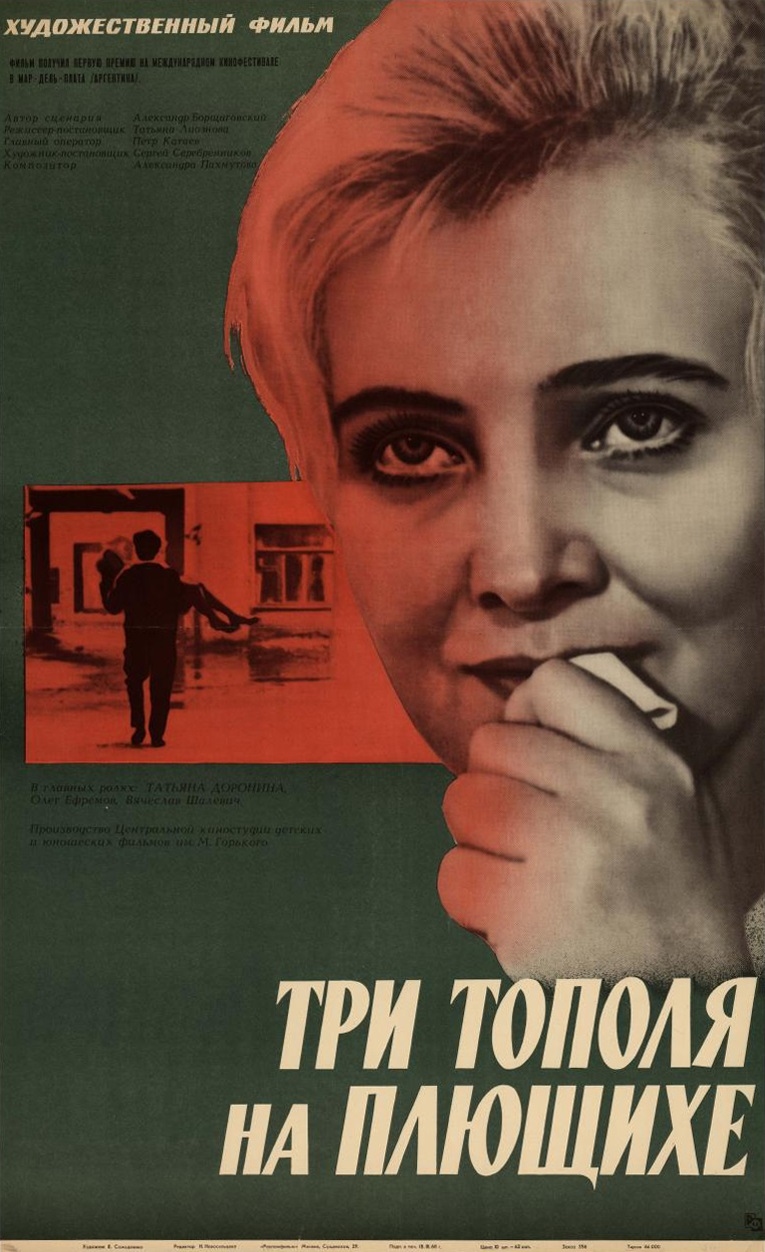
A Soviet Brief Encounter of sorts, Three Poplars on Plyuschikha Street is the sort of film you don’t really imagine coming out of the USSR, if grand epics featuring the entire Red Army are what you are used to. It’s a small-scale but beautifully crafted romance and in its day it was hugely popular. That side of it completely stands the test of time and, thanks to the passage of the years and the change in political landscapes, there’s now an added fascination to it which wasn’t there when it came out in 1968.
It’s also a very neat example of the directorial work of the quietly fabulous Tatyana Lioznova, who starts us off in a sort of fairytale dreamscape under-appreciated drudge Nyura (Tatyana Doronina), a still-youngish married woman whose nighttime fantasy about meeting a handsome man in the woods are interrupted by the daytime demands of her everyday life.
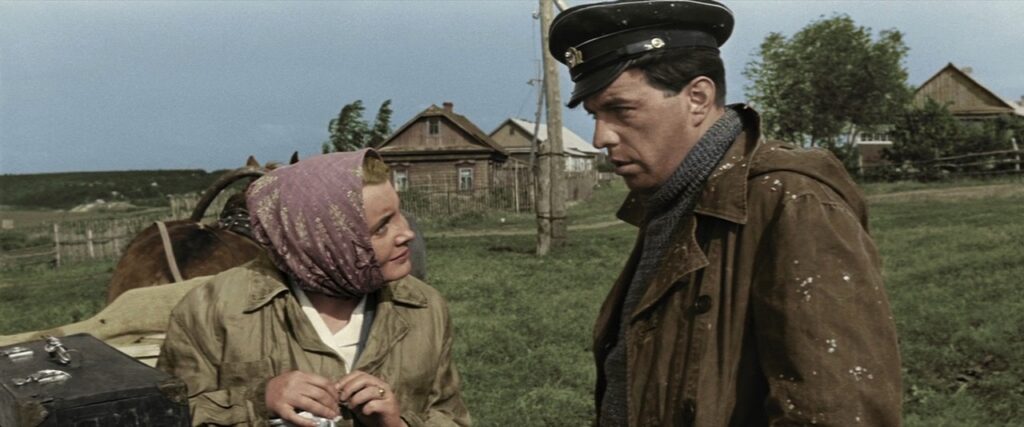
Nyura lives out in the boonies, where she feeds the family, tends the livestock and washes clothes the hard way, in the river. She works, she gets no thanks for it, that’s the way it is. Her husband won’t touch her any more either, that’s made clear enough. Life is OK, but it’s tightly constrained by tradition.
And then suddenly she’s on the way to Moscow, sent hundreds of kilometres to the big city with a suitcase full of hams to sell at the market and with a command to check up on her sister-in-law, who seems to be going off the rails, or so says her husband.
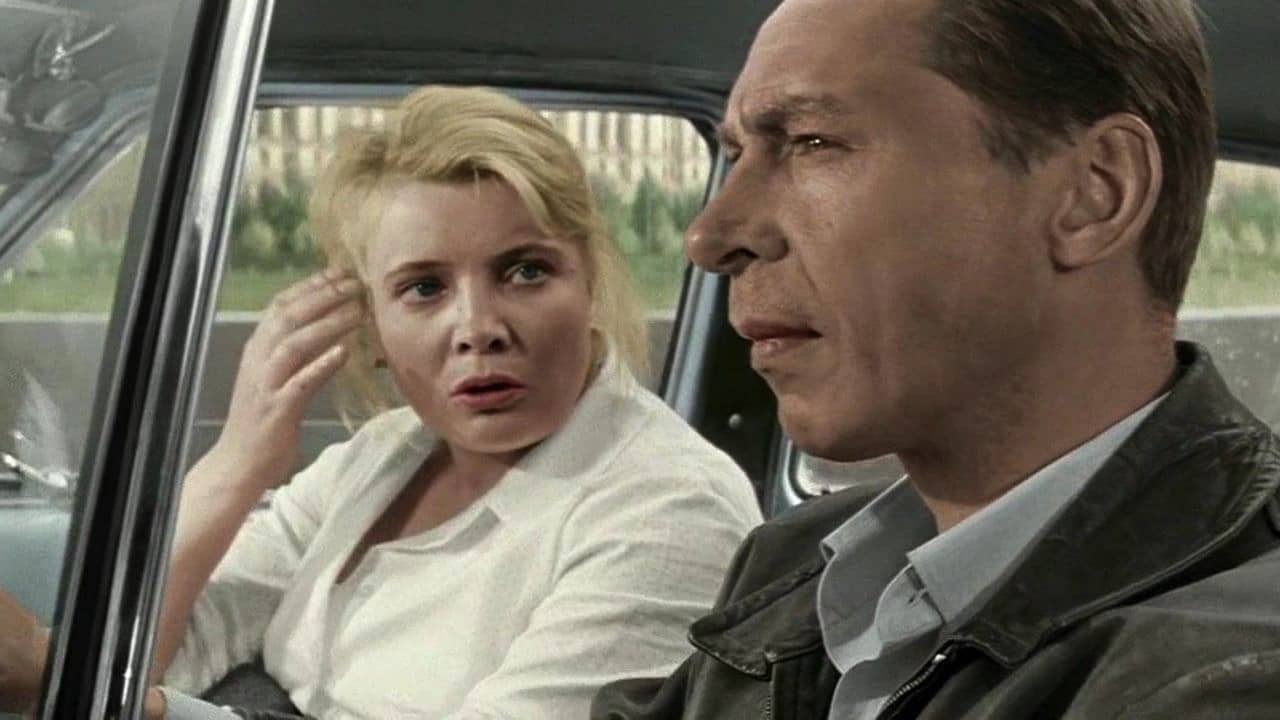
Here’s where the bulk of the film plays out, in a taxi driven by Sasha (Oleg Efremov), a kindly driver who spots instantly that Nyura is all at sea in the big city and takes her under his wing. He likes her straightforward ways and she likes him too, though initially she’s worried he’s going to rip her off for the fare. Eventually she softens and they start getting to know each other a bit. He offers to drive her around Moscow sight-seeing, off the clock. At one point she sings him a little country song. He wells up. A romance is surely in the offing.
How beautifully made this is. Lioznova is a real talent and can make even a static talky scene hum dynamically (if you’ve seen the USSR TV series 17 Moments of Spring you’ll know she can do this even with the most punishingly static material). Doronina is quite simply brilliant no matter which way the material takes her – the drudge back home, the wide-eyed country girl in Moscow, the girlish woman being charmed by this bluff driver until, eventually, she starts to overflow with longing. Efremov, too, is endlessly watchable, plausibly a working guy well used to driving and chatting to his passengers but caught off guard by this sweet woman’s simple ways.
There is more going on, though. In panoramic shots of the wide avenues we get a portrait of the Soviet capital in all its bustle. Multi-ethnic, as the Soviet Union was, modern, clean and efficient, with hints of influence from the West (Nyura mistakes a long-haired guy for a woman) and putting the depredations of the war years behind it (we learn that Sasha lost all his family in the siege of Leningrad, or Petersburg, as he calls it).
This film is not interested in Nyura’s hams and we never get to see the market, which is the main reason why she’s gone to Moscow in the first place. But we do meet the sister-in-law, Ninka (Alevtina Rumyantseva) who has modern views about men and a woman’s right to assert herself, something that troubles Nyura, who clearly finds abstinence easier to deal with than any sort of licence.
I’ll leave the description there. Really it’s a deceptively simple film relying on the playing, which is light as air, and Lioznova’s gossamer directing, which towards the ends shades back towards the fairytale again. Together, Lioznova, her actors and the writers manage to spin the material beyond its conceit of being a movie set in a car, as the best of them do – see 1945’s Detour, 1953’s The Hitch-Hiker, 2013’s Locke, 2023’s Daddio or 2025’s Hallow Road for other films which, like this one, get it right.
Incidentally, it’s hard to find a version of this film that hasn’t been colorised (as the one I’m linking to has been), but it isn’t too ickily done, the colours are fairly subtle and they shouldn’t ruin the viewing experience. If you’re feeling purist about this sort of thing, turning the colour saturation down on your TV will fix it.
Three Poplars on Plyuschikha Street – Watch it/buy it at Amazon
I am an Amazon affiliate
© Steve Morrissey 2025