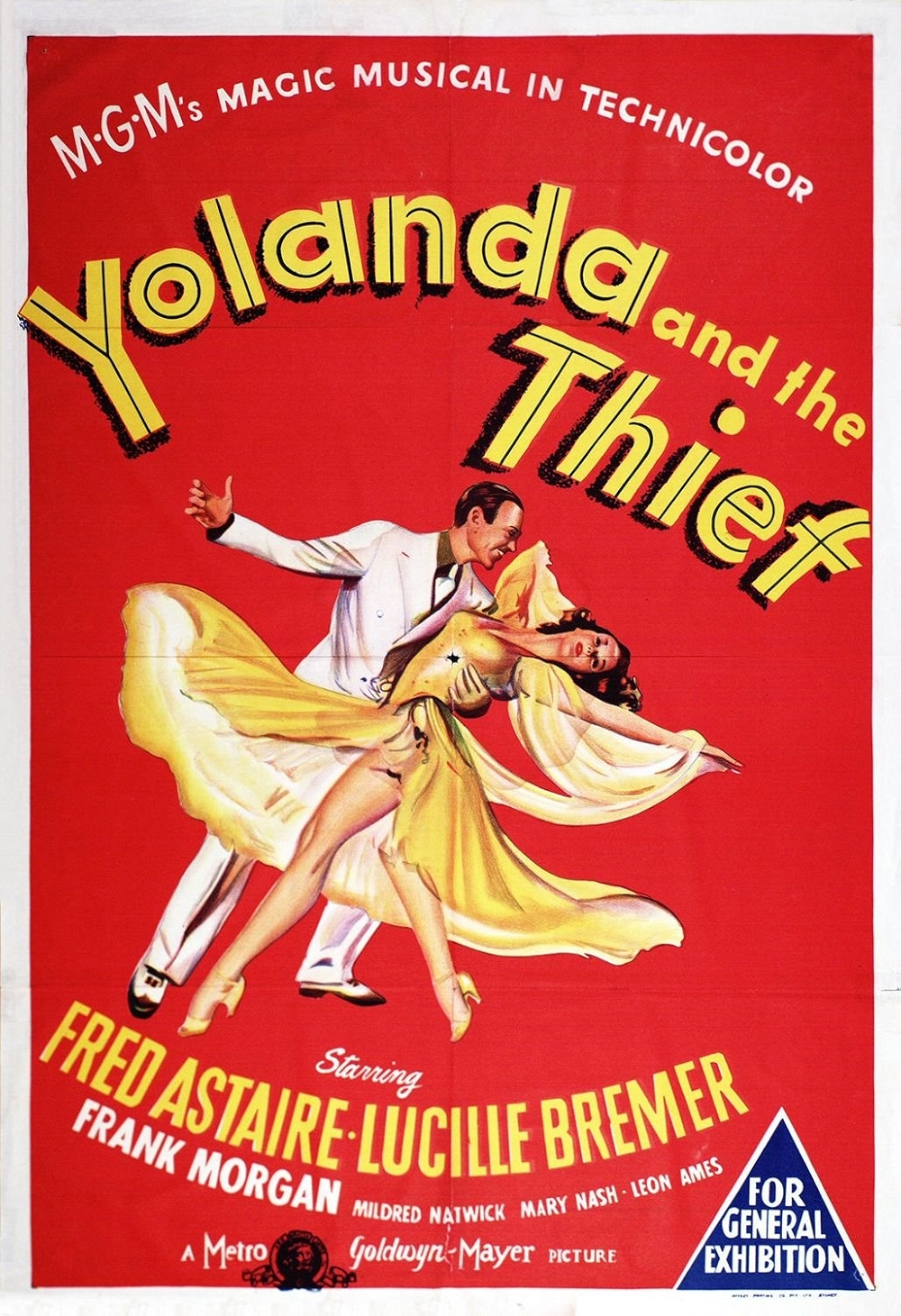
There’s not much wrong with Yolanda and the Thief that a lot more dancing wouldn’t fix. It’s a 1945 Fred Astaire musical, and the first in a run of Technicolor movies that would prove director Vincente Minnelli to be a master of colour and motion. Though it was a flop, there’s absolutely nothing wrong with Minnelli’s direction or his eye, or with Astaire, when he’s given the chance. There’s not even that much askew with Lucille Bremer, at whose door most of the blame was laid for the film’s failure. She was producer Arthur Freed’s girlfriend, and he insisted on casting her as the female lead, in spite of the fact that she had a resting bitch face and wasn’t much of a dancer. Having played Judy Garland’s older sister in Meet Me in St Louis only rubbed salt in the wound – Garland had been lined up to take the lead here.
But Bremer really isn’t that much to blame. She does OK. Her dancing shortcomings are carefully hidden by Minnelli, who lays on the beauty lighting, fine clothes and jewellery. She’s a fine foil in many respects to Astaire. In the familiar “mistaken identity” plot, he plays a conman who has expressly arrived in the quaint European country of Aquaviva to relieve its young new ruler of her wealth. Being a devout young miss raised in a convent, she mistakes him for her guardian angel, as devout young women do.
From here Johnny Riggs (Astaire) is taunted by his own deception. He has to forgo the food, drink and worldly delights off-limits to “angels” as the price for being in Yolanda’s company. Until Johnny realises, as he must, that he has fallen for his mark and needs to tell the princess of his deception to ease himself off the horns of his dilemma.

This was meant to be Astaire’s first colour film but in the end Ziegfeld Follies (also part directed by Minnelli) beat it to the post. But it’s as good a place as any to admire Minnelli’s technique, his use of Technicolor-enhanced design, the way he slides his camera about on beautifully dressed sets full of beautifully dressed people. This is high Hollywood, painted backdrops, elegant technique, entertainment at its most escapist.
It’s also the sort of musical Astaire generally stayed away from. He usually left the wafty, balletic and pseudo-arty stuff to Gene Kelly. For all the top hat and tails, Astaire liked to hoof like they did in the music halls. Leaving most of the decisions to Minnelli and choreographer Euegene Loring, here he appears to be road-testing a version of the “dream ballet” sequence – Dali-esque sets, distorted perspectives and a long piece of chiffon someone’s eventually going to get tangled in – that would later turn up in An American in Paris (starring Kelly, directed by Minnelli).
The big gripe is that there’s just not enough dancing. The first number arrives at around the 30 minute mark, and it’s Bremer’s. Astaire gets his moment at 40 minutes, but it’s that “dream ballet” sequence, and no sound is heard from our man’s feet as Astaire swooshes about the set expressively. It’s only at around an hour in that we get what we paid for – a percussive tap number, and syncopated rhythms as Astaire demonstrates he’s also a dab hand with a harp.
There is some redemption in the big finale, a massive dance number set on a shiny floor with op-art wavy lines. Astaire does the dancing, Bremer keeps up. And in the casting of side characters – Frank Morgan as Johnny’s (underused) partner in crime and Leon Ames as a carpetbagger also targeting the wealthy young woman. Both excellent, as ever.
Why did it fail? It’s not just the lack of decent dancing, but also the fact that Astaire’s character isn’t quite right. He usually plays raffish characters, but here he’s basically a criminal (the clue is in the title) and Bremer’s Yolanda is an undeserving victim. It’s hard to be onside with Johnny Riggs and only too easy to sympathise with the enchantingly naive Yolanda. You win some, you lose some…
Yolanda and the Thief – Watch it/buy it at Amazon
I am an Amazon affiliate
© Steve Morrissey 2025