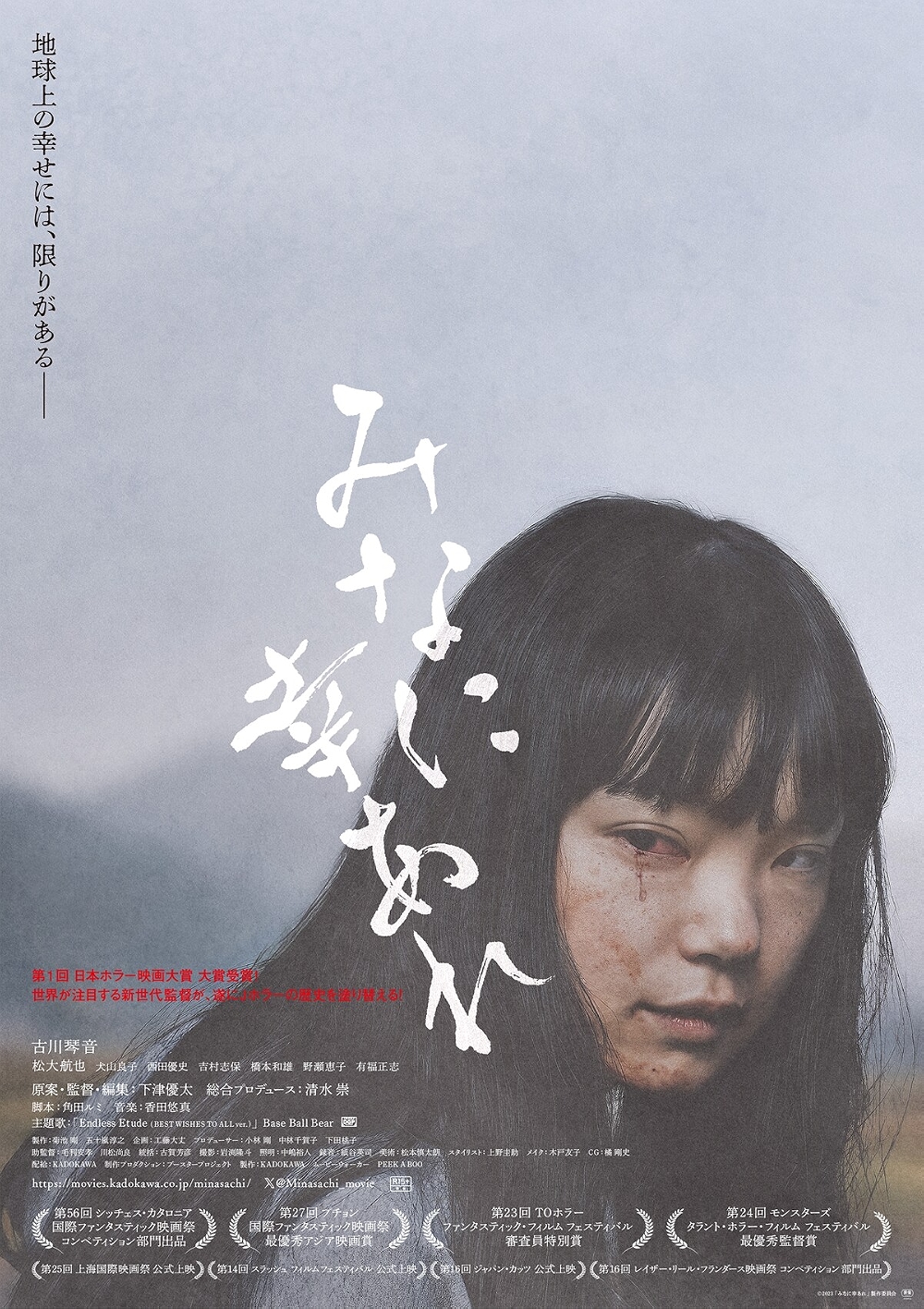
What is the price of living an OK life? Best Wishes to All offers a bleak answer to a question few ever really ask. Whether it’s also a funny answer depends on how much grim you can tolerate. Takashi Shimizu, director of Ju On: The Grudge, is its producer, which might give you an inkling as to which way things are going. J-horror: the next generation.
All is peace and light initially. A Japanese family eating dinner around a low table. Young parents with their parents and their daughter, who wakes up in the night to go to the bathroom and thinks she sees something – what though? – peering around a door.
Years later, this girl is now a woman (and played by Kotone Furukawa) and is back at the home of her grandparents (Inuyama Yoshiko, Arifuku Masashi), a smiling and happy pair who chat banally over noodles, miso broth and pork. “Are you happy?” they ask, in that loaded grandparent way, before grandma goes on to explain that she should be – the pig they are eating was raised in a confined space, then fattened and slaughtered. It led a miserable life so she could have a tasty meal, grandma explains coolly. This was its purpose and there was a kind of nobility to it. The young woman, a nurse by training, doesn’t quite know what to make of this.
It is the beginning of a series of increasingly bizarre events. Grandma walking into a door repeatedly like a wind-up toy. Grandpa standing as if frozen on the landing, mouth agape. The appearance at the dinner table one night of a near-naked old man, eyes and mouth sewn shut.
That, I think, is as far as I’m going to go with plot details. There aren’t that many of them and to package them all up and dish them out in a review is to shortchange Yûta Shimotsu, who co-wrote and directed this debut feature expanded out from a short, Dreaming to Accept Reality.

There are no character names. Grandpa and grandma, their grand-daughter, her mother and father, when they eventually arrive on the scene, plus the handsome young man who lives down the road (love interest?) and his father, all remain nameless blanks, adding allegorical weight to what’s close to an update on a Grimm fairytale.
There is probably too much allegory for some palates. One one side a “go woke, go broke” dismissiveness about the inevitability of pain in this bad old world. On the other a kind of Greta Thunberg idealism. At one point the handsome young man, talking to the young woman, asks rhetorically where would we be if we all pursued our dreams. “The world wouldn’t function,” he answers, losing the room.
Shimotsu’s way with an absence and his matter of fact storytelling is attractive, and almost hides the fact that he’s made his point early on. Piling increasingly grotesque revelations does help keep the wheel spinning. At one point the young girl, having heard that there is an aunt who was “like you” – ie unreasonably (?) ethical – goes to visit her and finds her living in near-poverty up in the hills. That doesn’t go well either.
Also keeping things going is Shimotsu’s command of atmosphere. The unsettling plot may be the headline but the way it’s sold is the real reason to keep reading – long, pregnant silences, sudden matter-of-fact reveals of bizarre details, a growling soundtrack doing a lot of the suggestive work.
Are they vampires, this family? Is everyone in the advanced world, in a sense, a vampire, inflicting non-stop misery on the less fortunate so they can have their noodles, miso broth and pork? Shimotsu cuts on several occasions to a shot of grandpa’s bonsai tree, a thing of clipped, cultivated loveliness in a tiny pot. Either a metaphor for doing more with less, or of beauty wrought from starvation and torture. Enjoy your dinner.
Best Wishes to All – Watch it/buy it at Amazon
I am an Amazon affiliate
© Steve Morrissey 2025