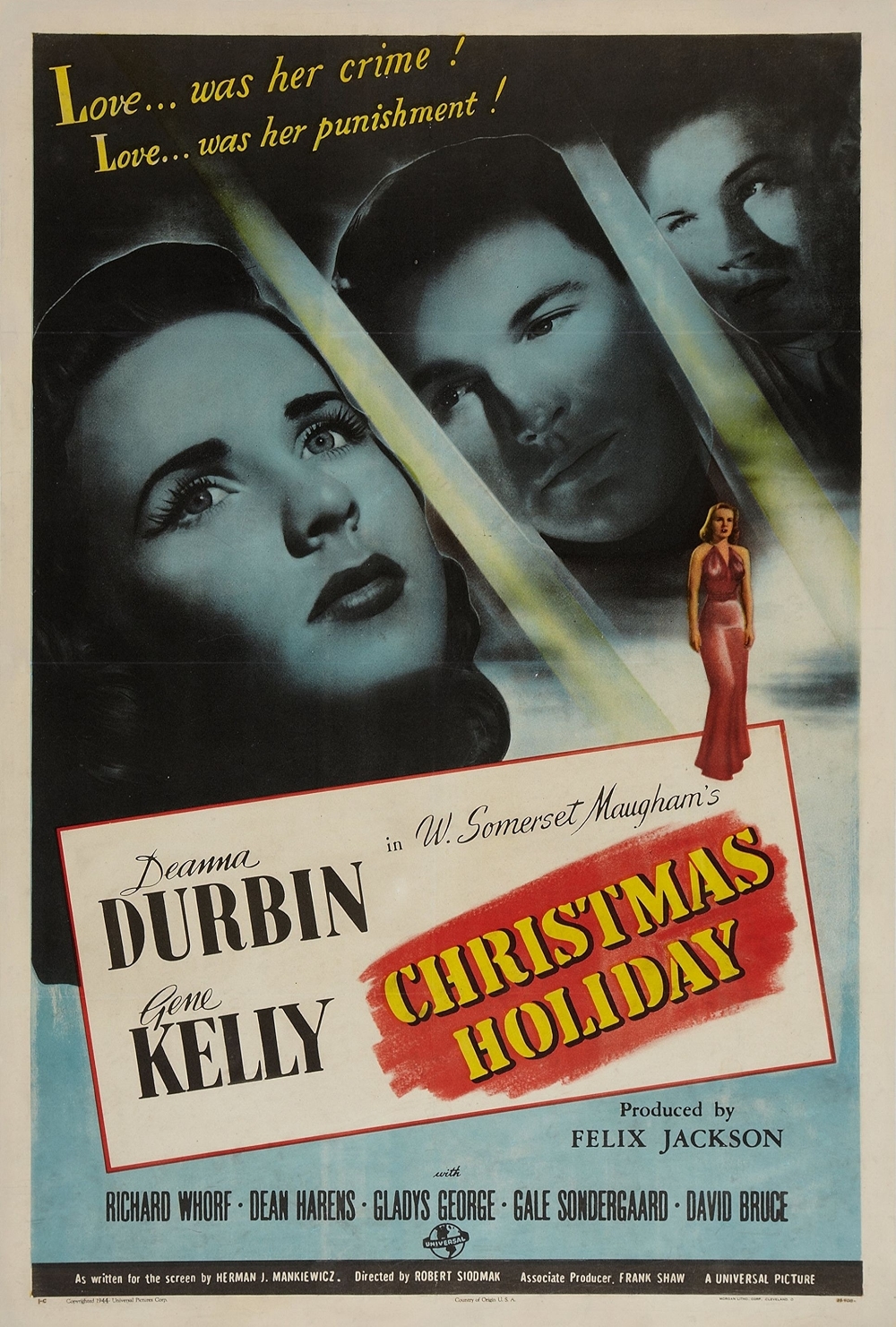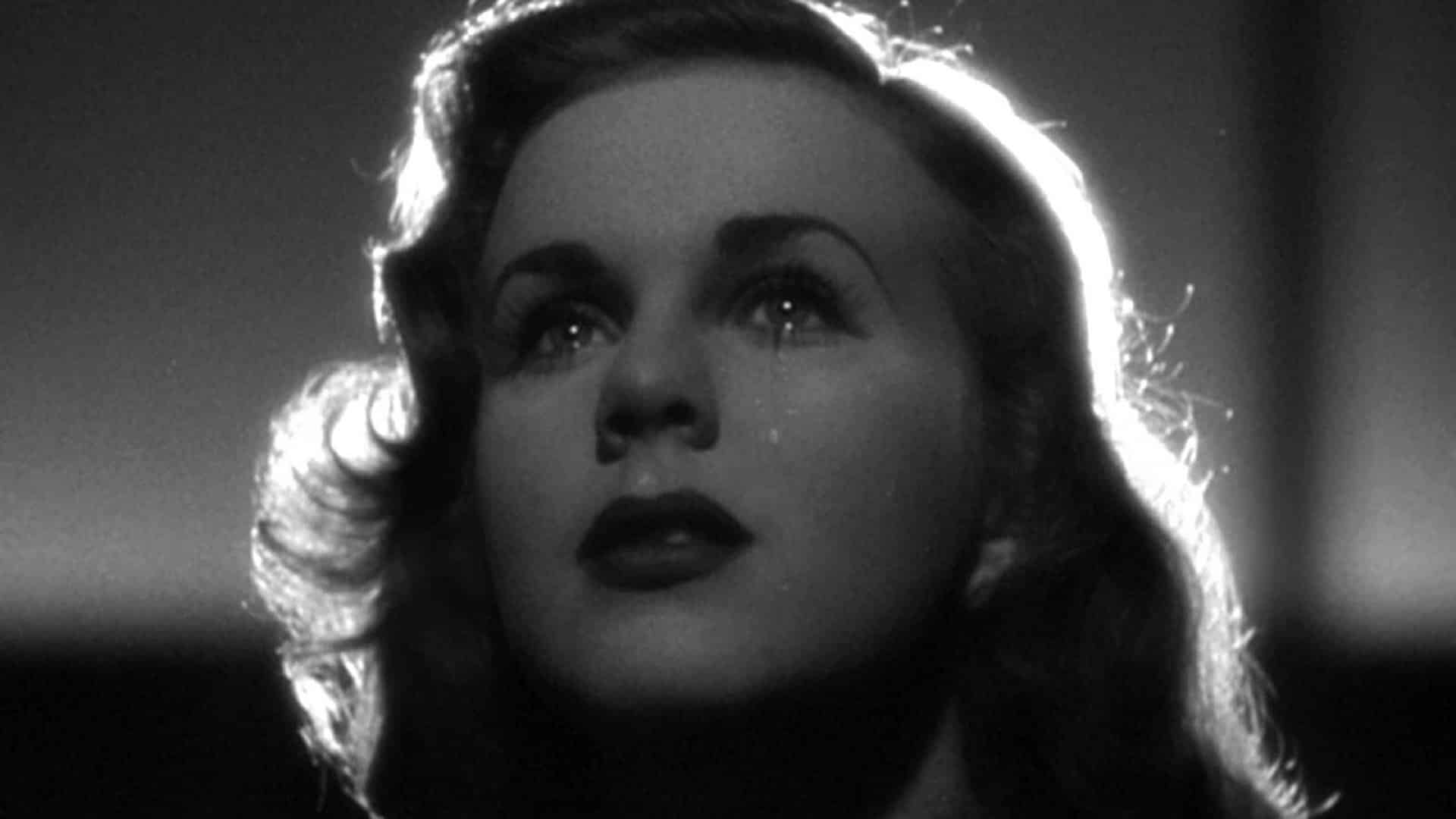
Imagine calling a film Christmas Holiday and then filling it with desperation, prositution, twisted mother love and murder. They knew how to have fun in 1944.
Ignore all the opening flimflam about a lieutenant being dumped by his girl on Christmas Eve, the day before his wedding. The film only really takes wing once we get to the backstory of Jackie (Deanna Durbin), the prostitute that heartsore Lieutenant Charles Mason (Dean Harens) hooks up with after accidentally landing in New Orleans en route back to San Francisco for the furlough he now no longer wants or needs. He winds up taking not to bed but to… midnight mass.
Charlie is a nothing in this story. Appropriately named, he’s soon forgotten. To help us dispel any thought of him as a potential love interest, Harens plays him as a gay man – those long lashes and eyelids accentuated by the make-up department are surely no accident. Maybe that’s why Charlie’s fiancée dumped him. It’s not important. What we’re here for is Jackie, the tart with a heart, where she came from and how she ended up in her dire situation.
Much of this is not entirely explicit but all except the naive cinemagoer in 1944 would have understood what exactly it is that Jackie does for a living, though there is a fig leaf. She sings in a club, we’re told, and since she’s played Durbin, known for her singing, there’s an easy plausibility to this. In Somerset Maugham’s original story, though, she was a prostitute plain and simple, because Maugham loved a tale about low status people morally turning the tables on their supposed betters.
In Jackie’s dark past we meet the man she married, a psychopathic murderer played by Gene Kelly – yup – and the mother (Gale Sondergaard) he is far too close to, and learn about how this creepily Oedipal duo ruined a cute kid and turned her into the creature of the night she is today, albeit one who has heroically retained her sweetness.
Sondergaard has the sort of role she pulled off majestically in countless films, a “mad dowager” turn as the mother of the clearly unhinged Robert (Kelly) – “he is what he is,” Mrs Manette says darkly about her son at one point. The film is as much a portrait of the relationship of mother and son as it is of Robert and the wife he cons into marriage.
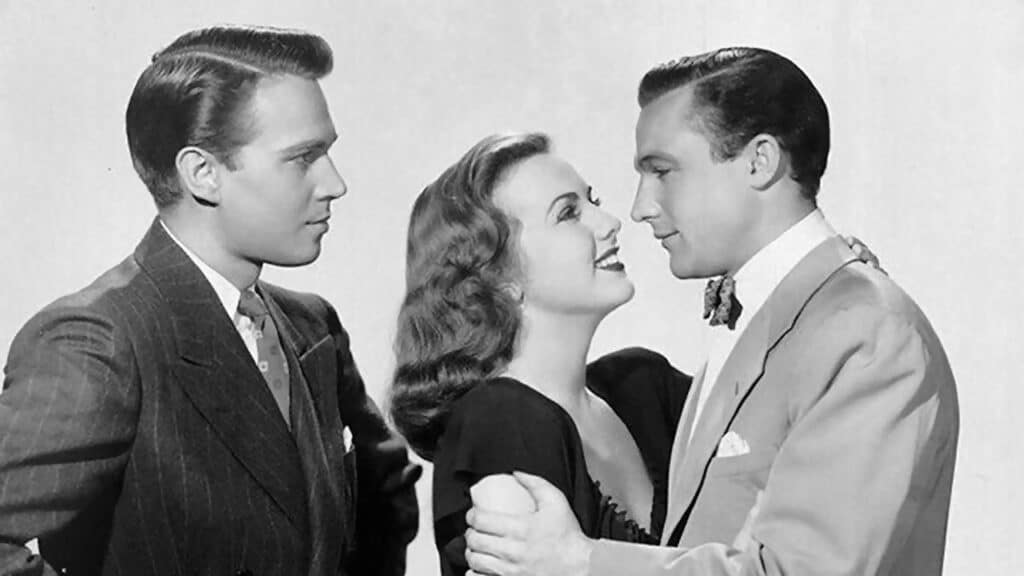
If Sondergaard is playing to her type, Durbin is against hers. The film was designed as a vehicle to broaden her girl-next-door range. She does OK as the waif sticking with her insane husband even after realising what he’s about – because that’s what good girls do – though critics at the time seemed down on her. Hamming it up as usual but also right against type, Kelly plays twisted psychopath Robert rather well, adding a sense of Victorian melodrama with his usual sudden full-body turns and face always seeking his keylight.
The characters plug away at these roles, the cute kid, the enabling mother, the wacko husband until, having driven his wife to the dark side, with the complicity of his mother – hair sculpted like a turban – Robert eventually winds up in jail. But, adding fuel to a fire that’s already burning well enough, he returns towards the end to kill Jackie for having become a fallen woman, even though it’s his fault.
This leads to one of the maddest, most ridiculous and gloriously redemptive finales in all movie history, a positively Wagnerian reckoning in a church complete with angelic choirs, haloes of light, the clouds parting and so on.
Add in cinematographer Elwood Bredell’s flashes of spectacularly moody lighting and Robert Siodmak’s rhythmic direction – bang, bang, bang it goes – and you have simultaneously a majestically dark film noir and a feast of camp that’s almost impossible to beat.
Durbin thought it her “only really good film” and it did well at the box office, though she never tried another role this challenging again. If you can’t face Love, Actually again this Christmas, maybe give it a go.
Christmas Holiday – Watch it/buy it at Amazon
I am an Amazon affiliate
© Steve Morrissey 2025