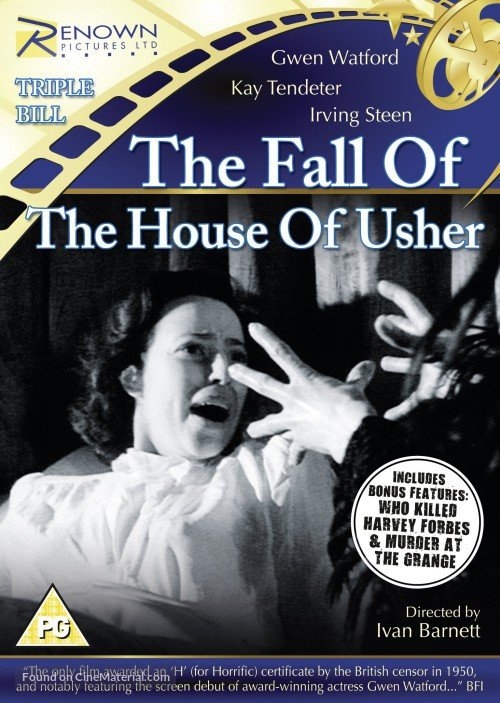
Overshadowed by both the Jean Epstein silent 1928 version and Roger Corman’s one from 1960, 1948’s The Fall of the House of Usher isn’t exactly a good film but it is a hellishly interesting one.
Directed by Ivan Barnett, it was shot mostly at GIB Studios in Hastings on the south coast of England, a town not exactly bristling with movie production facilities and people. GIB stands for George Ivan Bennett, the director’s full name. The studio was an offshoot of a film society Barnett had formed in 1944 when he was about 19. When Sight and Sound magazine did a report on the Hastings film scene in the mid-1940s they declared the society’s first venture, The Manor House, to be “beautifully photographed”. There is no record of it on the IMDb of it so who knows where it’s gone.
That means Barnett is about 23 when he’s shooting this loose Edgar Allan Poe adaptation, which has been hacked about to get around a lack of budget. But it remains largely the familiar story of a too-close brother and sister certain they are the end of the family line living out the end of their days in a remote old mansion.
It starts inauspiciously with formidably wooden scene-setting at a gentleman’s club where chaps in armchairs discuss books, then Poe and finally The Fall of the House of Usher itself. Eventually, one of their number pulls the book down from the shelf and starts reading.
Barnett’s film then finally gets underway with a dissolve and the arrival of Jonathan (Irving Steen), oldest friend of Lord Roderick Usher (Kaye Tendeter), at the Usher family pile. There he is introduced to Jonathan’s ailing, cataleptic sister, Lady Madeline (Gwen Watford), and learns of the family curse. Then things get properly weird with the arrival on the scene of a hideously disfigured creature, a harbinger of the death and destruction that will be meted out as the curse is fulfilled.
There are treacherous marshes, flickering candles, obvious insanity, a creepy butler, a doctor warning Jonathan of unspeakable woe if he stays in the cursed manor, the imposing house itself and a torture chamber (for no discernible reason). And on it goes – Poe done effectively but on a budget.

If you can get past the fantastically terrible opening minutes, things improve vastly once Barnett gets into the meat of the story and can start doing what he does best, weave a thickly gothic atmosphere. It also helps that the terrible post-dubbed dialogue gives way to live sound.
Another plus is Gwen Watford’s performance as the doomed Lady M. Dressed in white and like something out of a Wilkie Collins novel, she entirely gets what she’s meant to be doing. No one else in this production was ever in another movie (the IMDb trivia says as much, and I double-checked) and they are for the most part just about OK. Steen is a touch stiff as the handsome Jonathan, the only really normal person in this story. Tendeter’s gothic features suit him to the role of the gaunt Lord Roderick. Neither is exactly great but acting lapses don’t matter that much when nothing is really intended to touch base with reality.
It’s amateurish because it was made by amateurs, but it’s got something more than just heart. Barnett obviously has an eye and he works up an edgy and lugubrious mood as he spins out the story. He has probably seen Jean Epstein’s magisterial 1928 version. Certainly Tendeter and Watford appear to have been cast, dressed and made up to look like Epstein’s stars and there are occasional visual echoes of the earlier film. There’s also a touch of Hitchcock here and there – that glass of milk that the butler gives Lady M each evening appears to be a callback to 1941’s Suspicion.
Talking of which, what was that glass of milk all about? And another thing, what happens to Jonathan for the vast bulk of the film? He arrives, is told the story of the curse and then disappears until near the end. On one hand, everything is a bit at sixes and sevens, on the other there is obvious talent in Barnett. There are thousands of “better” films out there that are not as good as this.
See it as a decent film-maker trying to get his boat floated, though it never quite happened for Barnett. After one more feature and a couple of shorts he does not grace the IMDb again, popping up only once as a cinematographer before bowing out in 1968, when he must have been in his early 40s.
See it also as the link between British horror of the 1920s and 30s – The Hound of the Baskervilles and The Lodger, say – and the Hammer horrors to come. Interesting, very interesting.
The Fall of the House of Usher – Watch it/buy it at Amazon
I am an Amazon affiliate
© Steve Morrissey 2025