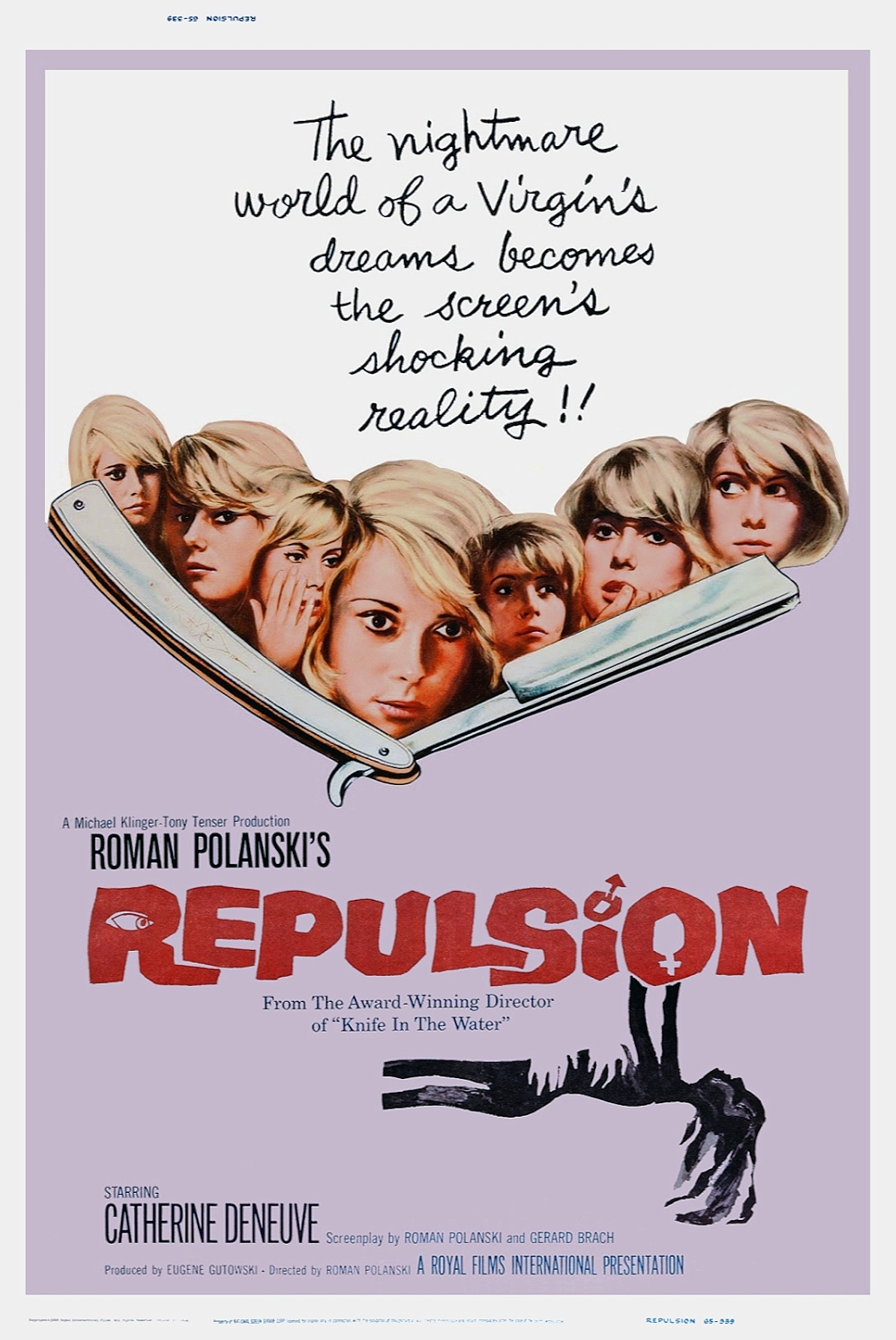
1965’s Repulsion is one of the greatest hits of the “apartment horror” genre. Expressionistic, claustrophobic and intense, it’s part try-out for Rosemary’s Baby, part grab for commercial success, so Roman Polanski could make enough money to finance Cul-de-Sac, his next film.
He succeeded. Repulsion was a box office and critical hit, and is now considered one of Polanski’s finest. Polanski himself doesn’t seem quite so enamoured. On the commentary track he describes some of his more florid moments as “artsy fartsy”. A touch too overwrought, maybe. But then it was the mid 1960s. Psycho and Mario Bava’s Black Sabbath had teed audiences up for a certain kind of theatricality, which Polanski gives them by the bucketload in a movie contrasting giallo-esque intensity with the mundanity of life in a London bedsit where a young French woman adrift in a foreign land loses her mind.
This was Polanski’s first film in English, Catherine Deneuve’s too. He had trouble getting it financed and wound up in bed with Compton Pictures, who usually did soft porn. That might explain why, for so much of the picture, Deneuve’s breasts are faintly visible through the white nightie she wears for most of the time.
It is Deneuve’s show. As the sister Carol (Deneuve) lives with, Yvonne Furneaux represents normality – French, young, in a foreign country and having fun with an English boyfriend (Ian Hendry). Carol, meanwhile, is timidity itself, sliding into work at a beautician’s like a ghost, then staring into space for half the day, before sliding home again, where she is the wet blanket putting a damper on her sister’s life.
We don’t know what sets Carol off on this strange jag. It’s like coming in on Billy Wilder’s Lost Weekend without knowing that the guy in acute psychological distress is an alcoholic coming off the booze. Whether Carol was ever bubbly and vivacious is left open by Polanski and Gérard Brach’s screenplay. All we know is that she’s in some sort of mental trouble and it’s getting quickly worse. In the very final shot, of Hendry’s Michael picking her up off the floor and carrying her as if he were a fairytale prince and she a sleeping beauty, we get a suggestion of what might really be going on, and why it’s not repulsion that’s the name of the game at all, but its opposite.

Maurice Binder (of James Bond fame) did the distinctive opening titles, of disembodied credits floating over the nervous blinking eye of Deneuve’s Carol, and the cinematographer is the great Gilbert Taylor, whose work here is a lot closer to Dr Strangelove and A Hard Day’s Night – crisp and stark black and white – than Star Wars, which he shot 12 years or so later.
Binder and Taylor probably soaked up much of the budget. With what’s left Polanski goes for maximum expressionism for minimal outlay in his use of askance angles, extreme close-ups and montages that flicker from one totemically mundane object to another. He uses silence like a threat and for huge chunks of time there is nothing much to hear. Deneuve barely speaks (which is handy, because her English wasn’t much good back then). Polanski, a master of ineffability, builds the mood, then builds it some more, and sets up lines of dramatic tension early on – Is Carol going to pay the rent or are she and her sister going to wind up evicted? Is Michael’s cut-throat razor going to become significant? And that crack in the wall that Carol is inordinately worried about, what is going on there?
The cracking wall eventually leads to the film’s most famous sequence, in which, like Snow White lost in the forest, Carol stumbles down a corridor while hands lunge towards her from out of the wall.
It is all a bit of a modern fairytale, really, and good use is made of Deneuve’s pale skin, big eyes and mane of blond hair to build a picture of innocence, which has become deeply ironic by the time the final credits roll. Polanski also works with the grain of Deneuve’s natural reticence so that even when Carol is doing terrible things as the film climaxes, we are on side with her, not her victims.
Polanski is right. It is a bit overcooked, but it’s all done so well that it barely matters. If you buy the Criterion version, linked to below, it looks as good as the day it was preview-screened, with the added bonus of a commentary by Polanski and Deneuve. A bit of a coup.
Repulsion – Watch it/buy it at Amazon
I am an Amazon affiliate
© Steve Morrissey 2025