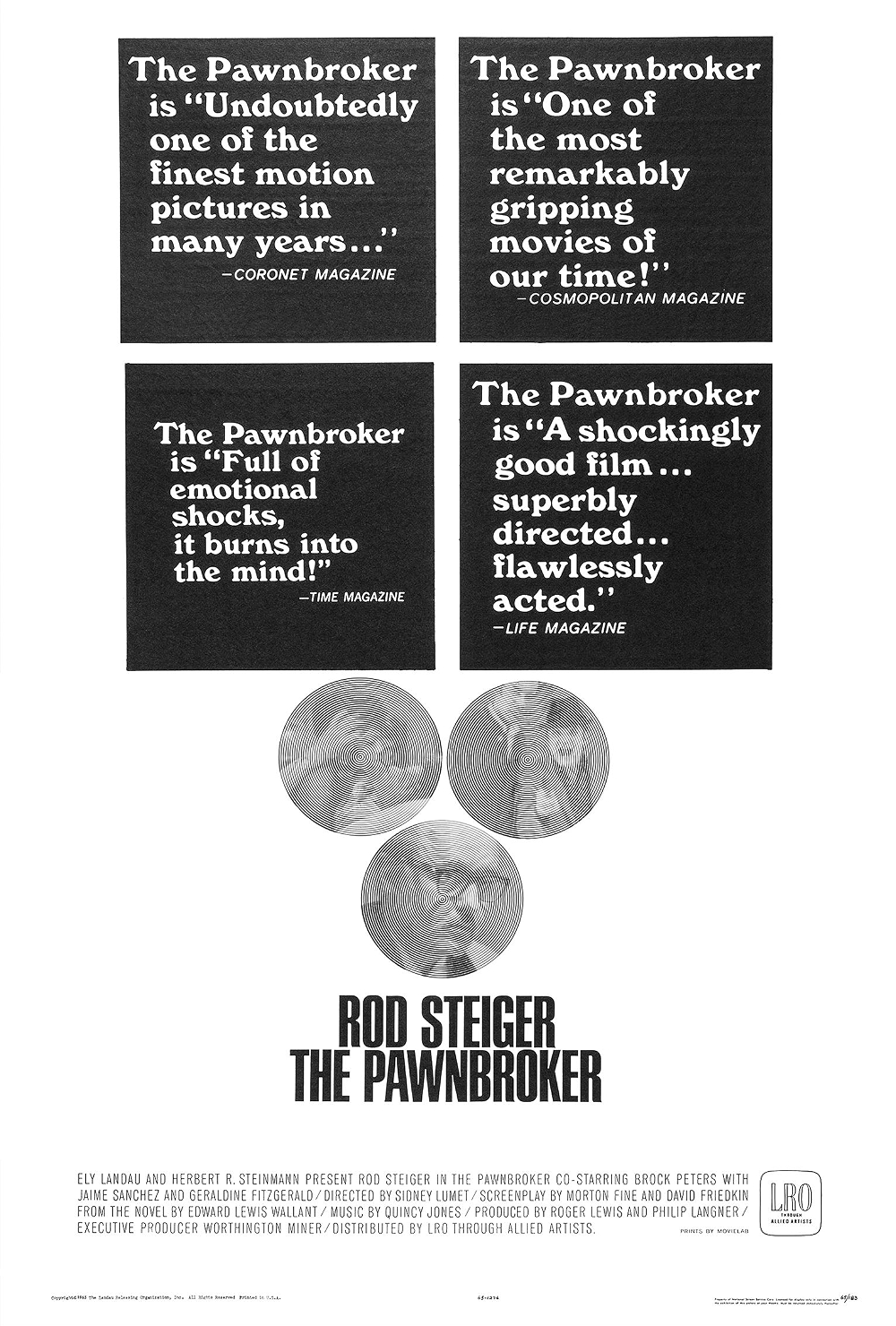
The Pawnbroker used to be a prestige movie, both when it came out in 1964 and for decades afterwards. It’s lost some of its sheen over the years, for a variety of reasons. Films referencing the Holocaust are no longer as scarce as they were when the Beatles were first conquering America. Rod Steiger’s star has also waned. Once seen as a rival to Brando, Steiger is now often regarded as a ham using Method techniques to disguise overacting. And the Method itself, of course, also no longer commands the respect it once did.
There is still much to admire in the film though, and in Steiger’s performance, which he promised director Sidney Lumet would be understated. It is, but understatement can also be a form of overacting. Whether that’s what’s going on here is the great Steiger tease.
Lumet kicks off the action in pastoral bliss, where a lovely Jewish family in Old Europe is enjoying a picnic in the countryside. Suddenly, we hear a car screech to a halt nearby. Doors slam, boots clatter and Lumet cuts to each family member as they lift their head. We don’t see who it is that’s arrived but we know… it’s the Nazis.
Cut to Money America in the 1960s. Now 20 or 30 year older, Sol Nazerman (Steiger) is having a day with what remains of his family. Pop music plays on a transistor radio. From a sun lounger his bored sister-in-law suggests that what the scowling, withdrawn Sol needs is a holiday. Maybe he should visit the old country, she chirrups, to languish in its “mellow” vibe and take in its cultured, old world “smell”. “Stink”, Sol spits back.
The Then and Now of it established, most of the rest of the movie takes place in Sol’s pawn shop, where, with a gimlet eye, the aged pawnbroker assesses the tat people bring in. A junkie offers him a radio. A pregnant girl tries to pawn her engagement ring (“Glass,” he tells her). A do-gooder (Geraldine Fitzgerald) comes in collecting for charity. One regular comes in ostensibly to pawn something but in fact is trying to engage Sol in philosophical debate. All are treated in the same cool-verging-on-dismissive way.
Sol is a tough man, though not an unfair one. He has given a job to Jesus Ortiz (Jaime Sánchez), who’s keen to learn the ropes. The immigrant keen to get on versus the immigrant who’s not sure he’s thankful to be alive.

The only other really significant character is the barely seen Rodriguez (Brock Peters), a local gangster who uses Sol’s shop as a front for his activity. That’s the movie – a character study of a dead man who is running on instinct alone, his spirit killed by the Nazis, in a post-Nazi world where the races collide and intermingle.
Lumet does it as film noir. From the stark black and white cinematography of DP Boris Kaufman to the brassy score by Quincy Jones, he wants us to feel the 1940s while seeing the 1960s. Occasionally he gives us a visual reminder of Then. Sometimes an almost subliminal flashback to some horror Sol experienced at the hands of the Nazis. Other times the callbacks are more suggestive. A mass of children’s shoes piled up in a window. Empty clothes dangling on hangers. The fact that Sol works behind bars in his shop.
The film has a bit of a problem with the Rodriguez/Sol relationship, as if it wants to suggest there is some equivalence between a 1960s crime racket and mass extermination, as if crime and morality were the same thing. But it does have the virtue of propelling the film into its final third, when Rodriguez makes demands Sol cannot quite deliver and Sol leave the shop for a finale that’s noir most glorious – dark New York streets, pool halls, tenements, the subway, Sol stumbling about lost and seeking help but unable to accept it.
It’s stagey and it wants to say important things and sometimes Lumet yields to the temptation to overdo it. There is a speech by Steiger about the plight of the eternal Jew – despised, scheming, good at business etc – which feels like it was put in so kids writing exam papers have something to quote.
It’s a strange mishmash – delicate and yet heavy-handed, perhaps too keen to cram in everything that needs to be said. It does not work as well now as it did then, because it can’t – that ground has been broken. This is the film that did the breaking.
The Pawnbroker – Watch it/buy it at Amazon
I am an Amazon affiliate
© Steve Morrissey 2025