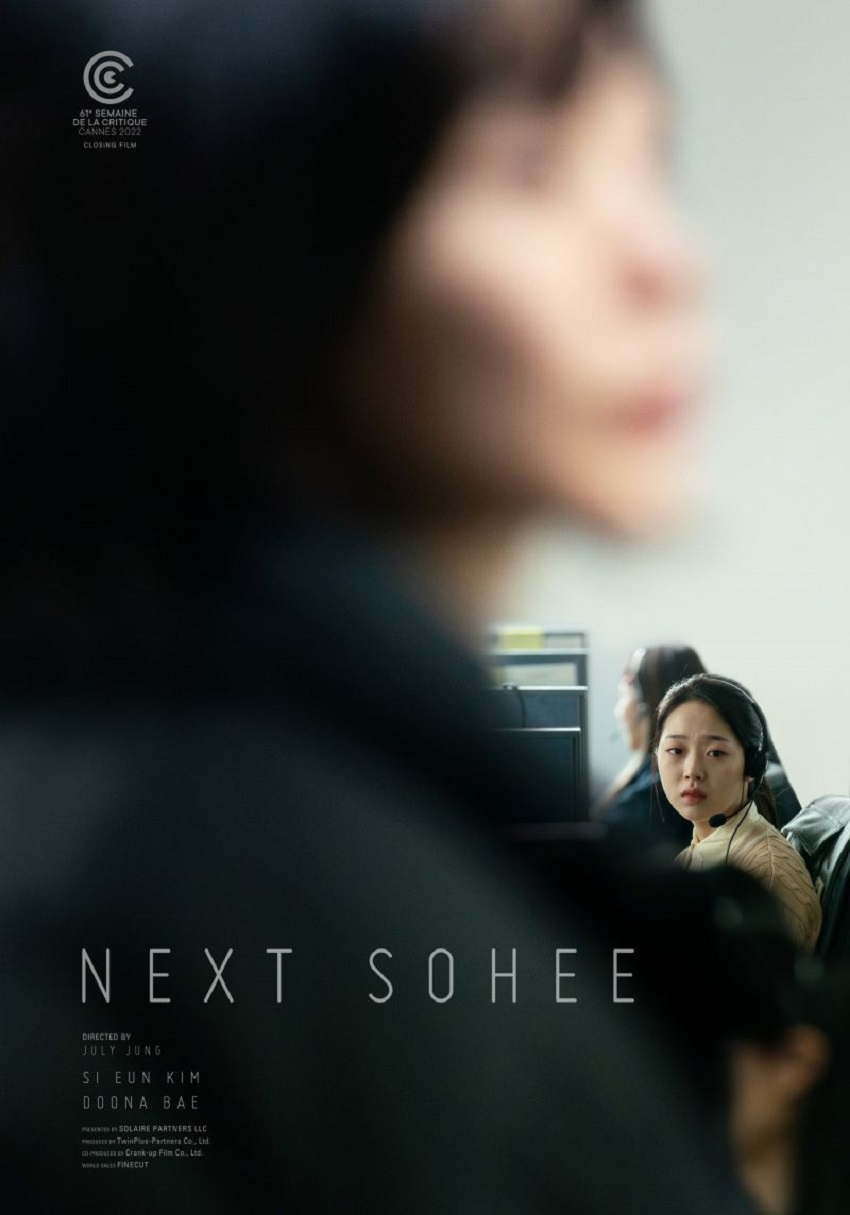
Life in a call centre is the focus of Next Sohee, July Jung’s belated follow-up to 2014’s A Girl at My Door. But it’s more than the story of grim days in a headset and on the clock. Based on the true case of a young woman who committed suicide while doing work experience in a South Korean call centre, it asks broader questions about the corporate capture of almost every aspect of modern life.
It breaks down into two neat halves. In part one we meet Sohee (Kim Si-Eun), a bright, feisty young woman who is lucky enough to get a prized work-placement at a major internet provider. Her job is familiar to anyone who’s ever phoned up anyone to cancel anything. In calm and gentle tones and sticking to a script, Sohee uses “dissuasion” – office buzz word – to talk the caller round. A cancellation fee is mentioned. A clause in the contract which the caller won’t have read. The caller is passed from one department to the next in a game of telephonic pass the parcel. Some callers eventually get angry. Others end up in tears. It’s not fun for either party.
“The work sucks. They swear at me,” Sohee tells her almost-boyfriend Dong-ho (Park Woo-young). Worse than that, Sohee discovers, almost everyone at the call centre is like her, an extern, and they’ve all been explicitly hired because that way the company can withhold bonuses they’d have to pay by law to full employees.
The work does indeed suck. Hectoring managers, suits interested only in driving the numbers up, creepy callers phoning only for sexual purposes, long hours, the pressure to deliver. Targets, targets, targets.
Then Sohee’s boss, not a bad guy compared to some, kills himself, a wake-up call for Sohee, whose growing resistance to the company’s automaton logic is met with a pushback that takes in not just her new boss but also her parents and teacher (you’re so lucky to have this job, don’t mess it up, kind of thing). Meeting a wall of collective resistance that seems total, Sohee opts to assert herself by taking her own life.

Great though Kim has been as the vivacious young woman broken on the corporate wheel, she leaves the story at the midway mark and is replaced by Bae Doona, who plays a cop on the routine case of a call-centre suicide who angers her own superiors by her refusal to let it go. Who’s to blame for Sohee’s death? The further Inspector Yoo-jin (Bae) looks the more conspiratorial culpability she finds. Not just the call-centre high-ups, but Sohee’s parents, her school, the regulatory authorities, a cultural expectation of can-do, hire-and-fire practices, targets – the needs of the company have political, institutional, cultural and psychological primacy, and, worse, everyone thinks this is completely normal.
It’s a crusading second half, in other words, though Bae stonefaces valiantly to prevent it looking like that. Her performance ties in to Jung’s interest in “almost relationships”, from Sohee’s almost boyfriend to parents, school and so on. Bae’s three-thousand-mile stare also helps hide the fact that Yoo is a lot more emotionally tied up in the case than anyone can know.
It is a quietly angry film, subtly pushing what was once seen as a countercultural attitude – the citizen as corporate slave – in as mainstream, measured and methodical a way as possible. That doesn’t mean it’s undramatic, quite the opposite, and Jung gives a brilliant demonstration of that at a certain point when Inspector Yoo suddenly reveals what she really feels about one of her many “captured” interviewees. I won’t ruin it but it made me almost spit across the room.
Next Sohee – Watch it/buy it at Amazon
I am an Amazon affiliate
© Steve Morrissey 2025