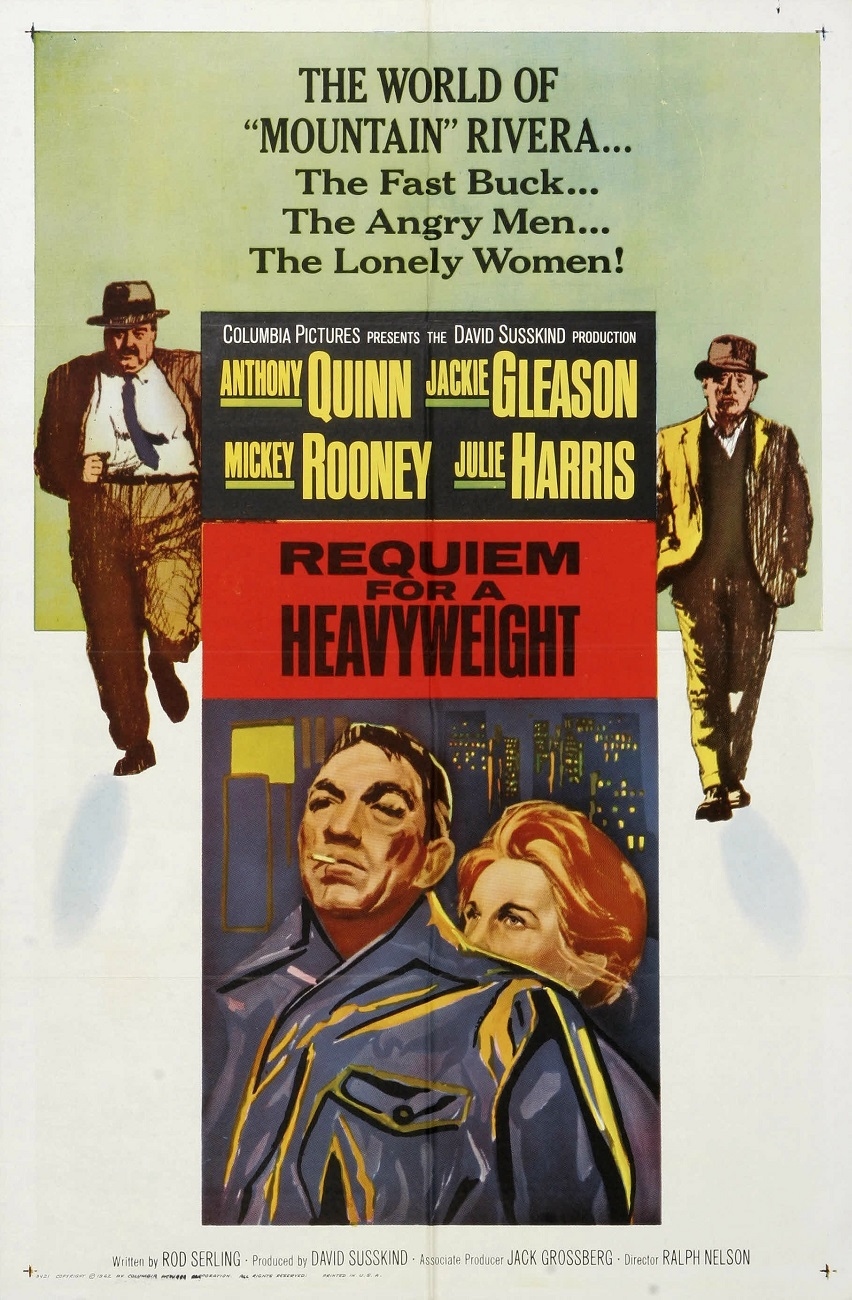
There are two versions of Requiem for a Heavyweight. The original was a 1956 TV movie starring Jack Palance as the ageing, punch-drunk boxer finally hitting the existential canvas. This movie version from six years later swaps out Palance for Anthony Quinn. Ralph Nelson directed both and preferred Palance – “truer to the role” was his verdict in a letter he wrote to the press.
That’s remarkable in itself, writing to the press to diss an actor. I have not seen Palance’s version but it must be pretty good to come in ahead of Quinn, who overdoes it a bit, for sure – Marlon Brando in “contender” mode crossed with Quasimodo – but also stirs up a lot of sympathy as a guy who cannot quit because he can no longer think straight.
It is a grim tale. We meet Quinn’s Louis “Mountain” Rivera having the hash knocked out of him by no less than Cassius Clay – as Muhammad Ali was still known then – and then follow this battered husk over several days as he tries to come to grips with the fact that his career is over.
It’s a film full of good things. Mickey Rooney as Army, Mountain’s trainer and a decent man trying to nudge Mountain’s manager, Maish, to do the right thing. Maish is played by Jackie Gleason and this is another piss-and-vinegar performance by the multi-hyphenate Gleason, whose big frame and jowly face suited him to roles like this. Julie Harris plays the employment agency worker Grace Miller, who takes pity on Mountain, overstepping her brief to go for a drink with him and getting in too deep with a man who cannot function properly any more. Further down the billing, the highly flavoursome Madame Spivy as Ma Greeny, a female mobster who is putting the squeeze on Maish, who will in turn put the squeeze on Mountain, with tragic consequences.
Mountain ends up being forced back into the ring, but as a wrestler rather than a boxer, trading the world of the real – “111 fights and never took a dive,” Mountain proudly says at one point – for the world of the fake. The masculine of the boxing world for the feminised wrestling world. This may not be a tragedy from everyone else’s point of view, but Quinn’s performance gives us to understand that it is from Mountain’s.
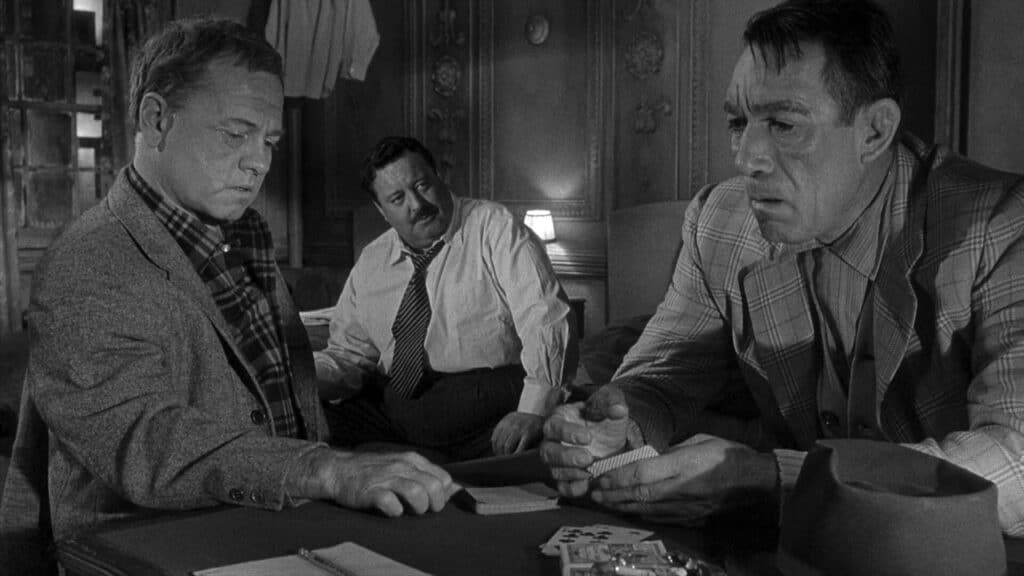
Cassius Clay is in it so briefly and tangentially that they clearly didn’t know who he’d become. There’s also a glimpse of ex-boxer Jack Dempsey in his nightclub, all part of Nelson’s drive for realism. There is a seediness here – the ring and the changing rooms, the doomy aura that surrounds a loser – and cinematographer Arthur Ortiz catches the pitilessness of it all with stark black and white images that hit hard. The make-up on Quinn is especially good. It’s by Dick Smith, already an industry veteran at this point, who’d go on to do The Exorcist, Scanners, Altered States, among others. Quinn’s face here – a mass of damaged tissue – looks like try-outs for all of them.
“Character study” encapsulates it, with Rod Serling’s writing making sure that we get studies of all the main characters – Army, Maish and Miller in particular.
In many respects it’s The Wrestler before The Wrestler, a portrait of a broken man who carries on because he can do nothing else. If there is a criticism, it’s that it makes this point too insistently, too often. The TV version went out as an episode of the Playhouse 90 show, in a 90-minute slot, as you’d guess, but running at only 73 minutes (once advertising has been stripped out). The movie version is just over 20 minutes longer. That, rather than the Quinn versus Palance difference, probably explains a lot.
Requiem for a Heavyweight – Watch it/buy it at Amazon
I am an Amazon affiliate
© Steve Morrissey 2025