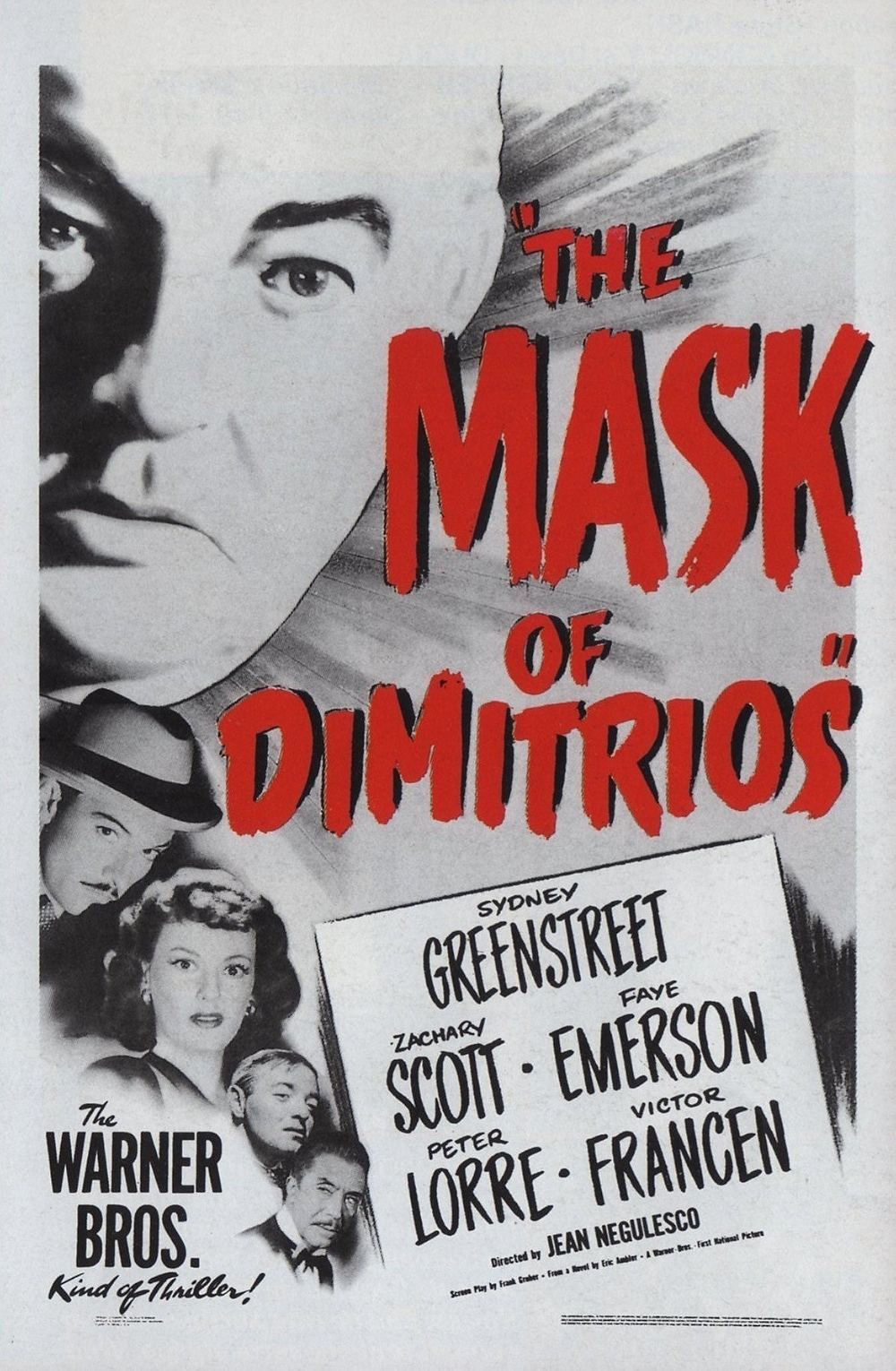
Writer Eric Ambler was the British spy guy in the mid 20th century and The Mask of Dimitrios is a good example of what he was about – sinister people in exotic locations doing dastardly things. Ambler followed John Buchan’s lead in that respect – don’t trust a foreigner. It took until John LeCarré – who’d actually been a spy – for portrayals of fictional foreign spies to come in human shape, though Graham Greene was a useful warm-up act.
The oddballs and gooks are out in their droves in this not entirely gripping but highly flavoured meta-fiction about crime writer Cornelius Leyden, played by Peter Lorre, chasing across Europe in search of an answer to his question – what happened to Dimitrios Makropoulos, a “dirty cowardly” thief, smuggler, trader in military secrets, master of betrayal and treason. The full “evil genius”, in Leyden’s words. Makropoulos may have washed up on the beach in the film’s opening seconds. And he may have been positively identified as being both dead and Makropoulos by Leyden himself. But does that mean he’s definitively deceased, or is that just the latest and most ingenious of his many masks?
The story starts in Istanbul, where we meet again – if we have seen 1943’s Journey into Fear – police chief Colonel Haki, an admirer of the novels of Leyden who chances upon the writer at a soiree he’s attending. To impress him, Haki takes Leyden to see the dead man on the slab in the mortuary, giving him chapter and verse on Makropoulos en route. Haki was played by a vastly amused Orson Welles in the 1943 film but here a much more austere Kurt Katch takes on the role, which fulfils the same purpose in this movie as in the earlier one – fills the audience in on the back story.
And from there Leyden is off on his wild goose chase across Europe, to Greece, Bulgaria, Switzerland and France, chasing the shadow of Makropoulos and learning more about him from the people who knew him.
They are a colourful bunch, starting with Haki and moving on through the romantically involved nightclub singer/prostitute Irana Preveza (Faye Emerson), to Wladislaw Grudek (Victor Francen), a masterspy out-masterspied by Makropoulos, an unlucky card player called Karel Bulic, and with frequent interruptions by a man calling himself Mr Peters, who also seems to be hunting for the dead man. But to what end?

Peters is played by Sydney Greenstreet, top-billed even though Lorre is the star – Jack Warner didn’t like Lorre, hence the measly fourth on the bill. Appearing in the fifth of nine films they’d do together, Lorre and Greenstreet do their Laurel-and-Hardy-of-noir double act, playing off each other, laying on the mannerisms and theatrical business. Here the idea is that they’re both men of the world. They both ham it up.
We’re four years on from The Maltese Falcon and three from Casablanca, both of which also featured Lorre and Greenstreet and it’s down to the success of those two films that this one undoubtedly got made. Lorre, for all his boggle-eyed charm, does not command the screen the way Humphrey Bogart did and is unable to glue this series of largely disconnected scenes together. On top of that, there’s little real mystery, not much of a puzzle to solve.
Though, god, how hard everyone works at trying to make it cohere. The score by Adolph Deutsch (who did The Maltese Falcon) is full of dramatic sinister crescendos. Arthur Edeson’s lighting gives it the Casablanca (one of his) atmosphere – smoky railway stations, disappointed people, noirish shadows. The stylish Jean Negulesco, in the first feature he directed from start to finish, just hasn’t got enough to work with.
The result is a technically superior, moody looking, gorgeously acted damp squib. Beneath the mask – not much at all.
The Mask of Dimitrios – Watch it/buy it at Amazon
I am an Amazon affiliate
© Steve Morrissey 2025