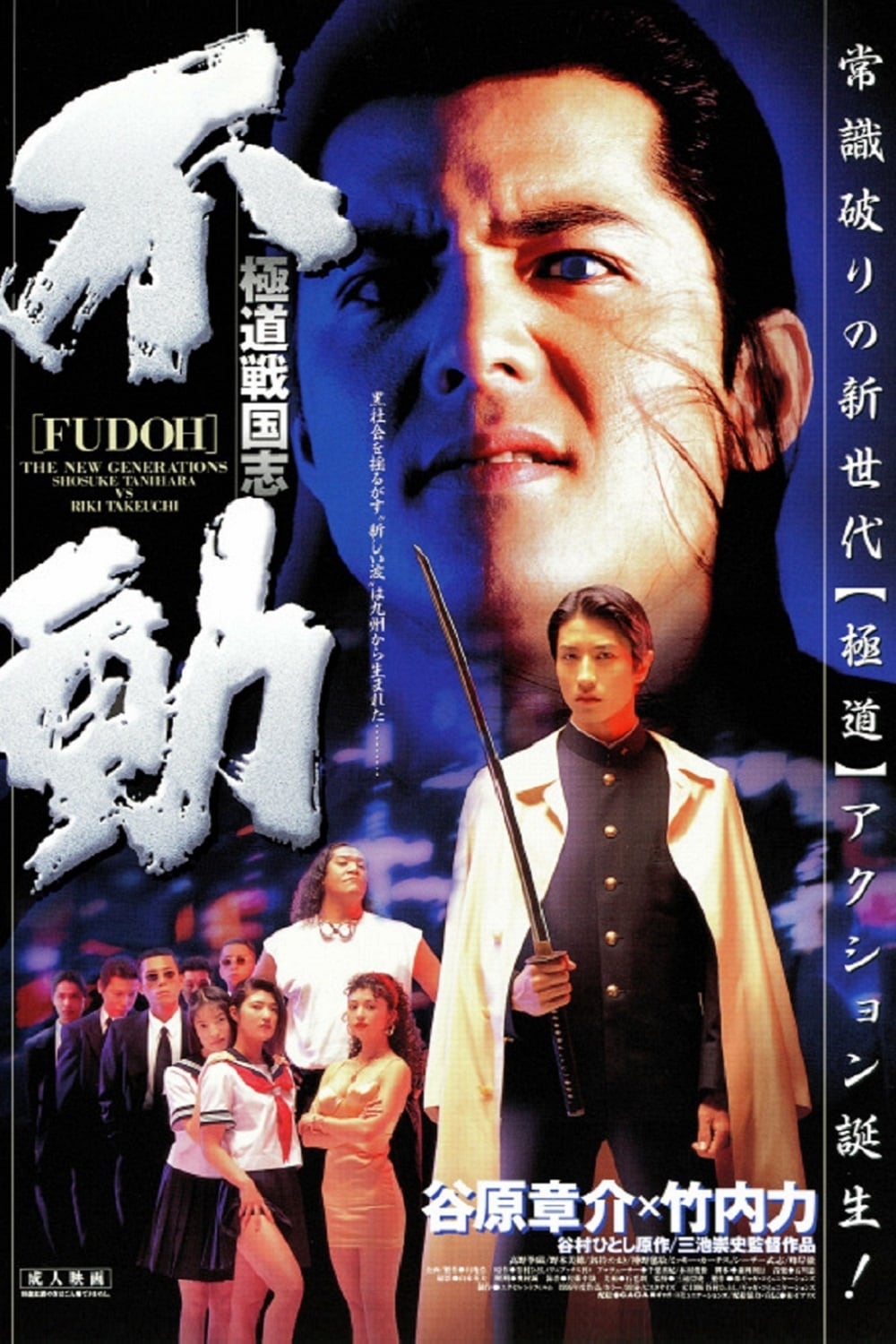
The title Fudoh: The New Generation begs the question: was there a Fudoh: The Old Generation? There wasn’t, strictly speaking, though there was a manga series called Fudô, which Takashi Miike based this film on. And there were some subsequent regenerations, with Fudoh 2 and 3, neither of which were directed by Miike.
Miike was largely an unknown quantity outside Japan when this film debuted in 1996. It made his name, which isn’t bad for something originally slated for home-release only. It also started Miike’s golden run – see Audition (still brilliantly yuk after all these years), Ichi the Killer or The Happiness of the Katakuris for examples of that.
What impressed audiences then, and still does now, is Miike’s disregard for good taste and his command of an action sequence. Within minutes of kicking off there’s been bodies spasming as they’re hit by bullets, a man’s head in a polystyrene box and more fountains of blood than the average viewer will be able to watch without laughing, possibly nervously.
A man with an eggplant penis, a woman who fires darts from her vagina, menstrual blood, children playing football with a human head, a schoolkid sexually propositioned by his teacher – dressed all in heels and sexy attire – minors wielding weapons, there’s plenty to get the moral guardians twitching.
But I’m forgetting the story, which is about a teenager taking revenge for the death of his brother by systematically working his way through his gangster father’s gang, using his own gang of cadet killers. By day Riki is the diligent and diffident high school student. By night he’s the cool ruler of elaborately staged death. Eventually, of course, the father is going to work out who is laying waste to his executive committee of very bad guys, and since he had no qualms about cutting off the head of his number one son, number two son will soon also be earmarked for disposal – enter a psychotic Korean called Akihiro Gondo, who starts working his way through Riki’s gang.
The basic idea is Spy Kids five years before Robert Rodriguez got there, though with more carnage, the youngsters entertainingly doing what oldsters usually do, and doing it well.
The visual style is comic-book and the tone is comic – with nods to the wry, the dynamic, the grungey and the cool, with Riki a dispenser of Confucian or Buddhist epigrams to educate or confound. “You can feel the wind but you cannot see it,” is one of his.

Shôsuke Tanihara makes an excellent Riki – cool as you like. Marie Jinno is also amusingly, ridiculously good as the sexy teacher. Miho Nomoto – she of the weaponised vulva – is by turns an alluring, deadly and touchingly vulnerable Mika. Not forgetting Takeshi Caesar as Gondo, a very nicely done emotionless and implacable killer of the old school.
Miike has great pace, and intersperses his action with talky scenes that might have been lifted from The Godfather, though this is a movie from 1996, there’s no doubt about that. The soundtrack, full of compressed guitars, gated drums and stabbing synths sounds like it could be David Bowie Tin Machine era, but is in fact by Chu Ishikawa.
There is a waft of a philosophical idea in here, about the point at which good guys become bad guys, and whether ends justify means, but it doesn’t get in the way of the main event – which is Miike’s demonstration of the dynamic of action cinema. Stuff happens but it’s not overwhelming. He gives us moments to breathe and relax, before embarking on another round of eye-gouging entertainment. You can mark it down a bit for Miike’s use of gratuitous use of violence and his almost wanton deployment of the striking image, whether necessary in plot terms or not. Though that would be to miss the whole point of the thing. Not one for the purists.
Fudoh: The New Generation – Watch it/buy it at Amazon
I am an Amazon affiliate
© Steve Morrissey 2025