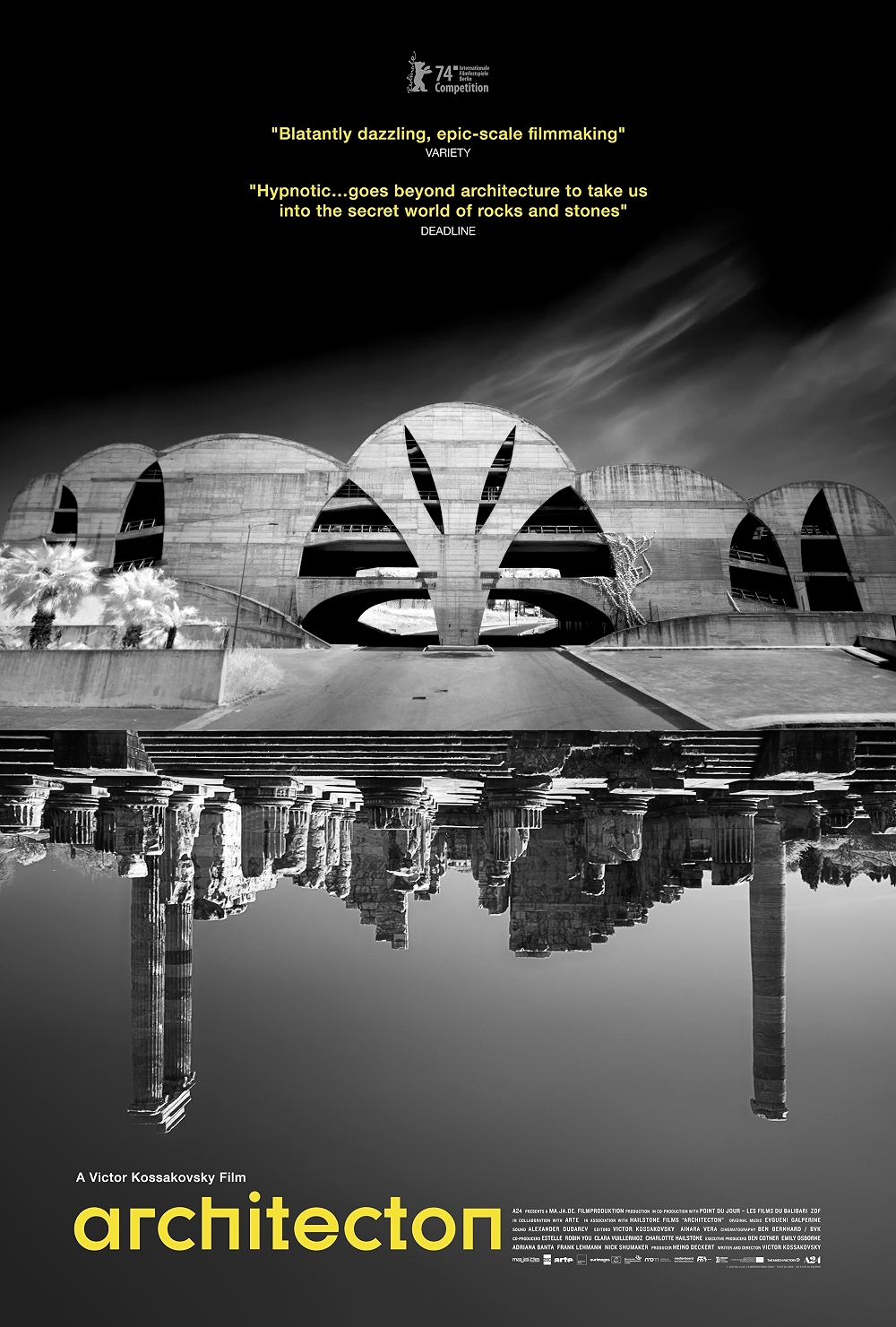
Victor Kossakovsky’s documentary Architecton is a poetic rumination on the building blocks of settled societies – stone in the ancient time, concrete today. What about brick, you might immediately ask? It’s been around for at least six thousand years in its baked form, and even longer if we include unbaked mud. Not a squeak, not a mention.
But let’s not review the film Kossakovsky hasn’t made. Instead here we are with an impressive montage piece starting in war-destroyed Ukraine, where remarkable camera footage slo-mos down a bombed tower block, revealing lives hastily abandoned – a TV set, a sewing machine, a slab of concrete floor hanging precariously into the dwelling below.
In a style reminiscent of Godfrey Reggio’s 1982 classic Koyaanisqatsi, Kossakovsky guides us wordlessly from one shock-and-awe image sequence to another. A mountainside of sedimentary rock, with one massive boulder suddenly breaking loose and crashing to the plain below. An ancient, stone-built ruin somewhere in Lebanon, its precision-engineered vaulted construction still holding up 2,000 years after the Romans built it. A vast quarry where huge explosions wrench whole mountainsides apart and tiny trucks beetle around below, loading up on the liberated stone and driving it off in massive convoys stretching to the horizon.
In among this sort of thing, shots of an artist – it is Nick Steur – balancing rocks on top of each other. Another man, the architect and designer Michele De Lucchi, supervising the building of a stone circle in his garden on a wet day in Italy. More shots of ruins in war-torn places. Occasionally concrete intrudes. Demolition work being done on modern buildings in the aftermath of an earthquake. A machine that appears to be constructing a building by applying wet concrete in long, thick ribbons over a pre-assembled lattice of metal, goo being squeezed as if from an icing bag. 3D printing tech, I imagine.
There is barely a word said, and the shush of the wind is high in the mix. A scratchy, trembly score by Evgueni Galperine avoids the cliches of ambience.

Human beings are good at building, whether it’s buildings out of stone, or empires, civilisations or megacorporations. One of the predecessors of homo sapiens, the thinking human, was homo habilis – the handy man.
Drones make the assembling of a film like this easier than it used to be when Reggio was doing it. And though Reggio and Kossakovsky are using similar methods – pile together as much awesome footage as possible – their purposes are different. Reggio’s was an ecological film, ultimately, drawing attention to the beauty and majesty of the planet as a way of engendering respect for it.
Kossakovsky’s purpose seems less instantly obvious, though over time as he keeps alternating between stone and concrete, concrete and stone, it’s hard not to get the impression that a pecking order is being established. On one side noble stone good for thousands of years. On the other concrete – useful, workaday, ugly, and as ephemeral as a single lifetime.
In case we haven’t got the message, as a kind of epilogue Kossakovsky himself pops up, talking to De Lucchi in his garden, where the splendid stone circle is now complete. De Lucchi talks of a building he’s just designed in Milan. He says he’s ashamed of it – “just another box” – and then makes explicit what the film has hinted at. “I hate concrete. Concrete is arid.”
And there you have it. Was the epilogue added because someone was nervous that the film didn’t quite add up without it? Possibly. Is it necessary? Not entirely. Is this a good film? It depends, I think, on how you’re approaching it. But in terms of sheer image-grabbiness, it’s remarkable, that’s for sure.
Architecton – Watch it/buy it at Amazon
I am an Amazon affiliate
© Steve Morrissey 2026