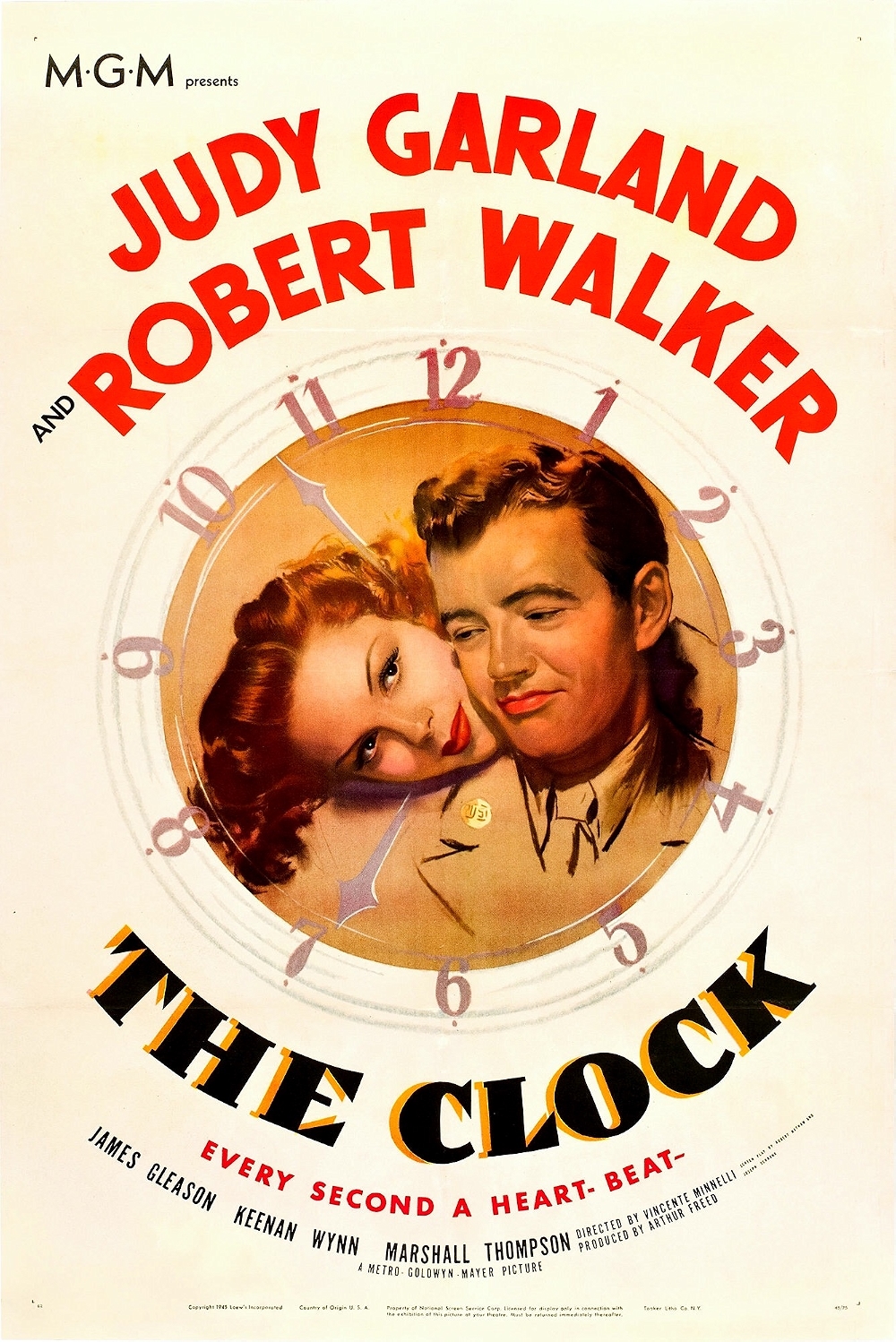
Stirringly democratic and winningly romantic, The Clock is one of Judy Garland’s best films. She sings not a note, you may be surprised to learn, but brings a tear to the eye with her portrayal of a sweet young miss having a whirlwind romance in surely the most New York New York ever committed to film. Almost all of it was shot in the studio, you may also be surprised to learn.
Anyhow, Alice (Garland), a button-bright go-getter meets-cute with Robert Walker’s Joe Allen, a corporal on 48 hours leave, after he causes her to break a heel on an escalator in busy Pennsylvania Station. Though properly contrite, he is taking barely any notice her because he’s overwhelmed with the sheer verticality of the Big Apple – “These buildings, they way they go right up”. It’s this “green as grass” nature of Joe that persuades Alice to take on the role of unofficial tour guide on this otherwise lazy Sunday afternoon – just one or two sights, you understand. Girlishly enthused by his enthusiasm, she gives him the tour of a rather folksy New York – on top an open bus, at the zoo in the park, watching an old guy feeding the birds, a young kid playing with a toy boat. One thing leads to another and in spite of a warning from her room-mate Helen about being picked up by a soldier, the inevitable happens.
Garland’s performance is a thing of wonder. About 22/23 and full of expectation and suppressed longing, her Alice casts regular sidelong glances at Joe – is he hitting on her? Is his cornball character a front? It seems not. Walker, so often the weirdo (see Strangers on a Train) is also remarkably winning – a decent young man unexpectedly on the town with a sweet and pretty young woman and happy just for that.
Eventually, in the film’s central ideological moment – when Alice and Joe are shown the life they might have together if a common future were on the cards – they help a milkman in a fix do his rounds and then meet his happily homely wife (James and Lucile Gleason were husband and wife in real life and did a lot of films together). Al Henry and wife are at the apex of a celebration of the little people who make a city tick. Irish cops, a waiter at a diner, an office cleaner, an official at a laboratory. It’s a city brimming with young women and their military beaus.

Fred Zinnemann was the original director, until he and Garland fell out. Then Vincente Minnelli took over. Minnelli and Garland would marry the following year. Here he seems determined to make this a love letter to his future wife. Though it’s in black and white, and Minnelli was a master of colour, Minnelli’s eye is fabulous. Crowd scenes are choreographed as if Minnelli were staging a musical. Framing and lighting are gorgeous, all slightly magical. Look at the scene where Joe and Alice finally kiss and Garland goes out of focus as Walker comes in.
It’s the wild-night-out-in-New-York movie – After Hours or, more recently, Caught Stealing – but done entirely as a twinkling romance. Drunks in bars are loud-mouthed but essentially harmless. Oddballs are eccentrics rather than dangerous cranks. Cops are helpful. The war is essentially won, America is ascendant, all is right with the world and New York is the best of all possible places.
On a wider level it’s a hymn to city life, how it works because people co-operate. Not noticeably, maybe, but in just letting their fellow city-dweller rub along in their own sweet way. Brilliantly expressed. A classic.
The Clock – Watch it/buy it at Amazon
I am an Amazon affiliate
© Steve Morrissey 2026