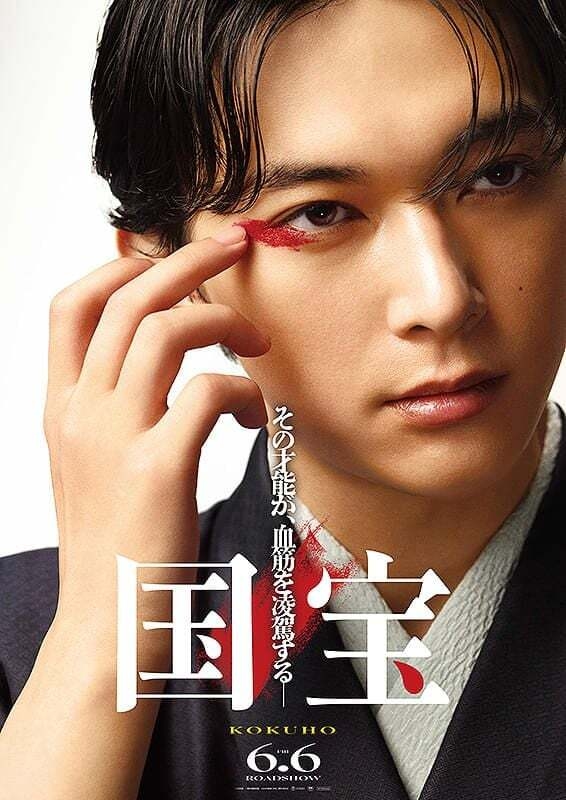
The highest-grossing home-grown live-action movie in Japan’s history, Kokuho is a decade-straddling epic about the sacrifices required to make great art, served up as a Jacob and Esau tale of two boys – one who has all the gifts, the other not so many.
The twist being that the talented kid is the son of a dead yakuza, and so cannot move easily, if at all, in the rarefied world of the kabuki theatre – his chosen field. As Lee Sang-il’s sumptuous film opens, young, orphaned Kikuo’s talent has just been spotted by one of kabuki’s masters, Hanjiro (Ken Watanabe).
Soon, the disadvantaged child (Soya Kurokawa as a pretty boy, Ryô Yoshizawa as a pretty man) has been invited to learn the craft of the onnagata – the men who play female roles in the kabuki – at Hanjiro’s academy, alongside Shunsuke (Keitatsu Koshiyama, and later Ryûsei Yokohama), the great man’s son and heir.
The path will not be smooth for either boy/man. The training is brutal but Kikuo’s talent and diligence push him forwards while his origins hold him back. On the other side of the divide, Shunsuke has the family name to fall back on and has been in training since he could walk. But he takes it all a bit for granted, is less driven than Kikuo and treats serious, precise kabuki as a bit of lark.
In spite of their differences, the two boys become friends. Later, biblically maybe, they will become rivals, and that will be the story till the closing credits – talent and blood fighting for supremacy, with one rising as the other falls.
Decade-straddling epics can be a bit of a bore and rely on world-building at a planetary level to be engaging. This Lee has achieved, and as the action shifts from the 1960s to the 2010s, he carries us in some style down the decades, weaving the two stories of Kikuo and Shunsuke together with those of Hanjiro, Mangiku (Min Tanaka), an ancient kabuki master, and the women and children in the lives of Kikuo and Shunsuke.

Knowing nothing about kabuki does not matter. It’s one of the film’s triumphs that it manages – without insulting those who already know all this stuff – to lead the ignorant by the hand. There are regular demonstrations of kabuki set pieces – all of them introduced in Japanese characters with a quick précis in English underneath. They all, one way or another, feature maidens killing themselves in a spectacularly ritualised fashion, so they’re not hard to follow.
The film has its own spectacularly ritualised rhythm too. Things suddenly crescendo in a moment of maximum drama, before falling back, only to crescendo again when one of life’s devastating switchbacks arrive to challenge Kikuo or Shunsuke.
It could all be highly histrionic but it isn’t. Instead, Lee does it in a measured and tender way, lavishing empathy on his characters even when they’re at their worst. This won’t enamour Kokuho to everyone. But for the doubters, maybe, there is the period detail to admire, and the spectacular kabuki costumes, and the precise colour work of director of photography Sofian El Fani, of Blue Is the Warmest Colour fame.
Yoshizawa trained in kabuki for a year and a half to make this film, which reflects the three years of research that Shuichi Yoshida did in kabuki theatre while writing the book it’s based on. The film works on both levels – as an introduction to this opaque world and as a torrid melodrama done with all the levels turned way, way down.
Kokuho – Watch it/buy it at Amazon
I am an Amazon affiliate
© Steve Morrissey 2026