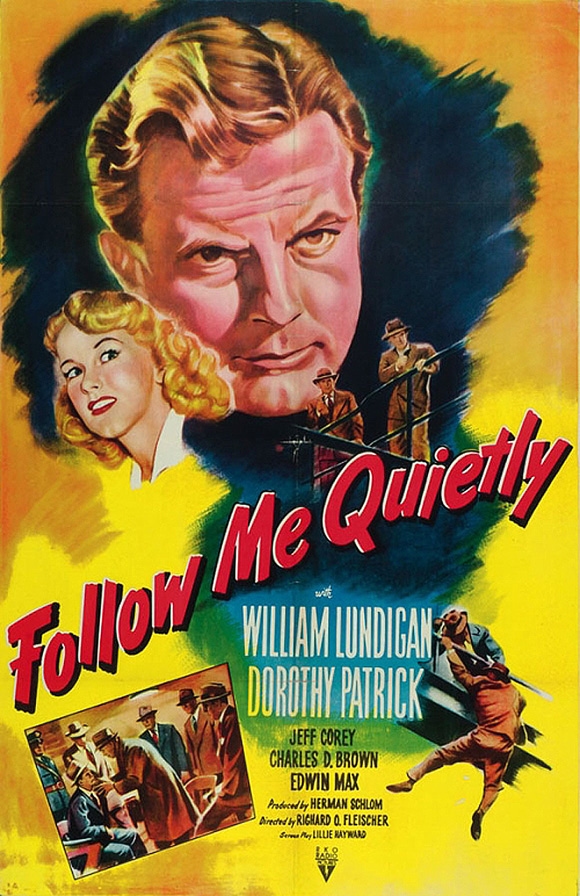
Follow Me Quietly is only one hour long and so desperate to use its time well that it’s already running its first scene beneath the opening credits – a woman walking to and fro in the rain. From the way she’s pacing, and shielding the glowing end of a cigarette like a soldier in a trench, we can tell she’s a femme fatale. Inside the next five minutes all the other key characters have been introduced in a similarly concise way, by which point we know this is a thriller about a serial killer called the Judge, and that this is a story about driven characters – the killer, the cop on his trail and the journalist who wants to scoop the story.
It is, in all honesty, not much of a story – cops look for man, get a lead, find the man – but the speed of it is fascinating and there’s an added layer of interest with a potential romance between cop Lieutenant Harry Grant (William Lundigan) and journalist Ann Gorman (Dorothy Patrick), who gets it in the neck from Harry when they’re first introduced because she writes for trashy magazines rather than the newspapers. “You’re not the press…” Harry sneers. But she persists, following him in a “follow that car” cab when he takes off to the scene where the Judge has struck again.
Eventually Harry softens a touch, impressed by Ann’s gumption – she reminds him of him – and by her attempts to charm him, though how he resists.
Scientific policing is what Follow Me Quietly really wants to talk about, with psychological theorising featuring prominently. Early on there’s a scene where some nutjob comes in off the street claiming to be the killer when he obviously isn’t – what sort of psyche comes up with that as a form of entertainment?
Then the police hit on a ruse and mock up a life-size and lifelike dummy of what they think the killer looks like, and get the press (the real press) in to take pictures. Later, fun is had with the dummy, when the Judge himself swaps places with it, the film’s standout scene.

There is a flavour of Seven here – weird killer, his taunting notes to the police, his righteous war on the wicked, the cops’ patient, methodical response – and there’s a lot of psychology wheeled out to try and crack the identity of the Judge. Why does he kill? Is he angry or is fear really what motivates him, and so on.
Lundigan isn’t much of an actor but he’s good enough, and Patrick makes a lot of the running as the plucky journo trying to make her mark (as is the killer).
The director is Richard Fleischer, who doesn’t mess about with fancy stuff but is slick, economical and unambiguous. We know at all times the who and the what and the where. This was made in 1949 and marks the beginning of Fleischer’s transformation from a director of shorts and B movies to someone much grander. He’d continue on into the 1980s with films like Conan the Destroyer and Red Sonja, but his heyday was the later 1950s onwards – from 1958’s The Vikings to 1973’s Soylent Green, with the similarly procedural thrillers The Boston Strangler and 10 Rillington Place in between popping up in a long list of box office successes.
You get a bit of both Fleischers here – the guy who can stage a spectacle and also work at a psychological level – and towards the end, after many interiors and a lot of theorising, he gives us what we’ve been waiting for, a bit of action, with a big chase and a finale in a refinery, where the Judge is finally chased to ground.
Is it good? Yes. A touch glib, maybe, but it’s packing a lot in and doing it well. Who hasn’t got as spare hour here or there? You could almost watch it waiting for a delayed train.
Follow Me Quietly – Watch it/buy it at Amazon
I am an Amazon affiliate
© Steve Morrissey 2026