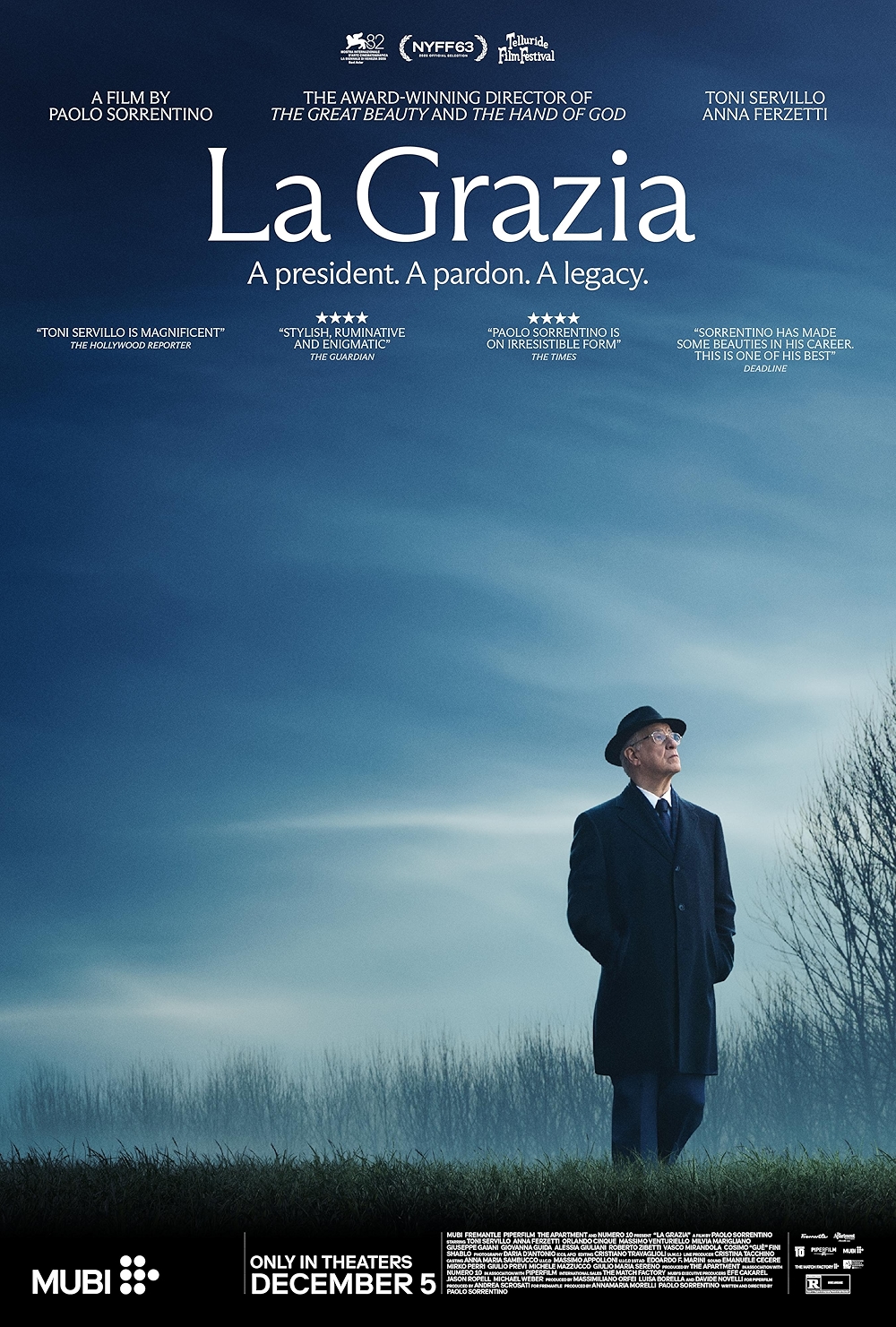
In La Grazia (aka Grace) Paolo Sorrentino once again gives us what we expect – a lushly gorgeous movie about a man in an existential funk – except this time he’s turned the power down a couple of notches. We’re back (almost) in the realm of his breakthrough, The Consquences of Love.
It’s a fugue of a film about a man in a fugue state, with Toni Servillo back for the seventh time with Sorrentino, this time playing the Italian president as he limps towards the end of his tenure. An extract from the Italian constitution up on the screen as the film opens us informs us that Il Presidente’s functions are mostly ceremonial, though he does have some decision-making power, notably the authority to pardon crime and commute sentences.
And that’s exactly what the wafer-thin plot turns on, if it turns at all. For the most part we’re watching a lame-duck politician hedged in by protocol and the restrictions of the “white semester” before he leaves office, ruminating on the meaning Of It All. Suddenly this inert guy locked in a personal crisis is gifted a chance to make a difference. Should he, by the grace of his office, offer pardons to two murderers, one of whom seems to have killed his demented wife as an act of mercy? Should he give the seal of presidential approval to a bill on euthanasia currently working its way through the political system?
In the meantime, his life is one of featureless comfort. His lawyer daughter, working as his aide and confidante, has her sick father boxed in – on a strict diet (quinoa), no cigarettes allowed (he sneaks them), while he flops about in the vast official residence, listening to rap on headphones and obsessing about his late wife’s possible infidelity with a friend, who might be the next president.

So far, so Sorrentino. It’s like he’s crashed together two of his abiding concerns – the workings of the Italian state (as we saw in Il Divo) and existential breast-beating (The Great Beauty and Youth). Exciting it is not, but it’s fascinating nonetheless, and in Servillo he has an actor who can do 50 shades of deadpan, each one expressive in its own way. The whole film is an analogue of the flatlining of this semi-redundant politician’s existence, bursting into life here and there in beautifully staged scenes – the one with the Pope (a black man with earrings and dreadlocks, for the haters), the one where Il Presidente decides to rap, which is funny. The one where the ancient president of Portugal arrives on a state visit and the heavens open and batter him with rain – no one moves a muscle to help because protocol must be followed.
Sorrentino and Servillo’s president appear to be one and the same at these points, observing with cool amusement.
Anna Ferzetti, as the president’s daughter, gets something to do as the concerned daughter, another human being whose life has been richly rewarded superficially but appears to be spiritually inert. Where is the joy? Suddenly, periodically, the staccato opening notes of I’ve Got the Power by Snap! ring out. A comment. Absurd. Ironic. Amusing. Welcome.
Death is everywhere in this film, and intimations of mortality. The dead wife the president is obsessing over, his favourite horse, mortally sick, the murderers he might or might not pardon. It’s an elegy, easy to hate because it’s not very exciting. What connection does it bear to the actual Italy of today? None, it would seem, though the publicity notes tell us it is based on a real case, when President Sergio Mattarella was asked to pardon a man who killed his sick wife.
It’s Sorrentino in a minor key. Though, let’s face it, he’s always in a minor key. A soft-pedal then, how about that?
La Grazia – Watch it/buy it at Amazon
I am an Amazon affiliate
© Steve Morrissey 2026