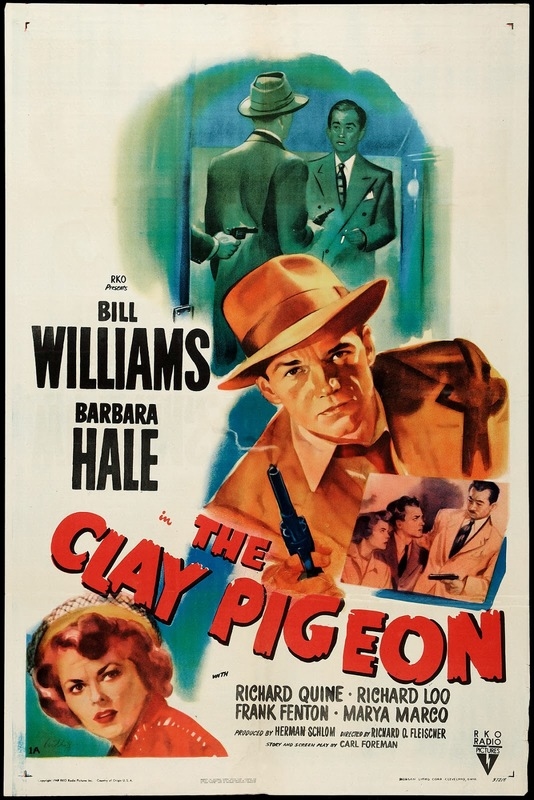
The issues are fascinating but the plotting swings about like a thing demented in The Clay Pigeon, a paranoid thriller written by Carl Foreman, of High Noon and The Bridge on the River Kwai fame, and directed by Richard Fleischer, estimable names both.
Bill Williams plays a soldier who wakes up from a coma only to be told he’s about to be court-martialled for murder and treason for turning a fellow soldier over to the Japanese when both were PoWs. Since Jim Fletcher (Williams) has amnesia, he has no idea what the charges are all about but he is clear-minded enough to know he’s in a fix. Climbing out of his hospital bed at the first opportunity, he makes a run for it. Only to wind up in the apartment of the man whose death he caused, talking to his widow, Martha (Barbara Hale), who quickly works out who Jim is. Whoopsie.
Is Jim innocent? You know he is. Is Martha, initially with huge reluctance, going to try and help him clear his name? Affirmative. Are the pair of them going to edge towards a relationship that is so inappropriate it can only be excused on the grounds that Hale and Williams were married in real life? Nothing else really explains it.
Off they set, on a road trip to LA, where Jim will try to track down fellow PoW Ted Niles (Richard Quine), who will help him get things straight, with Martha as driver and, increasingly, right-hand woman.
The brave individual standing alone against injustice is a trope from High Noon and complex relations between Japanese and allied soldiers would be worked through more fully in The Bridge on the River Kwai. Here, Foreman is going to some lengths to portray the Japanese as nothing more or less than human. There are bad ones – the familiar despicable, torturing sort – and there are good ones. In the figure of Helen Minoto (Marya Marco) he introduces a widow whose Japanese American husband heroically served in the 442nd Regiment, which comprised Japanese Americans. We get a glimpse of the dead husband’s citation for bravery in a scene that has little other purpose.
Things get fraught as Jim gets closer to an explanation for everything. US Naval Intelligence is on his trail as well as obvious bad guys, who try to run Jim and Martha off the road and, in LA, he catches up with Ken Tokoyama (Richard Loo) – not for nothing known as The Weasel.

As the atmosphere gets more tense, Fleischer and DP Robert De Grasse shift more completely into noir. The shadows start to crowd in, more scenes are set at night, things get noticeably more urban and fate’s hand in events becomes more obvious.
There are several wild leaps of improbability – about three – but most improbable of all is the explanation for everything, which comes in from out of nowhere and is completely head-scratching.
Foreman wrote the film as a lean and taut noir designed to fit a B movie slot, and Fleischer directs it that way, with great economy, but some of the transitions are so abrupt that the suspicion lingers that the film maybe once had grander ambitions. Or maybe this is just an example of a screenwriter’s desire to say something and to hell with plot logic.
It’s only 63 minutes long, which maybe explains the weird stuff, but the admirable aspects remain. The way Foreman gets a lot of plot into a tight space, and Fleischer’s direction, which somehow is both urgent and expansive – no mean feat. The acting of Hale and Williams is nice to watch too, even if the relationship is a bit skew-whiff. Leave the stuff you don’t like on the side of your plate.
The Clay Pigeon – Watch it/buy it at Amazon
I am an Amazon affiliate
© Steve Morrissey 2026