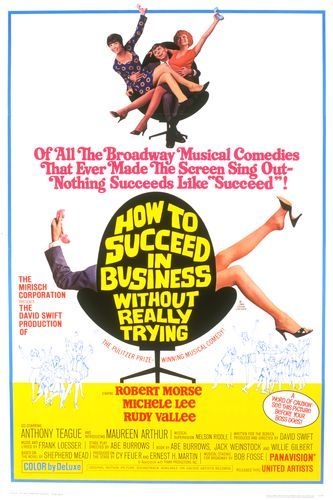
How to Succeed in Business without Really Trying was a massive hit on Broadway in 1961, winning seven Tony awards, including best musical and book, plus a Pulitzer prize. It was quite the thing – Bob Fosse did the choreography, Frank Loesser did the music, audiences flocked to see it and it ran for nearly four years. Since then it’s done US national tours, transferred to London (twice) and also been been successfully revived on Broadway twice, once with Matthew Broderick in the lead and once with Daniel Radcliffe.
And here’s the film version, made six years after that Broadway debut, with most of the stage stars back in the roles they originated, most notably Robert Morse as J Pierrepont Finch, a fink with a face off Mad magazine who buys a book on self-improvement and uses it to work his way to the top in an organisation that makes wickets – the World Wide Wicket company (sounds vaguely internetty). Whatever else it is, as an example of something dying in translation this film is hard to beat.
It remains a satire on the corporate, consumerist, conformist society. But 1967 was a very different place culturally from 1961 so tonally it’s off the mark right out of the gate. And the character of Finch, seen from halfway back in the stalls, is a very different proposition than the same man seen close up – not nearly as winsome.
However, some good things remain. It is visually witty and David Swift’s direction is bright and breezy, as you might expect from someone who did both The Parent Trap and Pollyanna for Disney. The production design is in big blocks of pastel colours, which Eastmancolor – used here – is ideally suited to capture.
There are some really great performances, particularly from Anthony Teague as Finch’s rival, the born-to-rule Frump and Michele Lee as Rosemary, the dynamic hottie who takes one look at Finch’s dopey, conniving mug and falls for him. It makes absolutely no sense but Lee almost makes it make sense.

Whose decision was it to remove most of Fosse’s choreography, which is why most people these days would consider watching this lost artefact? There are two numbers (to my eyes) remaining, in which Fosse’s production-line dance moves – finger clicks and hat tips as if commanded by punch card – suddenly bring the musical back to life. A Secretary Is Not a Toy is by a long stretch the standout number and if that isn’t Fosse, I’ll eat my (bowler) hat.
Several of Loesser’s songs have also been cut, which also seems unwise, leaving Nelson Riddle to fill in the gaps with incidental music. He also did the theme and incidental music for the TV Batman in the mid 1960s and the similarity is spooky, though inadvertently amusing.
Much later in his career Morse turned up in Mad Men, and that’s the sort of world the cast and crew are conjuring here – hats and suits, a place full of ass-kissing and yes men with a route to the top possible for someone who can wriggle and duck. By the end of How to Succeed in Business without Really Trying, J Pierrepont Finch has, by a massive effort of self-actualisation, lying, cheating and much bullshitting, become the head of advertising, with a shot at becoming chairman of the board in his sights.
Not much of the translation to film works, and as it winds to a close everyone involved as good as admits defeat. The pretence that this is a film set in a plausible world is suddenly abandoned and the final number reverts to where the whole thing should probably have stayed – a stage.
How to Succeed in Business without Really Trying – Watch it/buy it at Amazon
I am an Amazon affiliate
© Steve Morrissey 2026