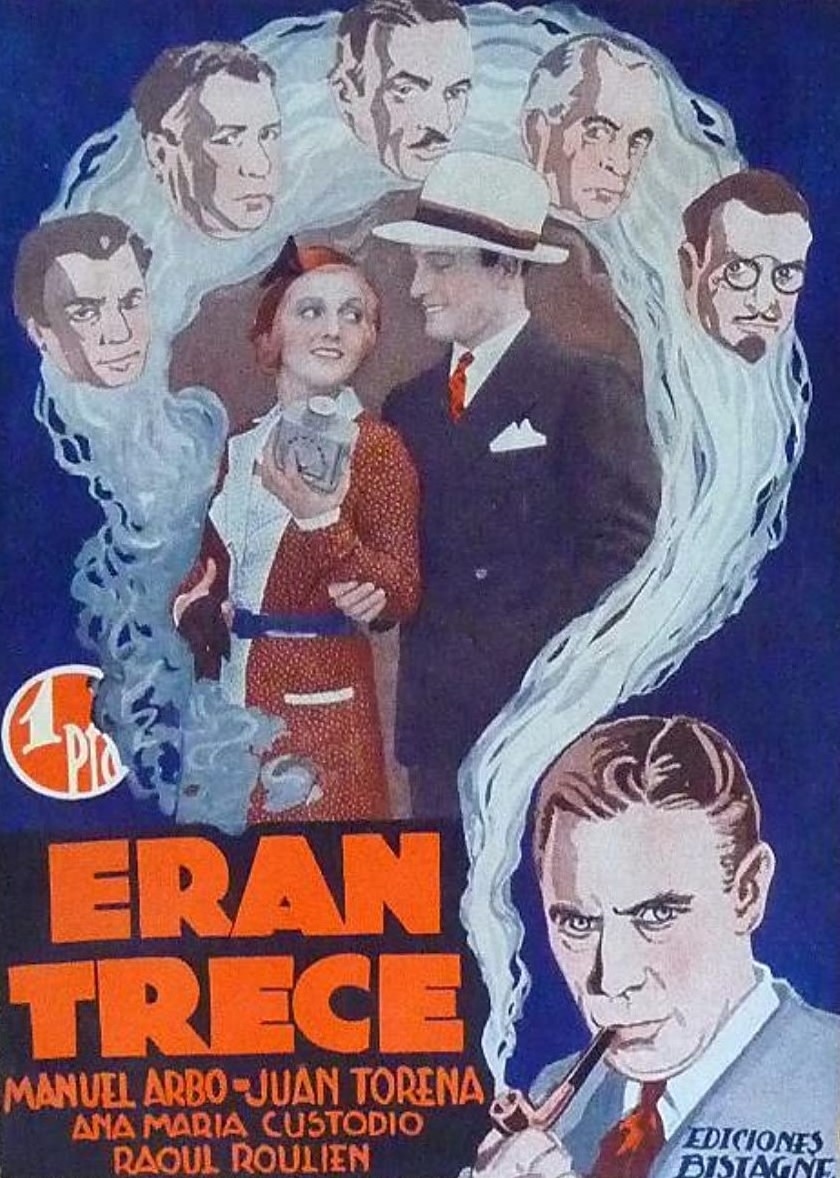
In Spanish it means “There were thirteen,” Eran Trece, and that’s the best title to use for a film originally called Charlie Chan Carries On. The original US version, in English, has been lost to eternity, it seems. But we still have this Spanish version, shot on the same sets with different actors and crew but working from the same story and using a lot of the same stock footage to set the scene.
It’s a very trad whodunit about a gaggle of rich people travelling around the world on a grand tour. The action kicks off in London, where one of the party has wound up dead. There were 13… until old millionaire Louis Potter croaked under mysterious circumstances halfway through this high-class package tour. But now there are 12. Whodunit? Inspector Duff (Rafael Calvo) gets on the case, but he’s stumped. If only Charlie Chan were here, he says to a fellow cop. But Chan is in Honolulu, far far away.
With the murder unsolved, the party moves on to new experiences in other countries, the Inspector chasing after them with a piece of evidence he’s convinced will nail the guilty party. After following them to France, Egypt, China and so on – with members of the party dying en route – everyone eventually winds up in… Honolulu. And with over half the movie gone, its star finally arrives on screen to solve the puzzle with many a gnomic pronouncement – “Only very brave mouse make nest in cat’s ear,” sort of thing – from Manuel Arbó’s Charlie Chan.
The relationship of the inspector to Chan is the one of flatfoot Inspector Lestrade to Sherlock Holmes but in most respects this is a familiar Agatha Christie story. Christie invented Hercule Poirot in 1916, with The Mysterious Affair at Styles. Writer Earl Derr Biggers created Chan in 1925’s The House without a Key, sticking close to the Christie formula. Here, much of the story is concerned with inspecting the bona fides of the various characters who might have turned murderer – the retired Chicago crook, the old, weak-hearted lawyer and his nurse, the cheery fantasist “captain” always spinning stories about his exploits, the rich socialite, the self-made lumber exporter, the dead millionaire’s pretty blonde grand-daughter, and so on.

This was not the first time out for Chan on screen, but it was the first time he’d been played by a non-oriental actor, in both the English-language and Spanish versions. Warner Oland played him in Charlie Chan Carries On, and Arbó follows Oland’s lead, much as Peter Ustinov would years later when he played Chan.
Racist? That’s the charge often levelled, though Biggers claimed he created the character to counter the “yellow peril” racism of the Chinese stereotype of the time. To nip charges like that in the bud Oland regularly claimed he had Mongolian heritage. Born Johan Verner Ölund, in Sweden, the actor may have had some Sámi (and hence potentially some asiatic) DNA in his make-up but even that’s disputed. Manuel Arbó, born in Madrid, Spain, could not fall back on that defence. His performance as Chan is all actorly business and peripherals (silk robes, black Mandarin hat), but it’s well meaning enough and Chan’s eventual solving of the case with a ruse is clever enough to render such considerations peripheral.
It doesn’t matter that much if it’s a good story, is what I’m saying. And it is. Perhaps surprisingly. It’s also very well acted for something clearly shot on the hoof at no real expense. The actors are lively and director David Howard keeps thing chugging along, handling the romantic and comedic elements well, though the sense of everyone being on a stage is quite pronounced.
With a new Charlie Chan TV adaptation currently in the works after decades of neglect, with Chan now reportedly played by Hong Kong-born Tzi Ma, is it time to go back and have a look at the old ones? “No” is a perfectly acceptable answer.
Eran Trece (part of Charlie Chan Collection: Volume 1) – Watch it/buy it at Amazon
I am an Amazon affiliate
© Steve Morrissey 2026