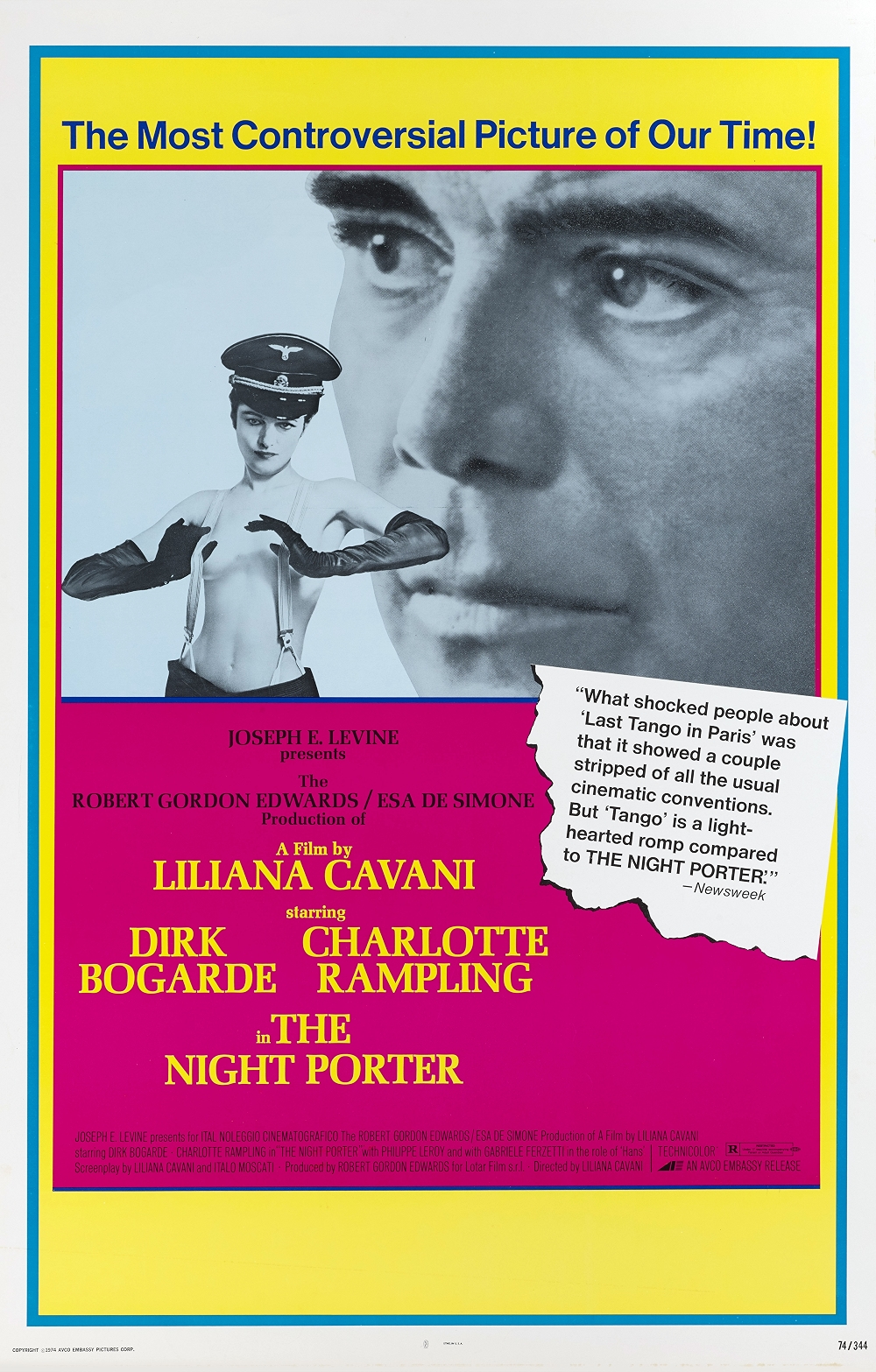
Problematical movies Exhibit A – The Night Porter. The story of a former guard at a concentration camp who meets up with an erstwhile prisoner some years later and starts a sexual relationship with her. Roger Ebert thought it “nasty”, Pauline Kael considered it “offensive” while Vincent Canby of the New York Times went for “a piece of junk”.
Kael also described it as “veneered with redeeming social values”. Is it though? Even that is up for debate. The director Liliana Cavani based the film, so she said, on a conversation she had with a woman who’d been in one of the death camps and had fallen for a member of the SS. Sex and death, it’s a potent combo, Cavani clearly thought, and so the idea for a film was born.
It’s also veneered with redeeming performances, by Dirk Bogarde as the Nazi hiding out in Austria in the 1950s, where he works as a night porter at a hotel. And Charlotte Rampling as the young woman who re-enters his life, and who Cavani shows us in flashback as a 14-year-old spotted by Bogarde’s Max Theo Aldorfer as she waits naked and shivering to be processed into the camp. While Lucia quakes, Max films, on his wind-up camera, focusing on her in particular and not caring who notices.
Later, also in flashback, we see Max lavishing special privileges on Lucia, removing her from a dormitory where one poor mewing fellow is being roughly buggered by another, and taking her off to his quarters, where he ties her to a bed and ravishes her.
Is this why, all these years later, Lucia is attracted to Max? Because he saved her, and that’s the main thing? It remains slightly opaque. Cavani and her legion of co-writers set up another theme – a Fassbinder-esque interest in the way ex-Nazis are carrying on in Germany and Austria – as well as this more psychologically nuanced relationship of subordinate to dominant in a sadomasochistic relationship.

Sadomasochism and sex are regular bedfellows and that’s clearly part of the reason why the film got so harshly reviewed. But, Cavani makes abundantly clear, it’s not play in the camps, there’s nothing frivolous going on between Max and Lucia, the stakes are high. Nor is Cavani bathing Max in any glory. Bogarde plays him as mostly unknowable and, in the bits of Max’s soul to which he grants us access, unlikeable. Max is mostly shot on the edge of frames and often in shadow, on film leeched of colour.
The film’s real problem is that it’s got everything it has to say out in the open by the halfway mark, leaving everyone involved to busk to the finish line. We get more detail on urbane ex-Nazis trying to evade detection by Nazi hunters, and we get more of the sexual games played by Lucia and Max, once Lucia has conveniently sent her conductor husband – an older man, significantly? – off to an orchestra somewhere. But there is a sense of the wheels being spun. There are only so many shots of Rampling’s eyes any film can take, remarkable though they are, and Rampling’s alluring ability to switch between the glacial and the animalistic can only be deployed so many times too.
The psychological position is stated and that’s that. There is no real working through of positions. What Max is getting out of it is easy to fathom; but what’s in this reheating of a ghastly past experience for Lucia? Search in vain.
But as a quietly insistent examination of the Nazis’ hold over the Teutonic psyche in the post-War world, The Night Porter does seem to have something valid to say. Bogarde tells the story of having to do a scene where he put on Aldorfer’s old SS officer’s uniform and went out into the street, where a crowd of onlookers had gathered to watch a movie being shot. They cheered when he appeared. They wept. It wasn’t, Bogarde later recalled, the sight of a famous actor but the uniform that caused the reaction.
The Night Porter – Watch it/buy it at Amazon
I am an Amazon affiliate
© Steve Morrissey 2026