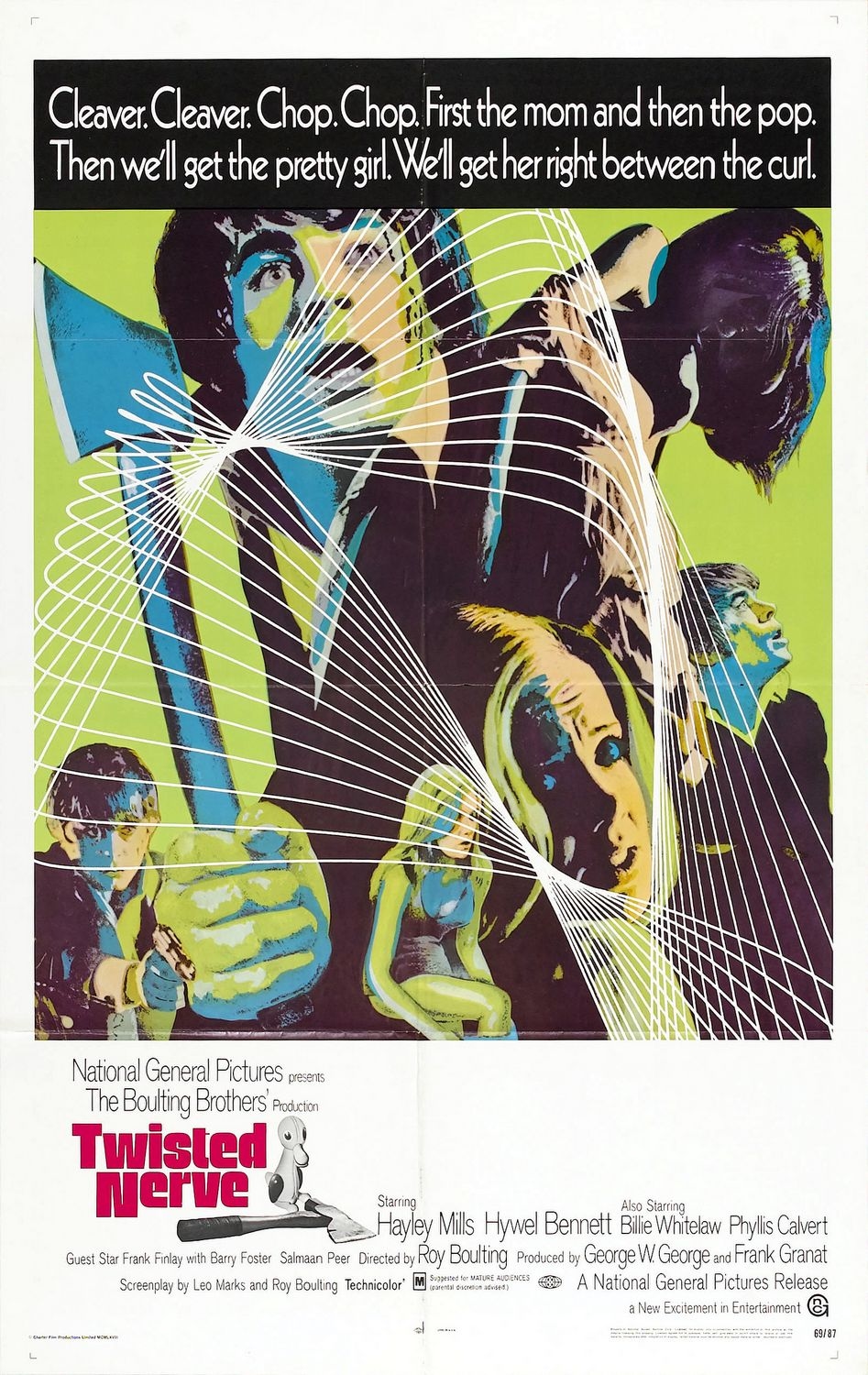
“A twisted nerve, a ganglion gone awry, predestines the sinner or the saint.” Twisted Nerve gets its title from a poem by George Sylvester Viereck – a German migrant who did time in a USA jail for being a Nazi spy – and worries away at that “predestines” bit for nearly two hours. What is it that makes this film’s protagonist, Martin, so weird? Was he born that way or is he just maladjusted? Nature or nurture?
It’s Hywel Bennett as Martin, for a while in the late 1960s and early 1970s the go-to man for weirdos, his cherubic features, hipster aspect and big eyes suiting him to roles like this, a dissolute Oxford dropout from a good family who gets caught shoplifting one day and, instead of taking his medicine, decides to feign being a simpleton called Georgie.
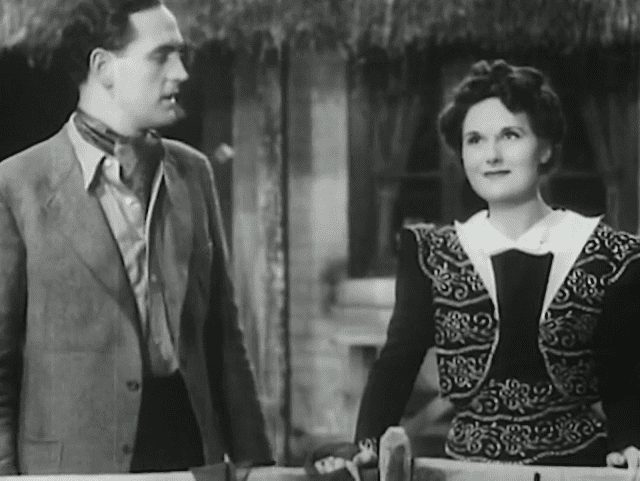
From here it’s a tale of two entities – useless Martin, his home life with his over-protective “mummy” (Phyllis Calvert) and his dismissive stepfather (Frank Finlay), who wants to ship his stepson off to an Australian sheep farm to make a man of him. And halfwit Georgie, who uses his disability as a way of getting close to the sweet-natured Susan (Hayley Mills) who was in the department store when he had his collar felt and got caught up in all the hoo-hah.
Insinuating himself increasingly into Susan’s life, Georgie starts by turning up at the library where she works. In short order he has moved into the house where Susan lives with her mother (Billie Whitelaw) – who takes in lodgers – and is making himself invaluable to the older woman.
It seems obvious what Martin wants from Susan, though the stack of muscle magazines in his bedroom suggests it’s not quite as straightforward as that. A general unwholesomeness seems to be the idea.

There’s a touch of Peeping Tom in the sense of mounting paranoia, and at various points the film breaks off to consider Martin’s psyche. Is he a psychopath? Is his disorder maybe genetic, like Martin’s brother’s Down’s syndrome?
The film opens with Martin visiting his institutionalised brother. If nothing else it explains why Martin is so good at pretending to be Georgie – he’s learned his cues from his brother. Down’s, still referred to as Mongolism here, got the film caught up in one of those synthetic media outrages the British press used to be so good at. It explains the apologetic introduction tacked on to the beginning of the film – “the producers wish to re-emphasise… that there is no connection between Mongolism and psychotic or criminal behaviour”.
If only it were apologising for a better film. The actors are superb – Bennett creepy and off-putting as both Martin and Georgie; Mills using her chaste beauty to great effect; Whitelaw extremely good as a smart woman increasingly concerned that she’s let an unclean presence into her house; Calvert as Martin’s socialite mother, a mix of control and neglect, as is Finlay’s stepfather. As two of the lodgers, Salmaan Peerzada is incredibly useful as a doctor adding medical footnotes to Martin’s condition, while Barry Foster is once again excellent as the lairy, sex-obsessed – but open about it – Gerry.
It’s the direction that undoes it. Roy Boulting is best known for comedies examining social attitudes. His pace plods here and his 1960s are just a touch off whack. It’s an old dude’s attempt to be down with the kids. Interestingly, both Whitelaw and Foster would turn up in Hitchcock’s Frenzy four years later, another old dude’s attempt to be down with the kids.
That’s probably the best way to see Twisted Nerve, as Hitchcock knock-off with not quite enough juice. Great performances though, and well worth checking out if acting and seedy atmospheres are your thing.
Twisted Nerve – Watch it/buy it at Amazon
I am an Amazon affiliate
© Steve Morrissey 2026