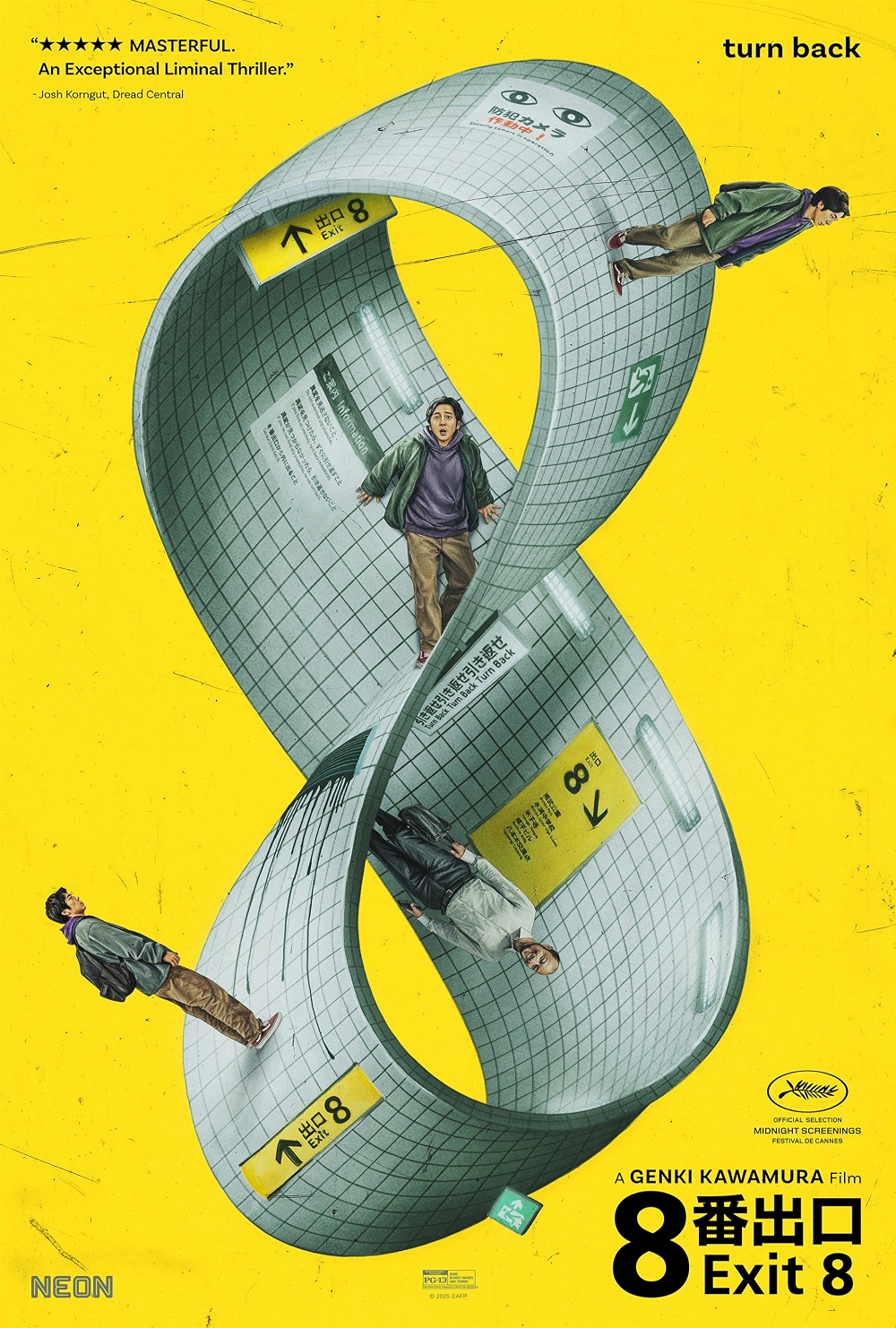
A man on the Tokyo subway struggles to find the exit. That’s the entire plot of Exit 8, proof that it’s not what you do it’s the way that you do it. This is a tense and atmospheric chunk of quasi-scifi, owing something if not everything to Jean-Paul Sartre’s Huis Clos, with a bit of a stylistic assist from Vincenzo Natali’s cult classic Cube.
Quite how Natali got sidetracked into gun-for-hire work on TV shows rather than making more superb high-concept movies like Cube is a question for another day. Here the incredibly capable director is Genki Kawamura, whose only previous feature, A Hundred Flowers, was a tremulous tale of encroaching dementia. Here, memory also figures in a sealed-room plot about a man (Kazunari Ninomiya) getting off a subway train as per normal. But instead of wandering down the white-tiled corridors to Exit 8 and the waiting city, he finds himself going round and round in circles, incapable of finding the way out.
Hasn’t he been down this corridor before, he starts to wonder after a few circuits of the increasingly familiar route? He’s certain he has, and so he starts taking particular note of advertisements on walls, security cameras, a photo booth, locked doors to who knows where. He also notices he keeps passing the same man.
Walking Man (Yamato Kochi) is how he’s billed, whereas our guy is Lost Man. On one of his laps of this ringroad to hell, Walking Man grins at him. So there are anomalies. Suddenly, he notices a sign on the wall offering him a strategy – “Do not overlook any anomalies,” it reads. “If you find an anomaly, turn back immediately.” “If you do not find an anomaly, do not turn back.” “Go out from Exit 8”.
So that’s what he does – goes forward until he spots something anomalous, then turns back, hoping to placate whatever cruel god came up with this weird version of blind man’s buff in a maze. But what counts as an anomaly? The ceiling weeping with blood? A small boy, billed as The Boy (Naru Asanuma)? The sound of a child crying in a locker? All are negotiated.

The vibe is nightmare, instantly, and because Lost Man is intently keeping an eye out for things that weren’t there before, we do too, willing him forward, or backward. Kawamura starts off in gamer first-person point of view, but switches early on to a semi-omniscient semi-third person, semi-point of view camera and stays there, working together the aseptic whiteness of The Cube with the corridors of Kubrick’s The Shining by way of the impossible perpetual mazes of MC Escher (a poster advertising an Escher exhibition features prominently).
Hell is other people, Sartre said in Huis Clos, which is often translated as No Exit – alternative translations include No Way Out and Vicious Circle. It features three people locked in a space together for eternity. Lost Man, Walking Man and The Boy are our three – what superbly controlled performances by Ninomiya and Kochi, and also from the impassive, saucer-eyed Asanuma, aged only eight.
Salvation is other people too. Psychologically Exit 8 hinges on Lost Man’s last contact with the outside world before everything went banzai – a tearful call from an ex girlfriend telling him she was pregnant and on the way to the hospital. For a check-up or a termination? He doesn’t know.
By the end, as Ravel’s Bolero plays us out, as it played us in – more repetition – Lost Man appears to have an answer.
The game-to-movie road is littered with vehicles that just didn’t make it, but Kawamura’s sleek and simple adaptation of a 2023 game does all the right things, doesn’t push things too far and stays stylistically and thematically abstract enough to invite all sorts of interpretations. It got an eight-minute standing ovation when it was screened at Cannes. Eight – appropriate!
Exit 8 – Watch it/buy it at Amazon
I am an Amazon affiliate
© Steve Morrissey 2026