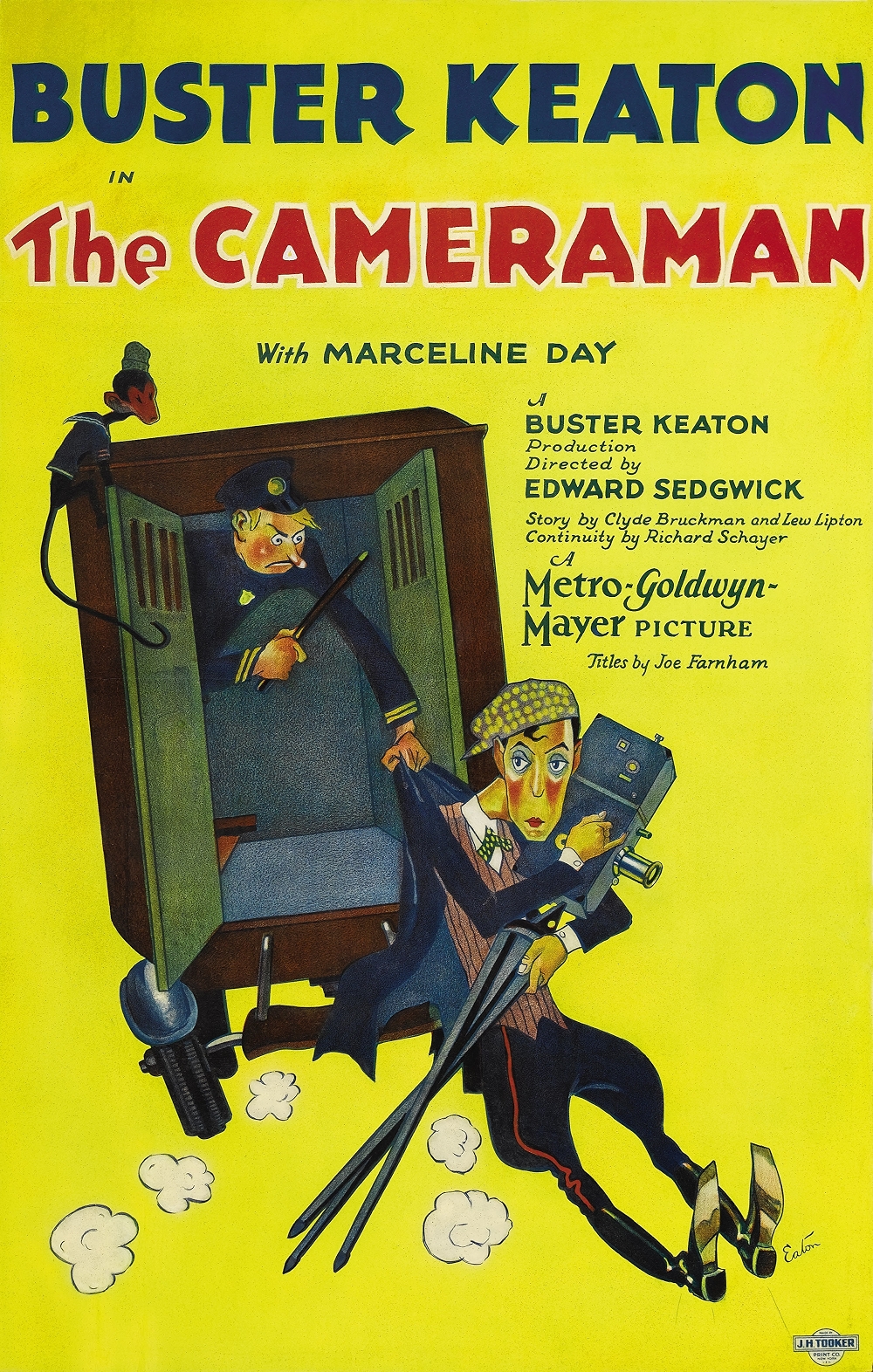
For Buster Keaton, it all went right and it all went wrong in 1928 and The Cameraman is where it all collides. Widely considered to be one of his masterpieces, the film marks the point where Keaton loses control of his own narrative. He’d gone from writer, star and director on a string of hits, like Sherlock Jr, Go West and The General, produced by his own company. But here he suddenly was, working as a gun for hire for MGM, who did their best (at first, at least) to keep him on a tight leash. It’s also the last of Keaton’s silent films and, ultimately, the beginning of the end for him as a major screen presence (though the list of credits on the IMDb stretching as far ahead as the 1960s tell only half the story – he did a lot of work as an uncredited gag writer).
The story is about a hapless street photographer who decides to pursue a career as a newsreel cameraman after catching sight of a pretty young woman called Sally (Marceline Day) who works in the newsreel department at MGM (keep it in the family). Even though Buster has no real experience, he talks his way into the job and into Sally’s orbit, and from there a combination of naivety, enthusiasm, innocence, lust, brass neck and sheer luck combine to busk him from one near-disaster to another in a typically Keatonesque narrative of the goof who makes good.
The set pieces are the stuff of social media clips, particularly the sequence at the Yankee Stadium where Keaton mimes all the different positions in a game of baseball – batter, pitcher, fielder and so on – in a display of athleticism that makes his usual extreme stillness only more of a contrast.
Through it all one gag repeats, of Buster being crowded out of the action, often literally swamped by throngs of people. Romantically the same applies – Sally fending off taller, stronger, richer and more handsome men. Will poor Buster ever get a look-in?

It’s easy to boo-hiss MGM for taming the comedic excesses of a man who had nearly bankrupted himself making The General. The big set pieces familiar from any number of his films – the train crash in The General, the collapsing house in Steamboat Bill Jr, the falling rocks in Seven Chances – are largely absent here. The sight gags are, for the most part, small in scale, though they’re exquisitely executed by “The Great Stoneface”. If Keaton movies are symphonies, then The Cameraman is a chamber piece. But to MGM’s credit, this is a superbly good looking film, better lit than many a Keaton movie made under his own steam, and with a more nuanced Keaton on display. There’s almost a range of emotions.
For all Keaton’s supposedly hands-off engagement, he re-wrote lots of the jokes, suggested plenty more and eventually ended up directing quite a bit of the film too, once nominal director Edward Sedgwick realised Keaton was ahead of him in almost every department. There is, for example, a decidedly Keatonesque lack of intertitles. For all their determination to treat Keaton as an employee on the payroll, he was much more than that. For years afterwards MGM would show this movie to prospective new directors as a textbook on how to make a comedy.
The irony of a man who has lost control of the movie camera playing a man in charge – however haphazardly – of his newsreel camera can’t have been lost on Keaton, and in one of the final shots in the movie an organ grinder’s monkey can be seen cranking the newsreel cameraman’s camera. Make of that what you will.
The Cameraman – Watch it/buy it at Amazon
I am an Amazon affiliate
© Steve Morrissey 2026