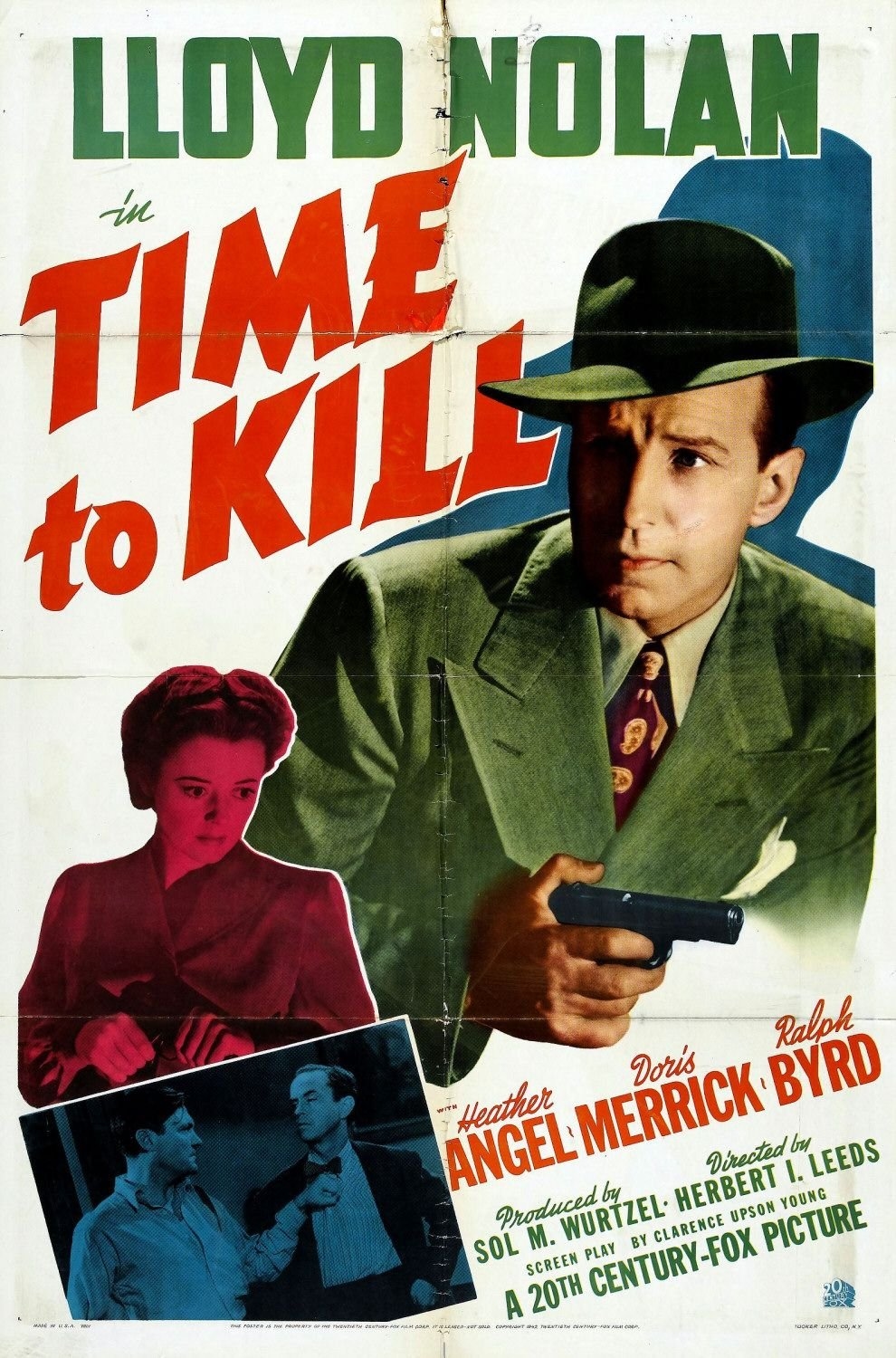
In one hour 1942’s Time to Kill achieves what a lot of much longer films fail to do. It delivers a story while painting a picture of a time, a place and the people in it, and is highly entertaining, amusing and dramatic. The fact that it’s based on a Raymond Chandler story helps – this is the first adaptation of High Window, which would re-emerge on screen as The Brasher Doubloon five years later. But Lloyd Nolan as Michael Shayne – Chandler’s detective Philip Marlowe in all but name – really helps too.
Shayne is introduced feet first, the camera lingering on the holes in his shoes as he takes a call that will set him off on a case of a stolen rare coin. Rich old dame Mrs Murdock (Ethel Griffies) wants it back and is hoping that Shayne can also, in the process, separate her silly son from the floozy he’s married.
It is a typical Chandler story: not so much a plot as a series of colourful characters visited by Shayne as he puts together his case and falls into its resolution seemingly without trying. With Chandler it’s the journey not the destination that’s important. Nolan has got the memo. His Michael Shayne is witty and plausible, brisk and savvy. If there’s a plot hole then Nolan’s playing busks straight over it. It helps that the rest of the cast are good. Griffies as the crotchety Mrs Murdock, invariably eating breakfast when Shayne turns up to take orders or report on his progress. Heather Angel as her put-upon secretary, flustered and pretty and a target for Shayne’s mock teasing. Doris Merrick as the floozie who’s obviously, in her ancient mother-in-law’s opinion, stolen the doubloon in the same way that she’s stolen her son’s heart.
In a Chandler story there’s often a sex-starved young woman panting in the wings somewhere. Here it’s Phyllis Kennedy as a coin dealer’s secretary, doing here what Dorothy Malone did as “Acme Book Shop Proprietress” in 1946’s The Big Sleep, though as a comic turn.

It bombs along. With only 61 minutes’ running time it has to. It helps that director Herbert Leeds was an editor before he became a sought-after director of B movies. He keeps things very tight here, using framing as well as slick editing to compress everything into the available time without things feeling too rushed.
Introduced as the guilty party and an obvious femme fatale, Merrick’s Linda turns out to be a surprise to the upside, even after having delivered one of those breathy vamping songs in the sort of style familiar from a thousand movie nightclub scenes. That is the nature of the film – stock characters given a twist.
Shayne was massively popular, the central character in dozens of novels written by Davis Dresser and a bunch of ghost writers, as well as hundreds of short stories. Film came early, starting in 1940 with the first of Nolan’s seven movies, followed by Hugh Beaumont taking on the Shayne persona, before the dog-eared detective conquered radio and then eventually TV. There are comics too.
Amazingly, considering his popularity back then, he’s almost forgotten today, though there are still fans out there. Shane Black adapted the Shayne novel Bodies Are Where You Find Them into his under-regarded comic noir Kiss Kiss Bang Bang (though the Shayne character is notably absent).
But back to Nolan, also somewhat forgotten and under-regarded but excellent here, breathing life into a character and bouncing this fast-moving and entirely enjoyable trifle from set-up to conclusion with charm and an apologetic shrug – every woman his character encounters finds him devastatingly attractive. His mock “what’s a guy to do?” is pretty funny. There are a lot worse ways to kill time than Time to Kill.
Time to Kill (part of the Michael Shayne Films Collection) – Watch it/buy it at Amazon
I am an Amazon affiliate
© Steve Morrissey 2026