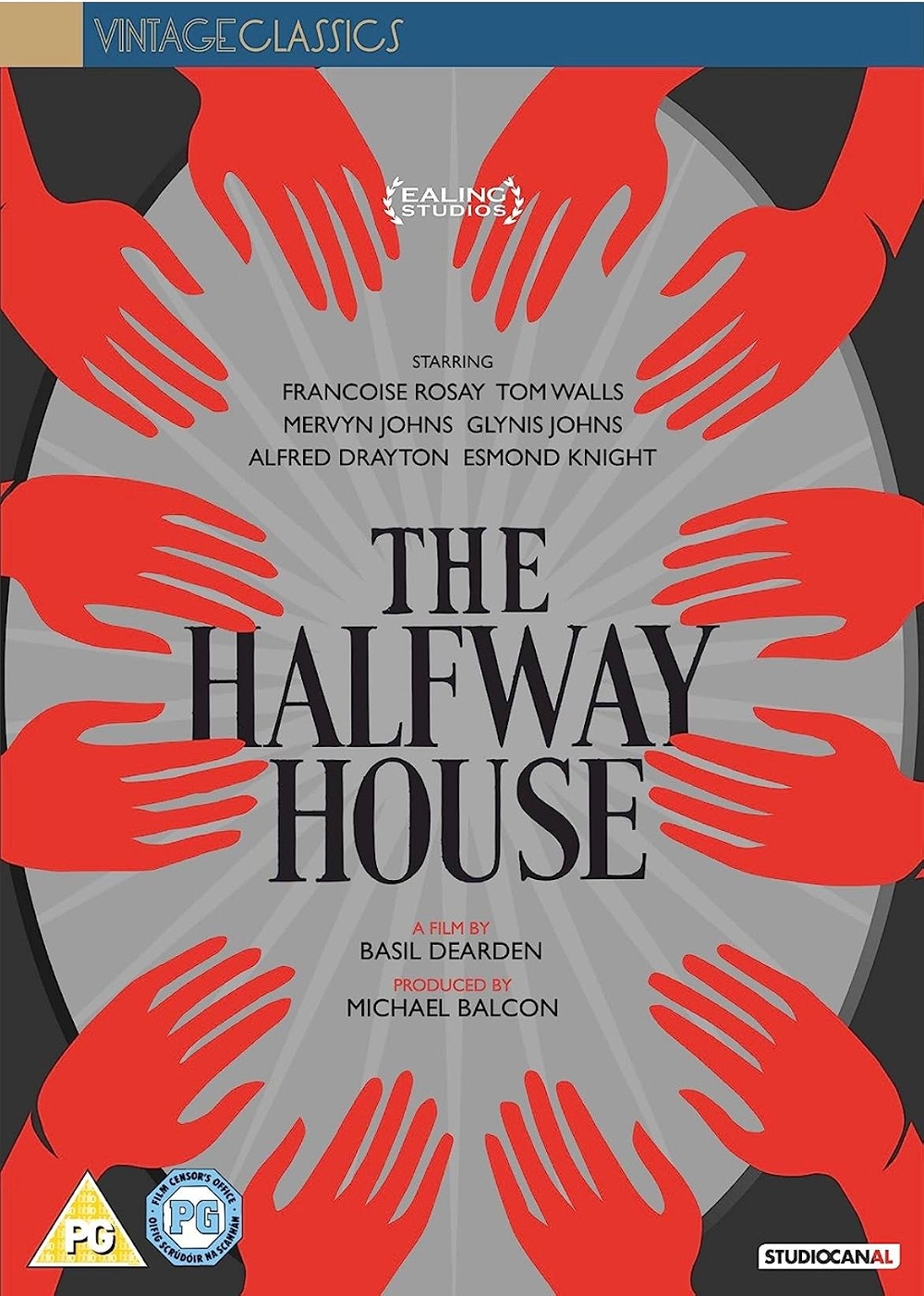
Ealing Studios’ The Halfway House is a halfway sort of film. Made in 1944, it’s not quite propaganda but is clearly on that road. Not quite a ghost story either, or not the usual sort of ghost story.
Brigadoon is somewhere in the back of the plotting. A mysterious pub out in delightful sun-dappled Welsh countryside, bombed out of existence a year before, somehow rematerialises, ready to welcome unwitting visitors.
The people who turn up are all in need of spiritual succour. David Davies (Esmond Knight), a conductor with a terminal disease. Captain Fortescue (Guy Middleton), a professional crook insisting on his rank. Richard French (Richard Bird), a squadron leader in the throes of a nasty divorce, along with his wife Jill (Valerie White) and piggy-in-the-middle daughter Joanna (Sally Ann Howes). Black-market spiv William Oakley (Alfred Drayton). Uneasy couple Margaret (Philippa Hiatt), a Brit, and her Irish fiancé Terence (Pat McGrath). And Captain Meadows (Tom Walls) and his French wife, Alice, who has lost both a son and her country to the war.
Meeting them, the cheery landlord of this wayside inn, Rhys (Mervyn Johns), and his perky daughter Gwyneth (Glynis Johns), father-and-daughter actors playing the father-and-daughter innkeepers.
It takes a while for the new arrivals to realise that something is not quite right about the place. The newspapers seem to be a year old, the innkeepers don’t seem to cast a shadow or throw a reflection in a mirror.

This is the “well fancy that” supernatural tale rather than the scary one. Spookiness is kept to a minimum. If Rhys and Gwyneth are ghosts, they’re very nice, well mannered ones, helpful, pleasant, diffident and polite. The inn itself is set in a sunny, bucolic corner of a very Welsh Wales, where people break out into spontaneous song. It’s all quite sweet, if a bit quaint.
What with a war being on, a decision has clearly been made early on that this isn’t going to be the sort of film where death is the ultimate disaster. Rhys and daughter Gwyneth seem quite happy being ghosts. Their spirits have clearly gone to a better place and now they’re back on Earth temporarily to lend a hand where they can. After all there is a war on.
Their task is to iron out the conflict in their guests. Healing balm is applied in the gentlest of ways. In the film’s most overtly propagandistic moments, Margaret and Terence wrangle over their future. Terence has been offered a job in Berlin and is minded to take it. Why not, after all Ireland is neutral and not in this war. Margaret weighs up her love for her fiancé against her love for her country. Which will prevail? One conversation later, in the course of which Terence has been reminded that this is not just a war of nations but of civilisations, all is resolved.
A halfway house is an obvious metaphor for purgatory, the place where souls rest en route to heaven and are cleansed of their minor transgressions. Not hell but not heaven either. This is an idiosyncratic film with an atmosphere that’s all its own, with cinematography from the top drawer by Wilkie Cooper, who did The Admirable Crichton and The 7th Voyage of Sinbad. He’s really on his game here.
There’s fun to be had seeing young versions of actors who’d be in big Disney hits 20 years on, Glynis Johns in Mary Poppins (she was suffragette Mrs Banks) and Sally Ann Howes in Chitty Chitty Bang Bang (she was Truly Scrumptious). So this strange and enchanting film is a halfway house in that sense too.
The Halfway House – Watch it/buy it at Amazon
I am an Amazon affiliate
© Steve Morrissey 2026