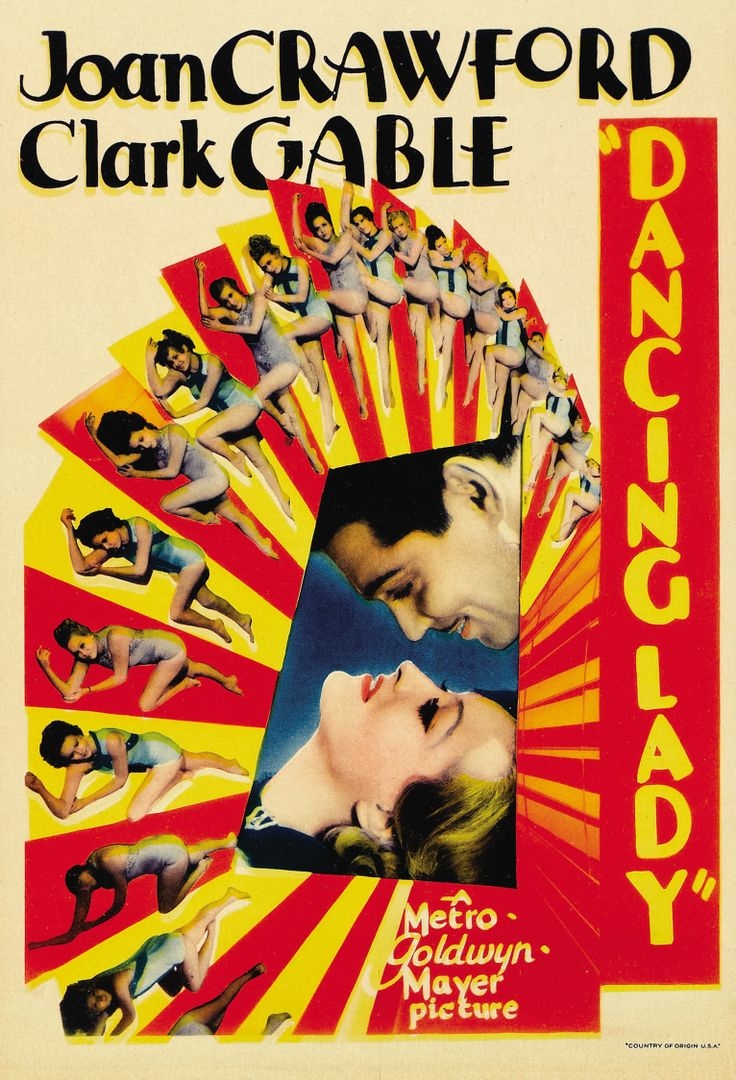
Can a dancer also be a lady? 1933’s Dancing Lady is already asking the question in its title.
It stars Joan Crawford – 1933 Joan Crawford, before the batshit stare developed – as a dancer in a risqué burlesque show who, in the film’s opening moments, is being arrested for indecency by the cops. And is then bailed out by a Park Avenue swell who thinks he sees something in young Janie Barlow. What Tod Newton (Franchot Tone) sees, in fact, is another notch on his bedpost, but ambitious Janie is determined she’s not going to help him carve it. Instead, holding on tight to her honour, she decides to ride what she sees as a meal ticket all the way to Broadway, without somehow being ridden in return.
That’s it. On one side Janie and her body, on the other Tod and his lust. Her goal: a role in the show currently being put together by Broadway legend Patch Gallagher (Clark Gable), an irascible but brilliant director Janie will clash with and… you can guess the rest.
This is a chorus-girl-to-star movie but a pre-Code one. In 1933 no one was bothered about the deal being offered Janie: it’s career advancement for sexual favours, if Tod gets his way. It’s a strange sort of refreshing, a backstage musical where nearly all the men are handsy, but it gives a blonde, pretty and pert Crawford a chance to flex the sort of role she’d later make her bread and butter in films like Mildred Pierce – the determined woman fighting the odds and doing things her way.
Crawford can dance, which helps. Talking of dancing, the film is famous for giving Fred Astaire his first screen role. He plays himself, already famous Broadway star Fred Astaire. He gets one scene set at a rehearsal midway through – Patch calls him “Freddie” – before following on in top hat and tails for the big production finale, which includes a ride on a flying carpet and a scene set in a Bavarian beer hall. As the film was being made, the Prohibition era was being hustled out the back door via the 21st Amendment to the Constitution. So the beer reference is hot-button stuff.

Chorus girls in flesh-coloured tops so they look like they’re naked, Dancing Lady offers up all sorts of other tastes of the racy modern world, plus a chance to see the Three Stooges when there were still four of them (Larry, Curly and Moe are joined by Ted Healy, who originated the act and plays director Patch’s emollient go-between).
Talking of Patch, considering Gable was a massive star at this point, this is a relatively subdued outing for him. He regularly has his back to the camera, graciously allowing the spotlight to fall more on Crawford, who needs all the help she can get with her character, who may be admirable but is also a bit of a prig. As if to relay what really goes on with dancing girls on Broadway, there’s the character of Janie’s roommate, brassy Rosette LaRue (Winnie Lightner), a breath of boozy, licentious air.
It’s packing a lot in – Janie’s ambition versus her wifely urges, two potential romances, the gritty backstage musical aspect, the lavish production numbers, plus Astaire and the Stooges – along with pauses for beauty-lighting shots of Crawford (Oliver Marsh’s close-up cinematography is particularly lustrous). But the plot itself – will she, won’t she? – is so thin that Crawford, Tone and Gable find themselves essentially repeating several scenes several times.
Can a woman who dances be a lady? Asked and answered in act one scene one, more or less, and then asked and answered again repeatedly all the way to the end. Plot apart, Dancing Lady is pretty good. And it usefully answers a potential quiz question – who was Fred Astaire’s first screen partner? Joan Crawford.
Dancing Lady – Watch it/buy it at Amazon
I am an Amazon affiliate
© Steve Morrissey 2026