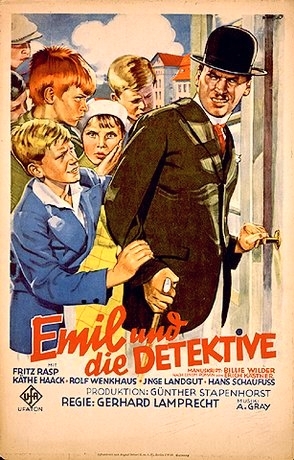
Though Erich Kästner’s 1929 novel has never been out of print, this first of many adaptations of Emil and the Detectives is chiefly remembered these days as a vehicle for Billy (here billed as Billie) Wilder. He’s the only writer listed on screen, though the IMDb includes Kästner himself as well as Emerich Pressburger as collaborators.
It’s a story about children being thrillingly set free to roam unimpeded in the world of adults, seen though the eyes of Emil, maybe 11 or so, who is packed off alone on a train to Berlin by his poor, struggling mother. She’s given him 140 Marks – maybe a month’s income – to give to his grandmother when he gets there. It is not to be. On the train Emil (Rolf Wenkhaus) meets a bowler-hatted creep, who offers him a drugged sweet, robs him of his money and then melts into the bustle of the city when the train arrives in Berlin.
But, coming around, Emil has just caught sight of the thief disappearing around a corner. Pulling himself together, Emil hares off after him, not sure what he’s going to do if he catches up with him. Enter the “detectives”, Berlin harum-scarums led by a cocky kid called Gustav (Hans Schaufuß), who puts his ragtag band at Emil’s service. Together they will attempt to win the day.
Think of Emil as wide-eyed Oliver Twist and Gustav as an Artful Dodger and that’s about the shape of the story, though there’s no sign of thievery from Kästner’s kids, who are plucky rather than Charles Dickens’s more feral street kids.
One of the interesting aspects of this in-many-ways boilerplate kiddie adventure is the picture it gives us of Weimar Berlin – orderly, clean, prosperous, with adverts for Pilsner Urquell on hoardings, fine cafes selling coffee and cake, all the busy coming and going of a European capital city. It’s the middle of the Great Depression. 1931 is the year Germany’s two largest banks founder. Industrial output is collapsing and unemployment rocketing. Not a sign of it here.

Another is that it’s a good example of the Neue Sachlichkeit (New Objectivity) movement, which was clear-eyed, unromantic, unsentimental, a reaction against what it saw as the excesses of expressionism, which had taken hold after the First World War. Italian neo-realism owes quite a debt to German movies like Emil and the Detectives.
With all that said about the Neue Sachlichkeit, the “drugging” scene is a special case and needs to be bracketed off. As Emil succumbs to the narcotic, director Gerhard Lamprecht gets busy with distorting lenses and expressionist angles like it’s the last chance he’s going to get.
Fritz Rasp is an excellent villain, as he so often was, scowling away like a man possessed as if this were still the silent era – much of the film is silent, in fact. The boys are well cast as lovable scamps, Inge Landgut makes a sweet Pony, Emil’s cousin, and Olga Engel twinkles as his grandmother.
Wilder didn’t know it in 1931 but within a couple of years he’d be exiting Germany at speed, heading for France en route to Hollywood, after Hitler’s rise to power. “It seemed the wise thing for a Jew to do,” he later drily commented.
Is Wilder’s precarious future foreshadowed here, in a story about an impish kid arriving in Berlin (as Wilder had from Austria) being mistreated by an authority figure? Probably not, though organising at street level against a criminal entity does seem to be very 1931 – that’s exactly how the child murderer in Fritz Lang’s M was caught.
All that darkness to one side, this is a jaunty, charming and lively adventure and a classic of juvenile self-sufficiency that’s obviously going to be highly attractive to kids. How the great mass of helicopter parents will view it is anyone’s guess.
Emil and the Detectives – Watch it/buy it at Amazon
I am an Amazon affiliate
© Steve Morrissey 2026