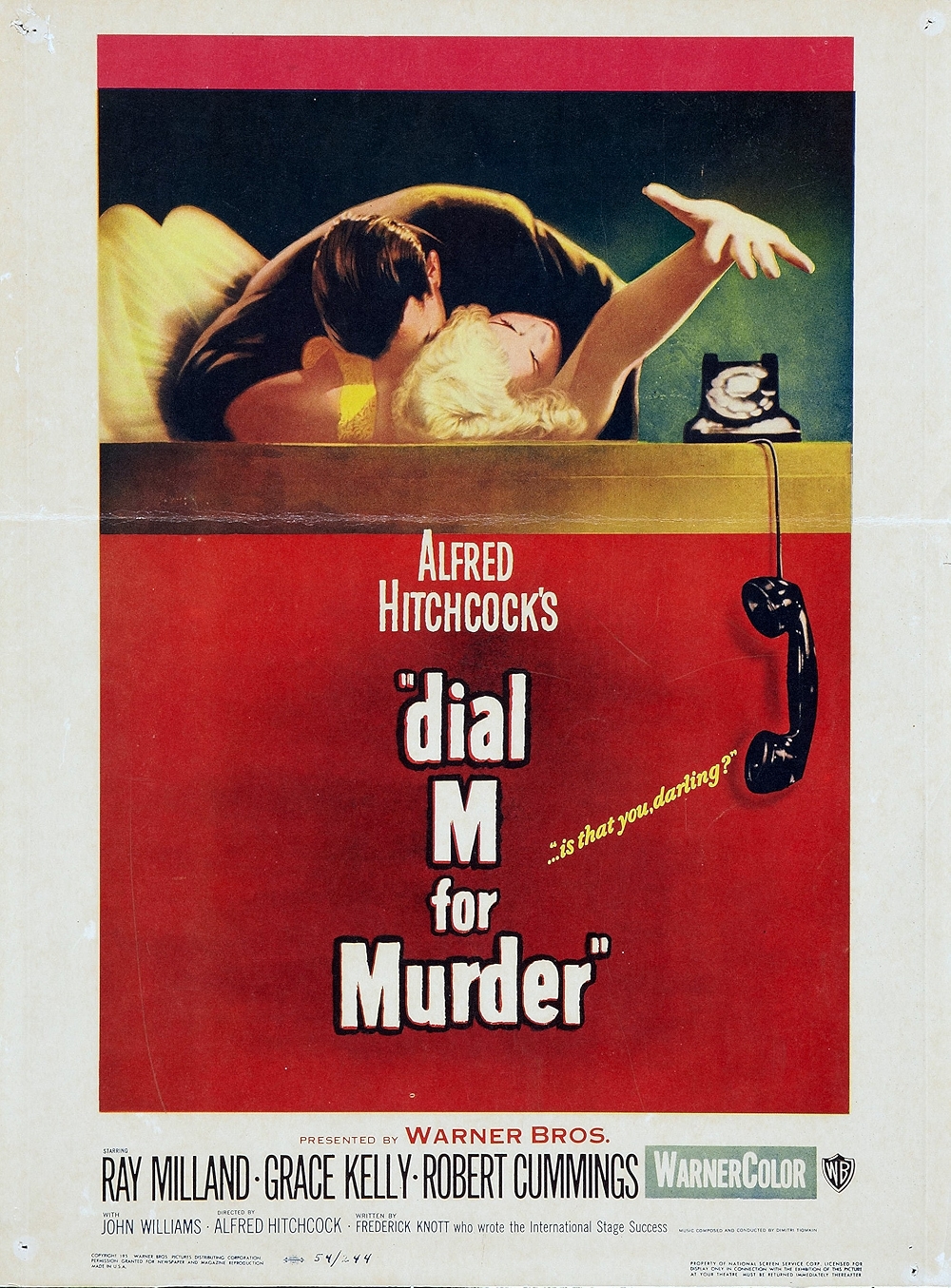
A fiendishly plotted, blackly comic thriller from Alfred Hitchcock, who was drawn to Frederick Knott’s play Dial M for Murder for obvious reasons – it’s right up his street. But also because an entire film could be shot on one set – a couple of external establishing shots to one side. This is something Hitchcock liked to do from time to time – Rope and Lifeboat being prime examples, though Rear Window also comes close to being a “chamber piece” or “bottle” movie.
Hitchcock enjoyed the challenge of the confined space but also relished the control that studios gave him – outdoors was unpredictable. Not insignificantly, he also liked to be done for the day and on the way home for his first martini by 6pm, which location shooting put in jeopardy. In this case also, there’s just a handful of actors to corral, and a fairly basic story about a husband who wants to be rid of his wife hiring someone he doesn’t know to do his dirty work – shades of Strangers on a Train. How does he know that the stranger will carry out the plan? Because husband Tony Wendice (Ray Milland) has dirt on potential killer Charles Swann (Anthony Dawson).
Wendice, an ex-tennis pro (again an echo of Strangers on a Train) might have been motivated to kill the lovely Margot (Grace Kelly) because he’s found out that she’s been seeing another man, Mark Halliday (Robert Cummings). But in fact Margot and Mark’s affair is over and Wendice knows it is. What’s really motivating him is his wife’s money, or his lack of access to it. Now that his days of earning on the pro circuit are over, Wendice wants to continue living in the style to which he’s become accustomed, without the indignity of having to ask his wife for handouts.
The only other real character is the cop who turns up after the plan goes murderously awry. John Williams plays Inspector Hubbard in much the way that Peter Falk would later play Columbo, as a dissembling, affable bumbler who always has one last question to pose just as he’s about to leave but knows exactly who his man is from the moment he arrives. Hubbard is God, in effect, or Fate at any rate.

The brilliance of the plot comes down to Frederick Knott’s way of turning Wendice’s alibi into the evidence against him. And the brilliance of the directing is most evident in two key scenes – the early one where the devious Wendice puts his plan to the initially outraged Swann, having lured him to his house under false pretences, and then walks him through it step by step. Hitchcock goes blasé god’s-eye-view here, an ironic masterstroke. And the much later, intensely watchful one – now down on earth – where Inspector Hubbard starts to unravel the case, in the process deliberately introducing a rogue element Wendice would rather remained out of the picture. Flush flush.
As a strange meta touch, Halliday, who happens to be a crime writer (more irony) also has a go at unravelling the plot, using nothing more than a crime writer’s surmise. A “here’s how I’d plot it”. He pretty much nails it, “hypothetical” though it all remains.
It’s superbly played. Both Kelly and Milland are meant to be British, which Kelly pulls off, but Milland (though born in the UK) does not. Saying “hendbeg” a couple of times is not enough. It doesn’t matter. Milland is always at his best playing dark characters and watching shifty Wendice being put to the sword is the movie’s chief delight. But how good they all are – Cummings perhaps less so than Dawson, entirely plausible as the guarded chancer who’s blagged his way through life and is now being asked to do something horrible in return. Grace Kelly plays the bad wife as a woman elevated to a kind of sanctity by her husband’s diabolical scheming. She’s a victim of the patriarchy too, or so it seems when her husband starts siding with Inspector Williams as he tries to crack the case.
What mortals put together, the gods take apart. Just deserts are served, all in one room, with five main actors delivering this parable in mockingly lush Technicolor hues. The BBC were the first to spot the potential of Knott’s story, and it aired on TV in 1952, before quickly going on to London’s West End before conquering Broadway (where Williams won a Tony for his portrayal of Inspector Hubbard). And from there on into many adaptations, mostly for TV (it’s cheap to put on!). Best known of the later iterations is A Perfect Murder, starring Gwyneth Paltrow, Michael Douglas and Viggo Mortensen – a case of Dial M for Middling!
Dial M for Murder – Watch it/buy it at Amazon
I am an Amazon affiliate
© Steve Morrissey 2026