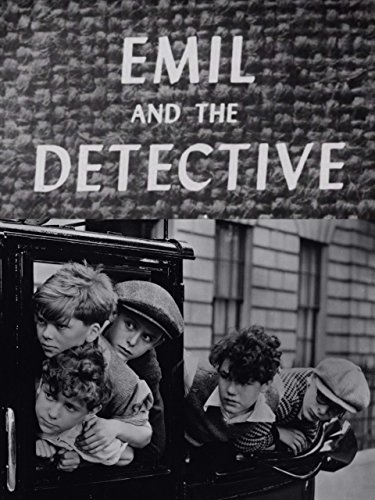
Where there’s a hit there’s a writ, as they say in the music biz. In other words, if you’re good someone will copy you. Emil and the Detectives was a huge success in Germany in 1931. In spite of the fact that this British version from 1935 is almost a shot-for-shot copy, no one sued.
The reason is that distributor Gaumont stumped up money for the rights from UFA, the German studio that made it. Nowadays, the film is seen less as an example of a typical business practice of the time, and more as a harbinger of the later success of its writer, Billy Wilder. By the time this remake came out, Wilder had fled Nazi Germany and directed his first film in France and was safe in Hollywood, working as a movie hack for hire.
Why everyone calls it Emil and the Detectives when the title on screen is clearly Emil and the Detective (singular), I don’t know. It must be a homage to Wilder, Gerhard Lamprecht, the film’s original director and Erich Kästner, who wrote a story so robust that it’s survived any number of adaptations (as I write, I see there is a 2026 one just out).
It is a classic children’s-adventure structure – child not only survives but thrives in the dangerous adult world, with teamwork winning the day – dressed up in a plot about Emil (John Williams) being sent alone to London (in this case) by his hard-working mother, with a wedge of money to give to his grandmother. En route, he is drugged and robbed by a sinister adult (George Hayes). Arriving in the capital without a bean, Emil is befriended by a street urchin and his gang of feral friends (the Detectives – plural) and together they skirmish about until boy and money have been reunited and the villain brought to book.
If you’ve seen the original (I watched it a couple of weeks ago), this English-language remake is remarkably faithful. Early scenes are set in Kent rather than the German countryside but it’s similarly bucolic – windmills, horses and carts, thatched roofs. When the action switches to London, it’s only really the landmarks and the language that are different. The children could almost have been cut and pasted across, and so could the 1930s attitudes.
Most obviously a direct read-across is the scene on the train to the big city, where Emil is drugged by The Man in the Bowler Hat and the film suddenly warps into an explosive montage of expressionist camera angles and special-effects trickery. As for the score, by Allan Gray, it’s the same one.

From a 21st-century perspective, even the thought of sticking a child on a train and packing him off to the big city is likely to bring on an attack of the vapours, as will scenes of Emil running around on busy streets with Gussy (Donald Pittman) and his gang. Emil is the Oliver Twist to Gussy’s Artful Dodger and the ragtag gang (with exotic names like The Professor, Tuesday and The Flying Stag) could all, with an update, have been lifted from the London of Fagin’s urchin pickpockets.
It’s the only role young John Williams ever played and, at around 14, he’s possibly just a shade too old for it. But the setting compensates, and the oddity of it all now – those cut-glass accents and a London where someone only has to blow a whistle and a copper magically appears – is charming if maybe a bit weird.
Thanks to Milton Rosmer’s jaunty direction it bounces along in a jolly way, and the kids are particularly good at playing it as if they weren’t carbon-copying the performances of their German counterparts.
At the end its moral is clear – not “don’t send your child alone to a big city” but “never accept sweets from strangers”. Though for all the jeopardy, it’s exactly the sort of light and bright kiddie adventure Disney would one day make their own – their remake came out in 1964.
If you want to compare and contrast, as I did, this British remake comes as an extra on the BFI physical copy of the German original, linked to below. Happy adventuring and remember, imitation is the sincerest form of flattery.
Emil and the Detectives (German and British versions) – Watch it/buy it at Amazon
I am an Amazon affiliate
© Steve Morrissey 2026