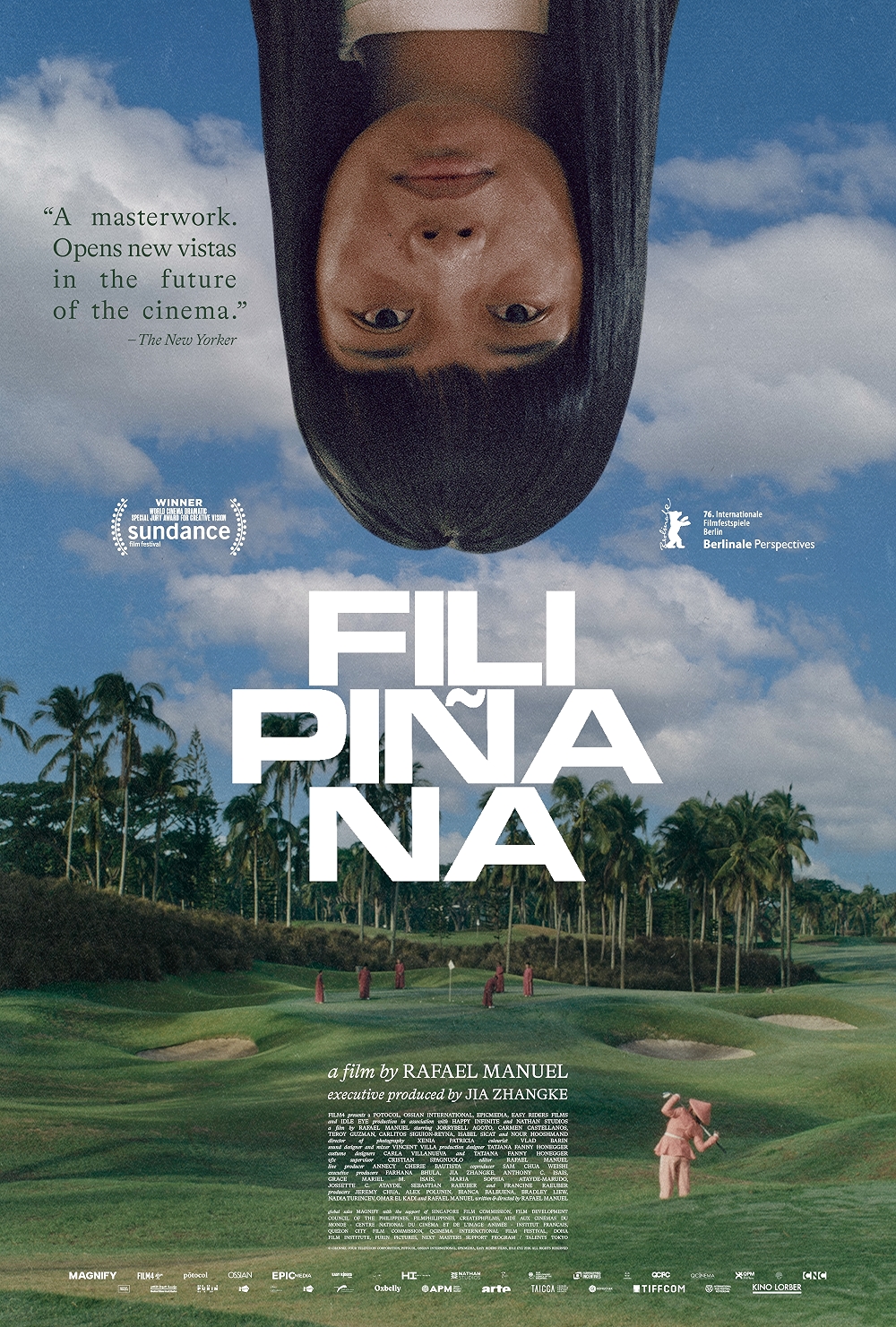
Golf as a state-of-the-nation metaphor? The Philippines as seen from the fairway? If Mike White and David Lynch played 18 holes together, something like Filipiñana might be the result – a pitch and putt of The White Lotus and Blue Velvet.
Debut feature director Rafael Manuel tees it all up coolly, though there are rumblings from early on. Phalanxes of pretty young women at a plush golf resort. The ones in pink are caddies, hefting about bags of golf clubs. The ones in blue are tee girls, bending to set up the next shot for appreciative male golfers. Out on the course, a wealthy man, Renato (Carlos Siguion-Reyna), takes his niece around for a few holes. Clara (Carmen Castellanos) is newly back from the USA and Renato hopes that over the game he can persuade her to stay in the Philippines and help him run his company, Golf Depot.
Isabel (Jorrybell Agoto), a new girl just in from the Ilocos region, has come to Manila to be a tee girl. It’s through her fresh eyes that we see this strange resort. She has heard rumours that club president Dr Palanca (Teroy Guzman) is sleeping with caddie Charlie (Elle Velasco) and can’t believe they’re true. Wide-eyed, she listens to the jokes more seasoned tee girls make about Charlie’s handling of Dr Palanca’s balls.
For Isabel, the golf club is an escape from the disadvantaged life she knew back home. For Clara, manoeuvring constantly so as not to be pinned down, it is a potential hazard – she wants to be back in the States, it seems, but Renato doesn’t want her to go. Charlie, meanwhile, is stuck in the bunker Clara is trying to avoid and Isabel doesn’t yet fully know exists.

In scenes that might have been lifted from The White Lotus, Chinese tourists arrive and are given an elaborate welcome by dancing hotel workers and a small guitar orchestra. More generally, pools are cleaned, floors are swept, chairs are stacked and unstacked. Here are snapshots of the daily routine set to a rhythm. It’s almost as if Manuel’s film were a musical, while his performers give almost affectless performances, as if they were automata going through rehearsed moves rather than people with a story to tell.
This golf resort appears to be the ultimate articulation of the expression: a place for everything and everything (and everyone) in its place. This tension between task and emotion gives the film its uncanny power. Will Charlie get sick of sleeping with the boss? Will Clara break for the border? Will Isabel learn in time what’s coming her way? “Most of the golfers,” Charlie warns her when the two unexpectedly wander into each other’s orbits, “are… (very significant pause) not so nice.”
There is a world of exploitation going on here. The vectors are whatever happens to be closest to hand – gender, region, country, geopolitics, wealth, status, skin colour, attractiveness, age – with Isabel and people like her most often at the wrong end of the power dynamic.
This is Manuel’s vision of the Philippines, and on top of everything a brain drain means tourism looms too large in the country’s economy – hence the golf resorts. Manuel’s sleight of hand makes all the political detail incidental. Instead he suggests that everything is heading towards some cool but brutal revenge finale. At one point Isabel hears Dr Palanca saying he has land back in Ilocos, which he can now develop thanks to various “agrarian reforms”. The look on Isabel’s face suggests she’s here on this golf course because of those “reforms”. Chased out of her family home, maybe?
In among all this subterranean flexing Manuel scatters dislocating surreal moments, like the blind musicians suddenly wandering around lost on the golf course, each with a hand on the shoulder of the person in front. It’s all very Lynchian and strange. The trees on the golf course, we learn very late on, are all dying of drought. What, in this super-luxe world of dead calm, can it all mean?
Filipiñana – Watch it/buy it at Amazon
I am an Amazon affiliate
© Steve Morrissey 2026