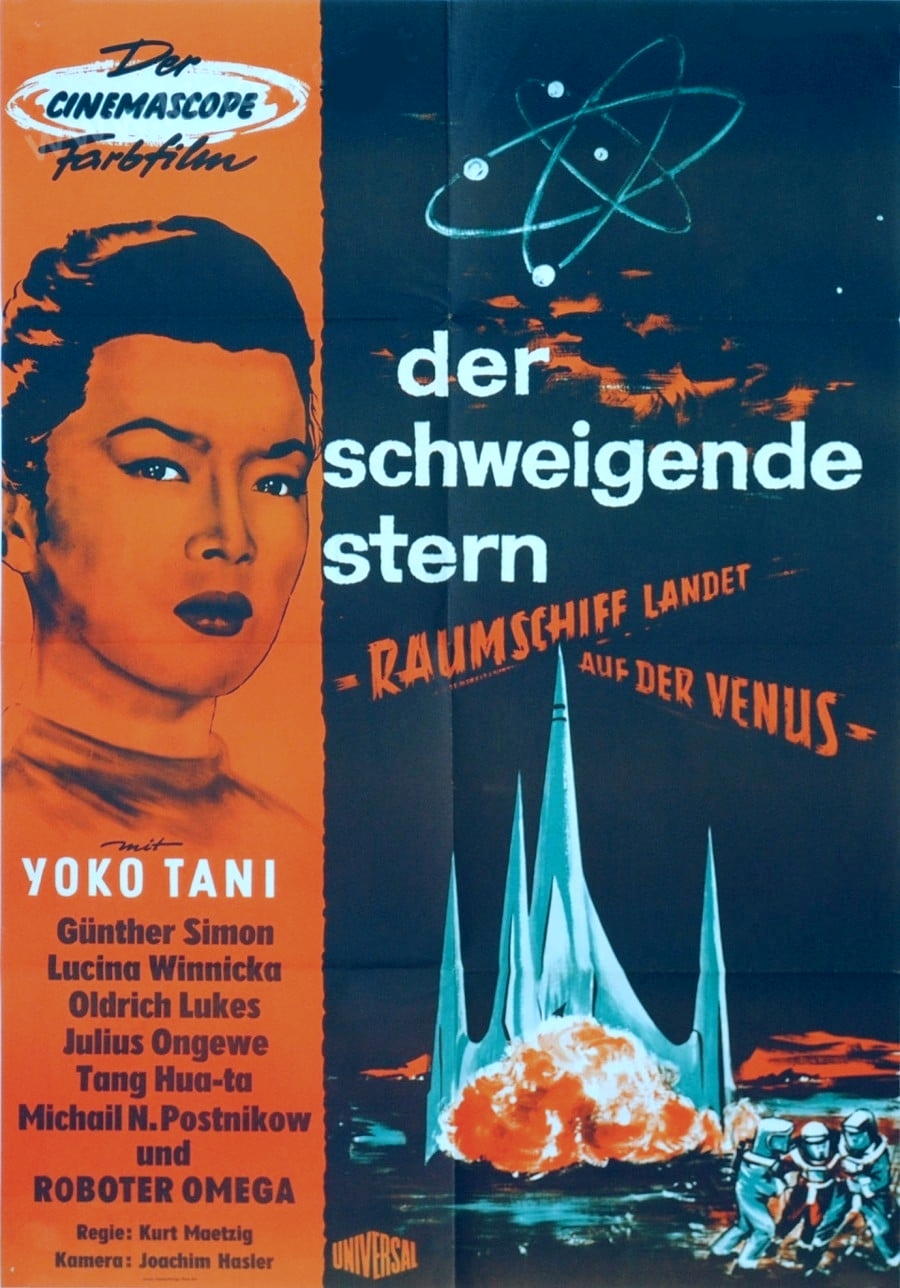
If the Space Race was all about doing things first, how about The Silent Star, an Eastern Bloc sci-fi movie boldly going where Star Trek believed it was the first to go six years later.
The final frontier, it turned out, was a multi-ethnic crew. On Star Trek it was Uhura and Mr Chekov, Sulu and Scotty alongside Captain Kirk and co. Here, the East Germans blast off for Venus with a US scientist, German pilot, an African comms guy, Japanese medical officer and Polish engineer in the ship’s company, on a mission to find out where a strange communication found in the Gobi Desert originally came from.
It’s a first in a couple of other senses too – first sci-fi movie out of East Germany (it’s a German Democratic Republic/Poland co-production), first adaptation of a Stanislav Lem novel (he of Solaris fame). It also goes by the name First Spaceship on Venus, so there’s another First for the list.
What the crew find on Venus is typically Lem, that is to say far from straightforward and quite cautionary – a civilisation that looks like it was planning an attack on planet Earth only to have somehow destroyed itself in a nuclear catastrophe.
En route, quite a bit of detail of life on board ship – from liquid food to navigation (done by the computer), to passing the time playing chess against a computer who’s the forebear of R2-D2.
There is jeopardy – on the spaceship (a meteorite storm) and on Venus itself (sentient sludge?) and some interesting sci-fi ideas, like the bit where Venus’s gravitational pull is reversed, threatening to hurl the recently landed spaceship from the planet’s surface.
The political messaging can be a bit heavy-handed, but it’s interesting to see “we come in peace” rhetoric from the other side of the Iron Curtain, delivered in much the same earnest way that William Shatner would do it week by week from 1966 onwards.
It’s a fascinating film, which is another way of saying it’s not that great, but the good stuff really is good. So let’s talk about the bad stuff first. It is needlessly wordy, the dubbing is criminally bad and some of the acting leaves a lot to be desired – Julius Ongewe, who plays comms guy Talua, at first looks genuinely mystified as to why he’s there (he had been a medical student in Leipzig before the call came). Later he looks genuinely delighted to be there. At no time does he make a plausible comms guy, touching though his performance is.
But then they’re quite a wooden bunch on the whole, Yôko Tani excepted, who plays the ship’s doctor as a woman grieving both the death of her husband and the nuclear obliteration of Hiroshima. Sumiko has a back story, which does go some way to compensate for the amount of skivvying she does – for much of the time this medical officer appears to be little more than a waitress.

The film’s big sell is its production design, which is fabulous. Creative, imaginative, making much of a budget that’s clearly on the generous side. Venus is one minute a planet of mosaic-encrusted termite mounds, the next a soup of flashing colours and billowing smoke.
The sound design is good too. Ghostly, uncanny electronically generated noises suggesting the spirits of the dead Venusians are still in the ether. The soundtrack full of woo-woos, bleeps and swooping glissandos is properly futuristic too, music in the modernist style.
And the special effects work well too. No one is going to be particularly wowed by the rocket ship – a silver three-legged stool surrounding a central capsule – but it’s an unusual and even beautiful design that rings the changes on the usual gigantic phallus designed to penetrate space.
Star Trek liked to end with a homily and the messaging in The Silent Star is similar. It could not be clearer. Don’t mess with nukes – look what they did to the Venusians.
I did not watch this on the upcoming Eureka release, Strange New Worlds: Science Fiction at DEFA, which boxsets The Silent Star together with three other sci-fi movies from the German Democratic Republic. It’s bound to be good though – a 2K scan of the original camera negative, which should make the rich colours ping even more than they did on my ancient version, at least if the trailer on YouTube is anything to go by. That’s clearly the way to go, if you’re interested. Eolomea, In the Dust of the Stars and Signals: A Space Adventure are the other three.
The Silent Star – Watch it/buy it at Amazon
I am an Amazon affiliate
© Steve Morrissey 2026