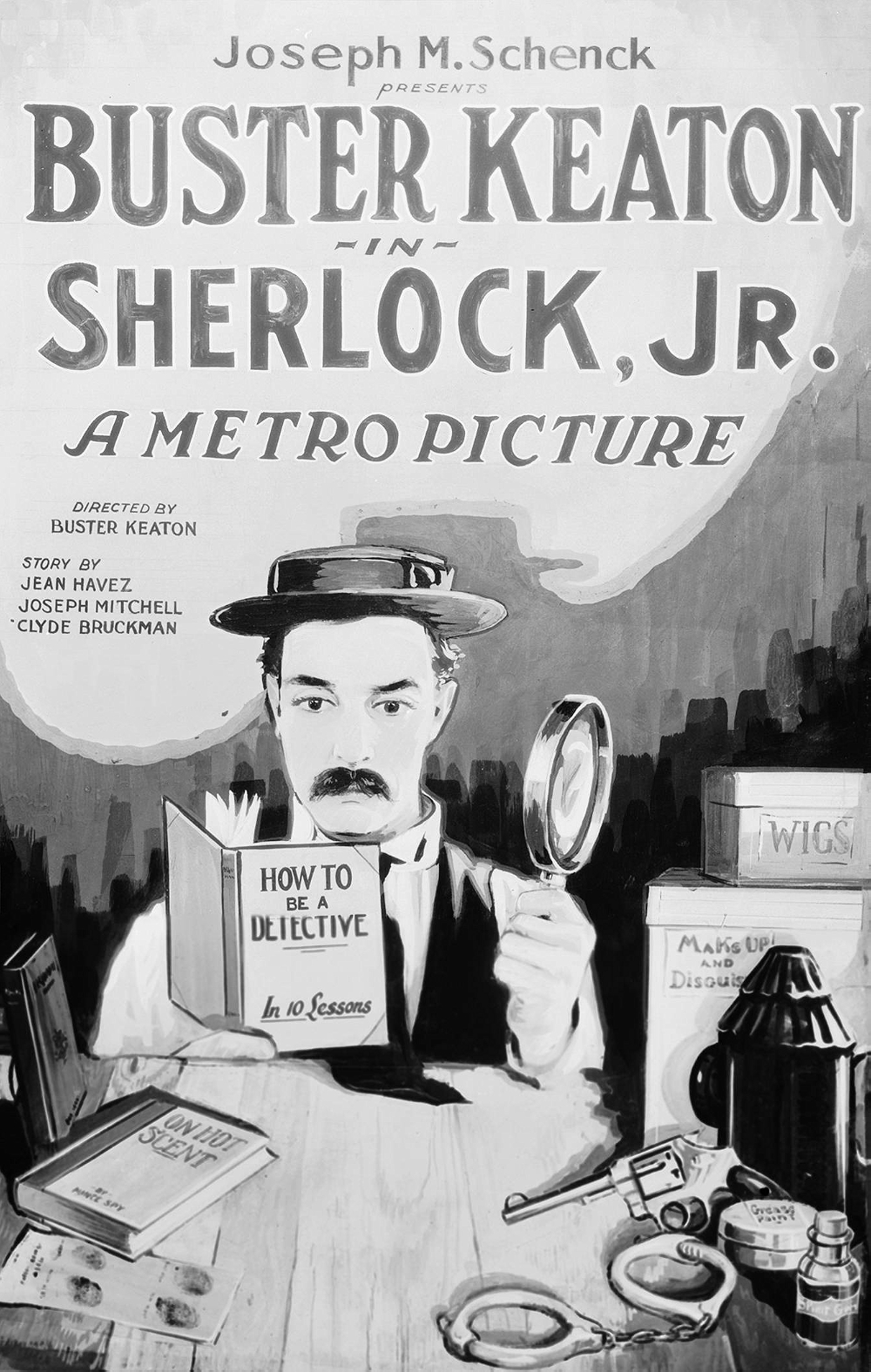
Buster Keaton’s masterpiece Sherlock Jr. wasn’t that successful when it debuted in 1924. Audiences didn’t laugh that much. Critics also didn’t think it was that hilarious – “far and away about the most laughter lacking picture that “Dead Pan” Buster has turned out in a long, long while,” said Variety. Even Buster Keaton seemed rueful about it when later interviewed – “alright but not one of the big ones”.
There is something in those verdicts. It isn’t a massively funny film but there is so much conceptual and theoretical brilliance on display here that it doesn’t matter. Variety’s review also reckoned Sherlock Jr. wasn’t a patch on Harold Lloyd. But Keaton here is doing a couple of things Lloyd never did: inventing the concept of the meta-cinematic joke, by turning the camera on the screen itself; and then going one further by turning it back on the watching audience – decades before Psycho or Peeping Tom, Keaton engages with the idea that there’s something pathological about looking.
“Don’t try to do two things at once,” an opening intertitle preaches, then does precisely that with a story about a projectionist (Keaton) with a yearning to be a private detective, who gets accused of theft by the father of the girl he is sweet on. Back at work and downcast because his relationship has ended before it really got started, the projectionist falls during a film, then dreams that he’s entered the movie, in the process morphing into a Sherlock Holmes-style super-sleuth solving the theft of some pearls – a situation that’s almost the mirror of his own out in the real world.
A character climbing up onto the stage and entering the film, that’s the central idea Keaton wanted to work with. It had never been done before (Woody Allen would most obviously rip it off for The Purple Rose of Cairo). Keaton could have done it sloppily and the novelty of the concept would have provoked gasps. But Keaton and his cameraman seem to be future-proofing this movie, constructing the initial arrival of the interloper in the film within a film with such precision that the sequence stands up a century later.
Right after the projectionist (never named) enters the movie, the image cuts and cuts again, propelling the interloper from one movie scenario to another. As edit gives way to edit, the new arrival is in the jungle with lions, then on a railroad track, then on a rock in the sea, in the snowy wastes, on a precipice etc. He’s the only continuous presence and as the scene suddenly changes he’s to the millimetre exactly where he should be – a precision enabled by the use of surveyor’s instruments.
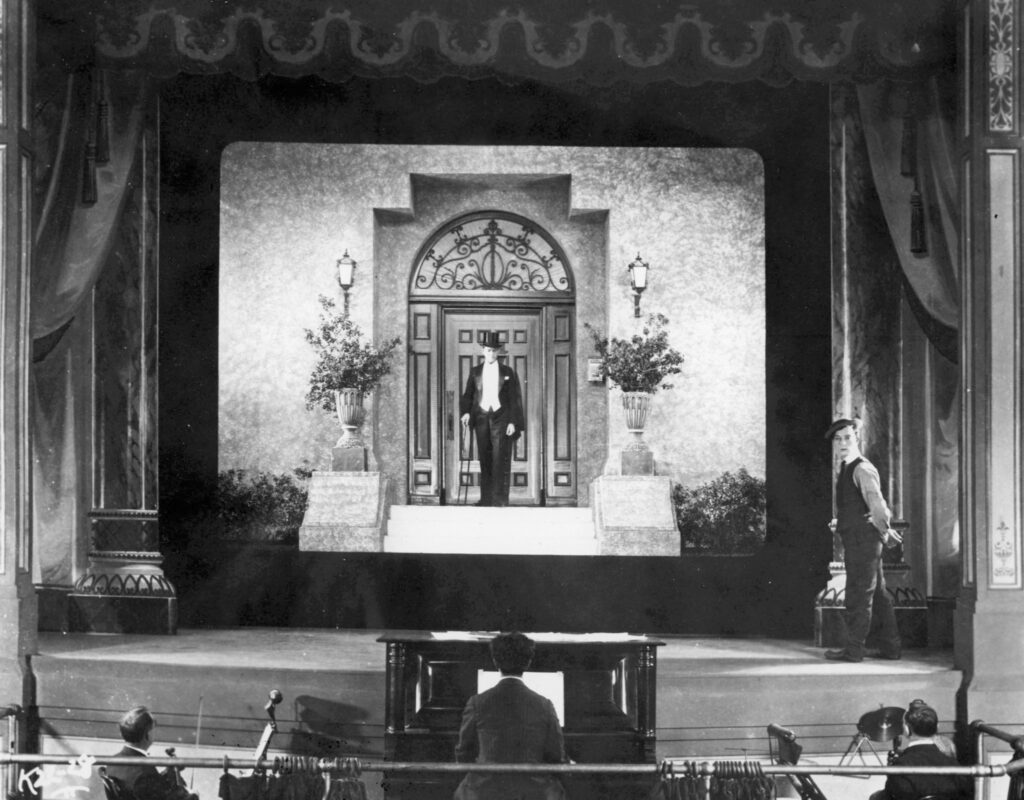
Cinema as a dream world where real-world problems are fixed, it’s Hollywood’s big sell to its audiences re-internalised as a plot. In case the conceptual stuff isn’t enough, Keaton backs it up (doing two things again) with old-school sight gags, like the early one involving a railroad water spout, which broke his neck (he discovered in the mid-1930s), then the famous one of the fleeing Sherlock jumping through a woman’s body. But there are many more – the game of pool with the number 13 ball (of course) swapped out for a bomb, the car chase in which the car becomes an impromptu boat (later repurposed in Live and Let Die). There’s even a banana-skin gag early on for the real traditionalists – amid all this technical innovation Keaton is possibly having a laugh at the expense of his audience here.
The second half of the film is mostly chase, and it’s possibly the familiarity of this as a trope that got the film the thumbs down. But it’s a chase done well, and in any case Keaton by this point has nothing to prove.
That’s Keaton’s own father as the disapproving dad both in the “real world” and its screen counterpart, and Kathryn McGuire, only five feet tall, is a good match for Keaton in stature and a romantic foil worth getting romantic about.
The restoration by the Cohen Film Collection contains an apology upfront – some second and third generation material had to be used – but in fact the picture quality is really good. There’s not much to see on Keaton’s “stoneface” – there never is – but you can see all the stunts. And in Sherlock Jr. that’s all that matters. This film is genius, 45 minutes of invention on stilts.
I am an Amazon affiliate
© Steve Morrissey 2024