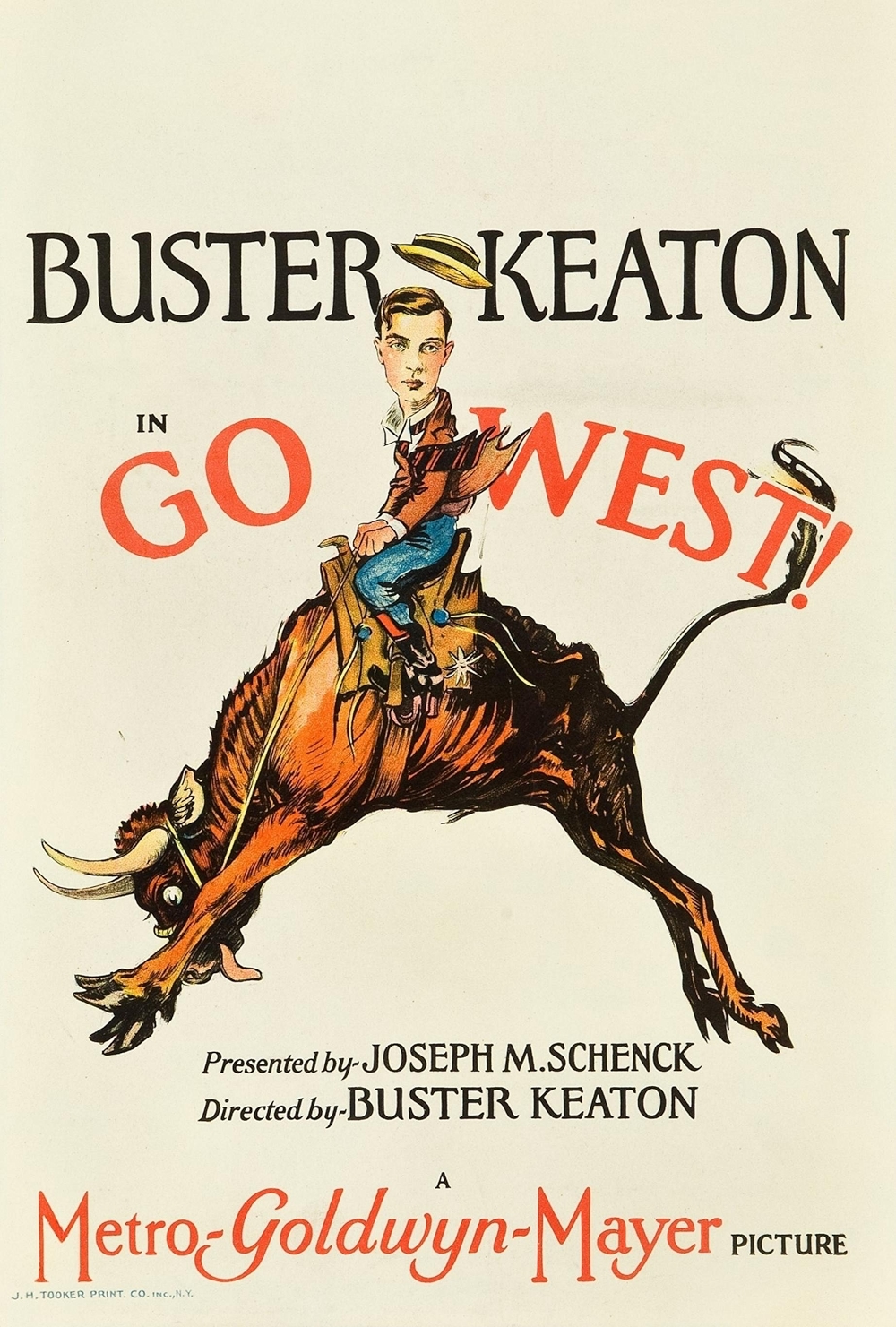
Because Go West came out in in the middle of Buster Keaton’s hot run, it’s often bracketed with the rest of them – The Three Ages, Our Hospitality, Sherlock Jr, The Navigator and The General.
But Go West isn’t conceptually brilliant, like Sherlock Jr is. Nor is the 1925 feature a compendium of brilliant sight gags, like The General. Instead, Keaton settles for making relentless fun of his character, billed only as Friendless, in a story following a hungry and penniless man initially to New York City.
New York turns out to be a bad idea – Friendless is literally crushed underfoot by the teeming crowds – and so he decides to heed the advice of writer and editor Horace Greeley to “Go West, young man” and ride the rails to California, en route becoming a cowboy, which suits him about as well as life as a city slicker.
It’s here, out on the wide open plains, that Friendless meets the film’s other significant character, Brown Eyes the Cow. She and Friendless form the sort of bond that he doesn’t not seem to be able to form with a human. Friendless has a friend.
And while Keaton sets everything up for his big finish – Friendless takes a vast herd of cattle into Los Angeles – there are many scenes of mawkish and repetitive gaggery, though Keaton’s weeks spent training his bovine co-star do extract an astonishing performance from her.
The big, final set piece is much more what we expect from Keaton. It’s complex, brilliantly choreographed, technically remarkable and unlike anything else anyone else was doing at the time.

But for the most part small-dick energy fuels this film, signified by the tiny gun Friendless regularly brandishes. It’s so small that it keeps getting lost in its holster. However, there are limits as to how often any one person can cackle at a man’s tiny gun, and that goes for the whole film, which asks us to laugh at a loser having a relentlessly bad time.
Inadequacy in the mighty is funny. In the downtrodden it’s tragic. In Keaton’s best films his Stoneface character triumphs in spite of his shortcomings, using ingenuity – often accidental – as a secret weapon. Even though the butt of the joke is the same man who wrote the gag, Keaton’s usual sympathy for the underdog and lightness of touch seem to have deserted him this time around, or maybe he’s just trying something new.
The sight gags are good all the same – falling off a horse while still in the saddle, getting a foot stuck in a hole while a bull is charging him, attempting to lasso a steer and making a hash of it several times, in several ways.
It is worth hanging on for the finale, which not only shows us Keaton at his best but also gives us a glimpse of LA in the 1920s. There are black people just going about their business, unusual for a film of the time, and there’s a chance to see Joe Keaton, Buster’s dad, in a barber shop scene. He’s the guy covered in shaving soap who climbs onto a hat stand when the shop is invaded by cattle – you can see where Buster got his acrobatic skills.
There are various iterations of this film. I watched the Kino Lorber one, which is sharp, flicker-free and certainly good enough to watch, with original scratches and blips left in to suggest original authenticity. DVD Beaver (a reliable guide when it comes to picture quality) have good things to say about the Eureka version, but are most enthusiastic about the MK2 one. If I were going for Keaton completism, that’s probably the way I’d go.
Go West (in a double bill with Battling Butler) – Watch it/buy it at Amazon
I am an Amazon affiliate
© Steve Morrissey 2025