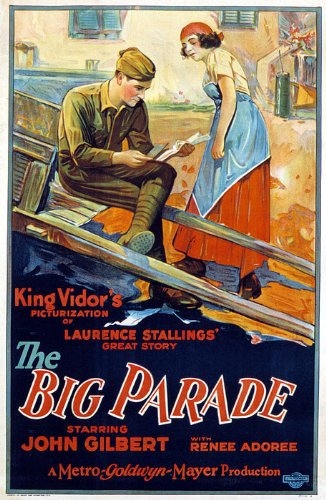
King Vidor’s first name really was King. It suited him. The master of the big Hollywood movie, here he is in 1925 with The Big Parade, laying down the template for all the war movies of the future.
The Big Parade is the highest-grossing silent film of all time so it would be nice if we still had the original version. But it’s been lost. Instead there’s the 1930 re-issue – same movie but with sound effects and a score added. It’s the basis of the restoration done in the 1980s, which replaced the original score with one by Carl Davis.
How good the film looks. It’s fabulously sharp, in fact, apart from the odd blurry flutter here and there, and the tones are rich across the range, tinted yellow and blue in many scenes.
Rex Ingram’s The Four Horsemen of the Apocalypse of four years earlier could claim to have written the masterplan for the Hollywood war epic. But Vidor rewrites and improves it. To modern eyes Rudolf Valentino and his Four Horsemen co-stars have a museum-like quality. Not so the characters in The Big Parade, who speak to us almost as if from the here and now (exaggerating slightly to make a point, but not much). Vidor is by far the more modern film-maker – less static visually, more emotionally complex thematically.
The story he tells isn’t a long way from the one told in the Four Horsemen – an idle youth is annealed by the experience of war. John Gilbert plays James, a footloose rich American with no intention of signing up for action when war is declared. But he somehow gets caught by a wave of patriotic fervour and, not fully realising what he’s doing, enlists for duty.
Vidor wastes no time in these early scenes, but he does gives us chapter and verse on James’s background – the rich dilettante with a flighty fiancée (Claire Adams), a proud and vain father (Hobart Bosworth) with no idea what war is about and a loving mother (Claire McDowell) distraught when she learns what her son has done. All sketched in swift broad strokes.
In very short order James is in France, having made friends with two guys from very different social backgrounds. Bull (Tom O’Brien) the bluff New York toughie and Slim (Karl Dane) the tobacco-chewing hick. Together the three of them will roister, banter and compete for the favour of Melisande (Renée Adorée), a pretty French maid at the farm where they are billeted. Eventually the three will go into battle together.
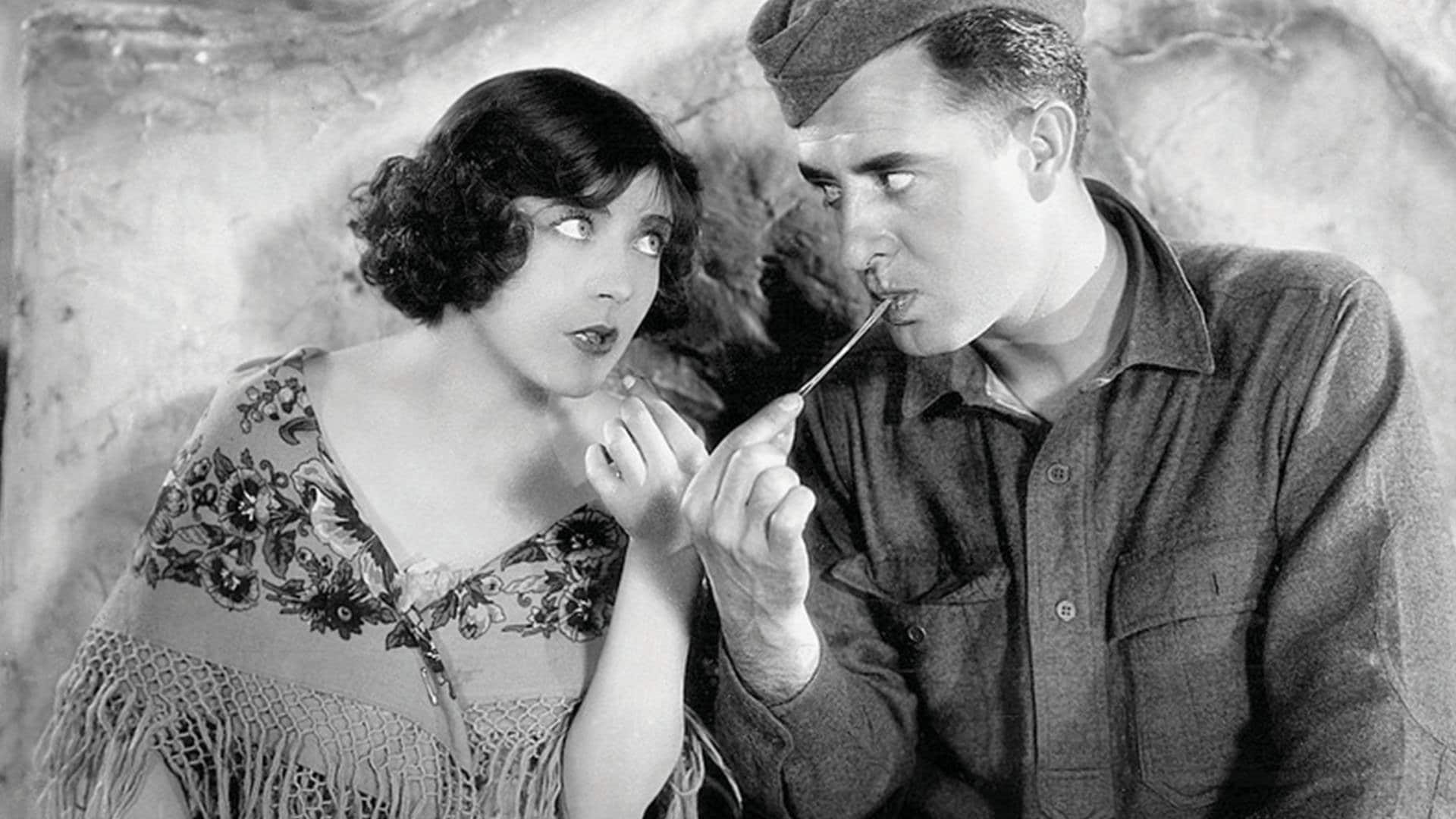
Excluding the US-set prologue, which is only a few minutes of running time, the 151 minutes break right down the centre. The first half is all light-hearted tomfoolery as the guys, in what would become classic style, get to know each other before James gradually wins through as the soldier Melisande likes the most, a piece of chewing gum helping him close the deal.
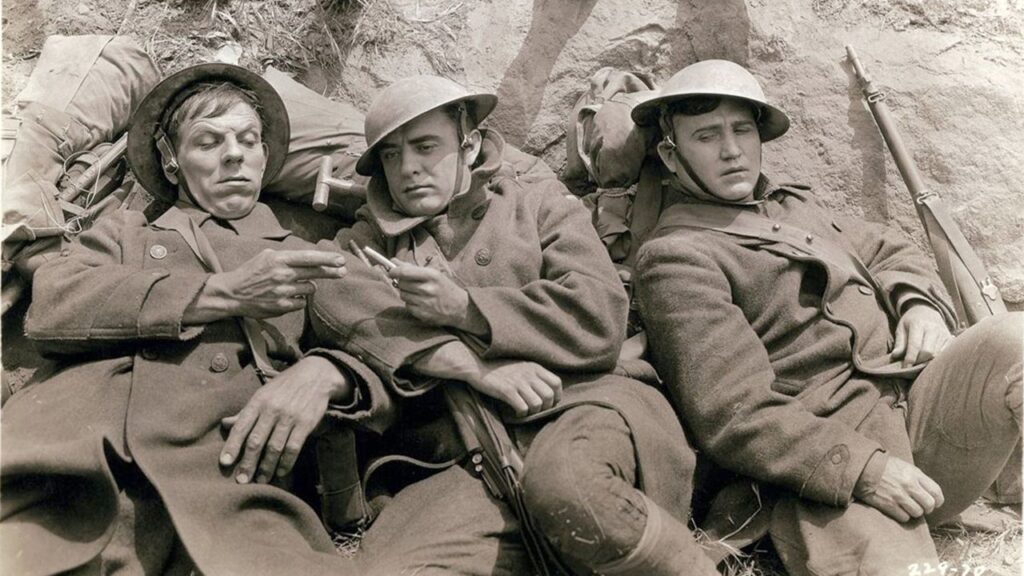
This first half is good – entertaining, interesting and charming. It’s in the second half where Vidor really earns his spurs, as the men advance towards the front and the war movie takes over. In spite of the slightly picturesque quality of DP John Arnold’s lighting and framing, Vidor is seeking realism – men dying left, right and centre, war as carnage.
The fighting men look much more like familiar American soldiers than the slightly stiff characters often seen in First World War movies. These guys eat corned beef, which they cut in chunks with a knife. They share cigarettes. Up eyeball to eyeball with the enemy – blameless young men like themselves – they aren’t quite sure what to do.
Vidor is particularly good at directing large groups of people (which is handy) and has an eye for the spectacle. A standout is of lines of trucks, with planes overhead, disappearing over the horizon and impressing on us the huge scale of the undertaking. The night-time battle scenes are remarkable technically and artistically.
There is psychological complexity here. Men kill for a variety of reasons – patriotic duty, bloodlust, camaraderie, training. And bravery is presented as sometimes foolish, sometimes noble. Interestingly, for a film made only seven years after the Armistice, Vidor presents war as glorious to an extent. Because heroism – however sparked into life – is glorious.
In its best stretches – the war stuff – Vidor ascends to glory. Gilbert’s loose, plausible and unmannered James keeps us anchored in the moment with this frail human being in the killing fields. Carl Davis’s new score, meanwhile, with its monotonous hammer of a bass drum in the big battle sceens, persuades us of the monstrous awfulness of what’s going on. It’s of a piece with the elemental, repetitive words on the intertitle cards, which almost have the evocative quality of Cormac McCarthy. “Dusk – – Silence… Mud… the whine of a shell… Mud… Silence…”
An enduring classic, I can’t recommend this movie highly enough.
The Big Parade – Watch it/buy it at Amazon
I am an Amazon affiliate
© Steve Morrissey 2025