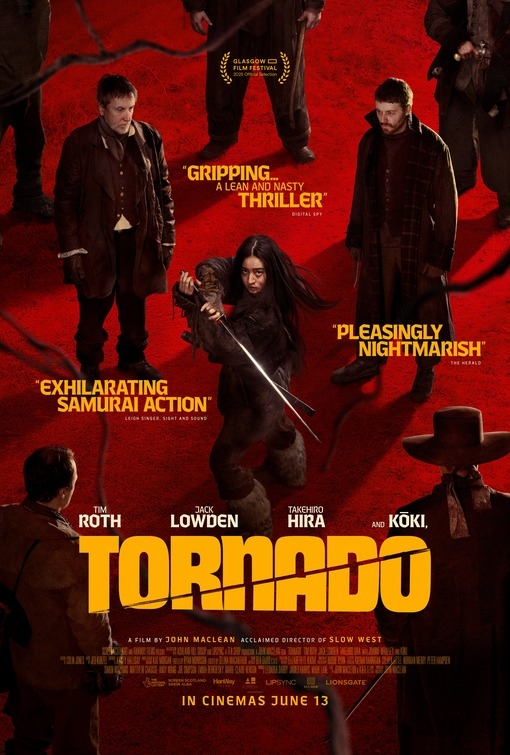
Samurai swords in Scotland in the 1700s. Like his debut, Slow West, John Maclean’s follow-up Tornado is a grand chase movie held together by not much at all. In this case a simple plot about a young Japanese woman on the run from some vagabonds who want their gold back. Simple stuff. Akira Kurosawa is in here, so is Sergio Leone. It’s very elemental. Archetypal, you could say, an arthouse western in an unlikely setting.
What the men chasing Tornado (Kōki) don’t fully understand is how skilled this slip of a girl is when it comes to wielding a honed blade, but they will, when they back her into a corner in the film’s final moments.
Until then, a lot of sumo-style powerplays. A lot of watching and waiting, guile and stealth, from fugitive thief Tornado (and director/writer Maclean) as we learn about this member of a troupe of travelling puppeteers who lucks into the gold belonging to Sugarman (though he stole it from a church) and hares off with it, with the bad guys in pursuit across the bleak Scottish moors.
Were there really Japanese people in Scotland in the 1700s? Would one of Sugarman’s gang really be a black man (Dennis Okwera, dressed in black to add a Lee Van Cleef vibe)? Maclean is clearly in “take it or leave it” mood here. It doesn’t matter, he appears to be shrugging, it’s all fictional, made-up stuff. I’m telling a story.
These characters are almost, in any case, placeholders for real human beings, types rather than personalities. The stern father (Takehiro Hira) of Tornado who runs the puppet theatre and speaks only in Japanese, to his daughter’s English. A character called only The Boy (Nathan Malone) whose light fingers first lift the gold. The frightening Sugarman, played by Tim Roth as a man who kills only out of necessity (as he sees it, but he does see it as necessary more than most). His gang, all with nicknames – Squid Lips, Lazy Legs, Kitten. And Sugarman’s son, Little Sugar, played by Jack Lowden as an Oedipal figure out to deprive his father of his gold, his status and his life, if necessary.

Elemental struggles by puppet characters, appropriately. Think of the characters at the start of Once Upon a Time in the West, moving stiff-legged around each other like stylised kabuki figures. Maclean clearly wants us to make the Sergio Leone connection, in the same way that Leone connects back to Kurosawa through A Fistful of Dollars, a reworking of Yojimbo. Jed Kurzel’s score hums with unusual, Ennio Morricone-style instrumentation and is full of rousing crescendos, particularly towards the end when Tornado makes her final play for her sackfuls of dollars (guineas, most likely).
Cinematographer Robbie Ryan, meanwhile, shooting on film, can’t give us expanses of sun-drenched desert but he does give us widescreen Scottish moorland, using warm colours to indicate potential refuges in the bleak, sunless and hostile Caledonian climate. Plus pore-examining close-ups for contrast – see also Leone.
The message is elemental. The love of money is the root of all evil. Or if not evil, then bad stuff. And when it happens it is as if it was ordained from on high. Everyone connected with the pursuit of the gold loses something. Most of them their lives. Those samurai swords can (and do) take an arm off with one swipe.
In many respects it’s Slow West all over again – different setting, yes, but the endangered-youth dynamic is there, the simple chase structure and the sense of everything building towards an implacable inevitability. The beautiful images. The haunting score. Kōki holds it all together with a minimalist performance to match the stark setting and simple dynamic. Behold the samurai-western heroine.
Tornado – Watch it/buy it at Amazon
I am an Amazon affiliate
© Steve Morrissey 2025