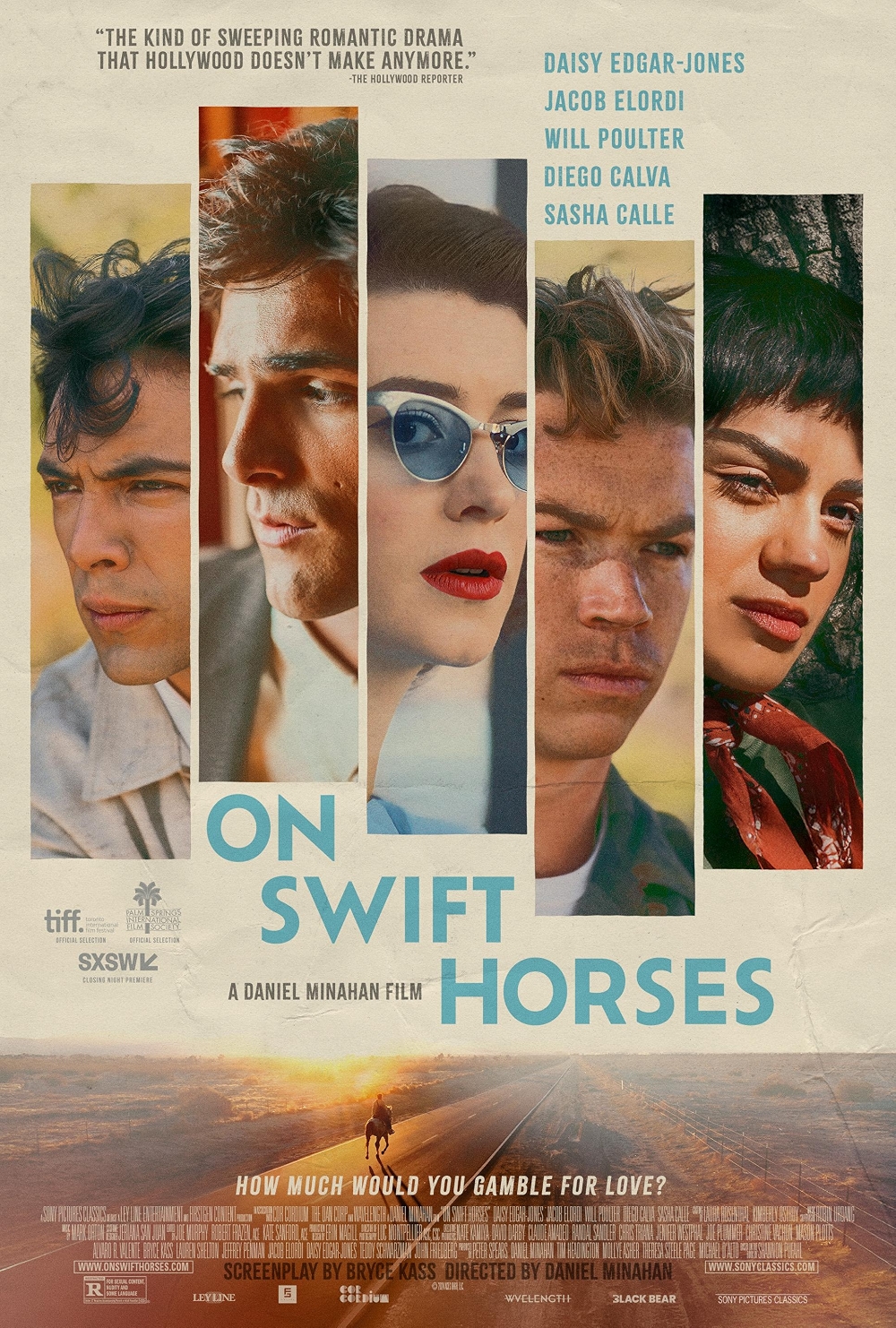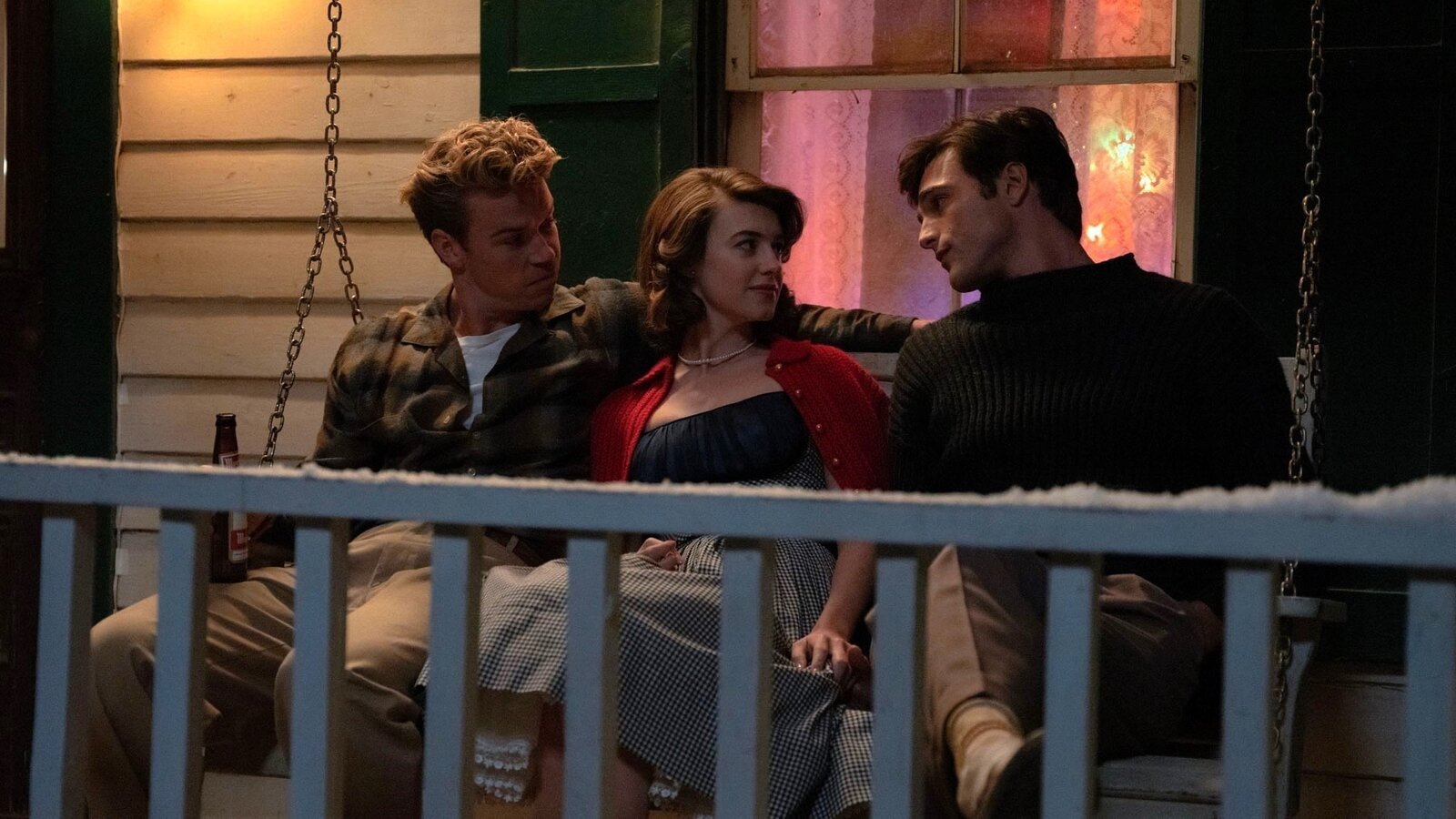
On Swift Horses is giddy 1950s melodrama for the 21st century, with Will Poulter and Jacob Elordi as brothers charting separate courses through the great American post-War boom. Daisy Edgar-Jones plays the prize for one of them, or she would be if she weren’t also on a journey of her own, towards a sense of self-actualisation.
The dynamic is good boy/bad boy, Poulter drawing the short straw as Lee, the hard-working, conformist brother married to wife Muriel (Edgar-Jones), while Elordi has the fun as Julius, the sexy gambler on the road less travelled. In the film’s opening moments Julius arrives back from the Korean War at the homestead of Lee and Muriel and the whole thing almost instantly kicks off, when Muriel cops an eyeful of Julius sunbathing in the snow with his top off. Oooh, I want some of that, her face signals.
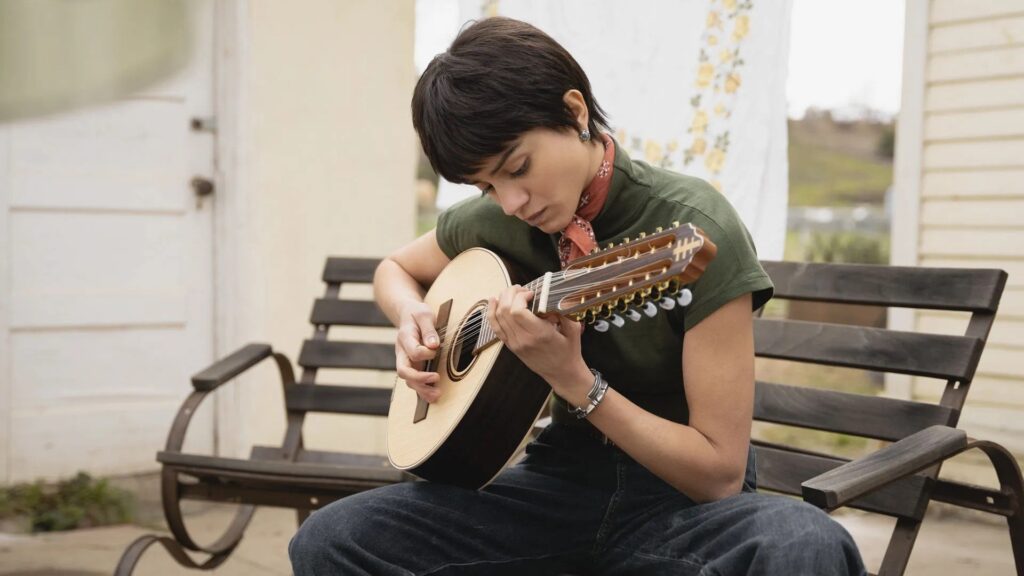
Will she get any? The film keeps us on tenterhooks, contriving to hold Muriel and Julius separate from each other for most of its running time, though something massive is clearly waiting somewhere in the wings. Lee and Muriel leave Kansas (obvious reference to innocence in here) and head for San Diego, where he wants to buy a frame house off plan and do the suburban 1950s thing. She, meanwhile, learns to bet on horses (secretly) at the track and to follow her inclinations with two young lesbian women, local Hispanic Sandra (Sasha Calle) and clearly out Gail (Kat Cunning).
Back east, Julius almost has a movie of his own going on. He’s cheating at card games and getting beaten up for it, until he decides to get a job as “surveillance” in a casino, watching eagle-eyed through a two-way mirror eagle-eyed as customers play the tables below. Here Julius meets Henry (Diego Calva) and embarks on a torrid homosexual relationship with a Hispanic of his own.
The idea: Julius and Muriel are the same. Unorthodox sexually and in their attitude to risk, they don’t run with the pack in the very conventional (or so it says here) 1950s. These two, they should be together, no?
It’s melodrama, pretty pure but not quite so simple, and in its emotional arcs and sense of repressed longing it harks back to 1953’s From Here to Eternity, when Deborah Kerr eventually got her roll in the surf with Burt Lancaster – “I never knew it could be like this,” she panted at him back then, causing cinema seats the world over to become damp as well. But who’s going to romp in the waves in On Swift Horses? Will it be Muriel and Julius? Muriel and Gail, Muriel and Sandra, Julius and Henry, or even Muriel and good old Lee?
Director Daniel Minahan makes it almost explicit, giving us an ironic semi-reference to From Here to Eternity at one point. This is the same Daniel Minahan whose debut movie, 2001’s Series 7: The Contenders, set in the world of reality TV shows, was a satirical takedown of the genre.
At first glance he’s playing it more down the line this time. Though he’s opted not to shoot it as if it were a 1950s movie, Minahan does make one interesting stylistic choice. His film is the familiar good-looking, nicely lit movie where everything looks brand new. The chrome on the cars is not pitted, everything looks freshly painted. Diners are spick and span. Jacob Elordi’s tightie-whities gleam. Daisy Edgar-Jones’s tailored outfits fit her just so. It feels entirely phoney, bogus and fake from front to back. Is Minahan, who caught reality TV with its pants down in 2001, being TV-movie lazy or is he up to his old tricks again?
If so this is a simulacrum of something that was a simulacrum first time around. The ironic approach favours the film’s themes more. Is it worth being honest in relationships? Is it even possible? And if so what if being yourself and being happy are not compatible?
It says something about changing times that the gay sex can be presented so matter-of-factly. Boringly even. But it also adds to the sense of there being a lot to chew on that’s left unchewed.
Emotionally, it’s a bit cool, partly because of the ironic distance, partly just the lack of screentime together for Julius and Muriel. Edgar-Jones and Elordi do their best, making cow eyes at each other when they are sharing a scene. Poulter, for all his abilities, has little to do here.
Ultimately, don’t we want some metaphorical rolling in the surf, whoever’s doing it? And then, as the film moves into its closing moments it suddenly decides that yes, we do and starts to unburden itself, surging into the fever zone in the grand, doomed and glorious way it’s been teasing all along. As the film’s beautiful closing song, Song for Henry, aches off the screen, On Swift Horses finally comes alive.
On Swift Horses – Watch it/buy it at Amazon
I am an Amazon affiliate
© Steve Morrissey 2025