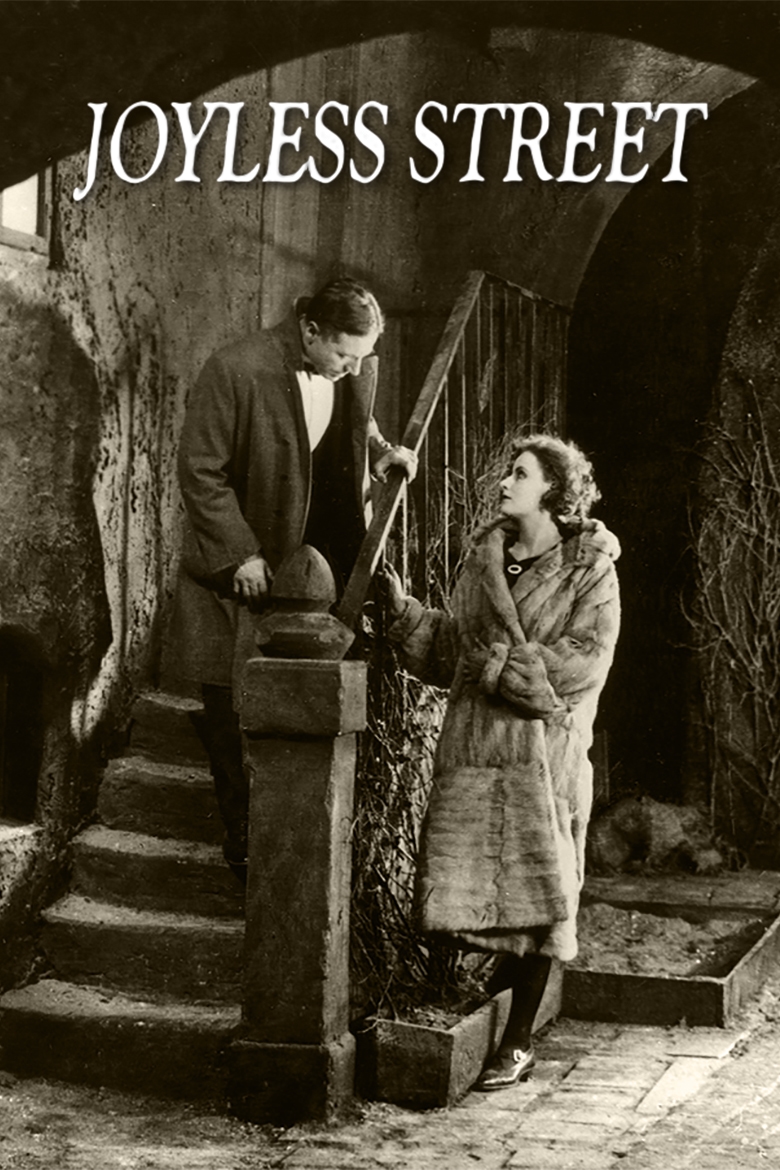
There’s a lot going on in Joyless Street (Die freudlose Gasse), GW Pabst’s epic “Straßenfilm” about the Weimar era in Germany, made during the Weimer era in Germany. Greta Garbo is in it, which tends to draw a lot of attention, and because the film survives only in a print with a good half hour missing, it’s often described as her film. It certainly looks that way from the 150 or so minutes now available. But Asta Nielsen was top-billed when it came out and she thought she was the star. So spare a thought for poor old Asta as you watch a tale of two impoverished young women doing what they have to do to survive in an entirely rapacious world of dog eat dog. If we had that missing half hour, the balance would surely swing much more in Nielsen’s favour.
Hang on to that thought all the way through, in fact, because this really is a tale of different paths taken by women in the same circumstances. Both are poor, both have a tough time at home. Both live in a neighbourhood ruled over by a vainglorious butcher who offers meat for sexual favours. Both eventually wind up working as prostitutes. And yet Garbo’s Greta manages to maintain a sense of integrity which Nielsen’s Maria does not. Maria ends up accusing her ex-boyfriend, who’s been carrying on with two other women, of murder, as a way of getting back at him. Greta’s path, meanwhile, leads her into the orbit of the procuress Frau Greifer (Valeska Gert) and towards a ruinous moment where she will be forced to appear naked in a tableau vivant before a roomful of men, one of whom is the man she loves.
It is a picture of pitilessly avaricious humanity, with the butcher Geiringer (Werner Krauss) the epitome of all that – the silent-movie-villain moustache and flashing eyes. In this world there is a price for everything and everything has its price. “These days money is all you need to be happy,” Marie’s beau Egon tells her, en route to treating her in a most cruel and cavalier fashion by making her whore for him. Meanwhile, in regular cutaways to an adjacent world of rich men, the swells who call the shots are gaming the system with inside trades on the stock market, living off the fat of the land and congratulating themselves on their wealth – the outward sign of inner virtue, they reckon.
What chance for a poor woman? Though in this film a woman’s virtue is also a tradeable asset, Pabst at least has an eye for beauty and the flapper fashions of the time. Garbo stands out in a cast full of attractive women. There’s a lot of bobbed hair and semi-formless, dropped-waist dresses on display.
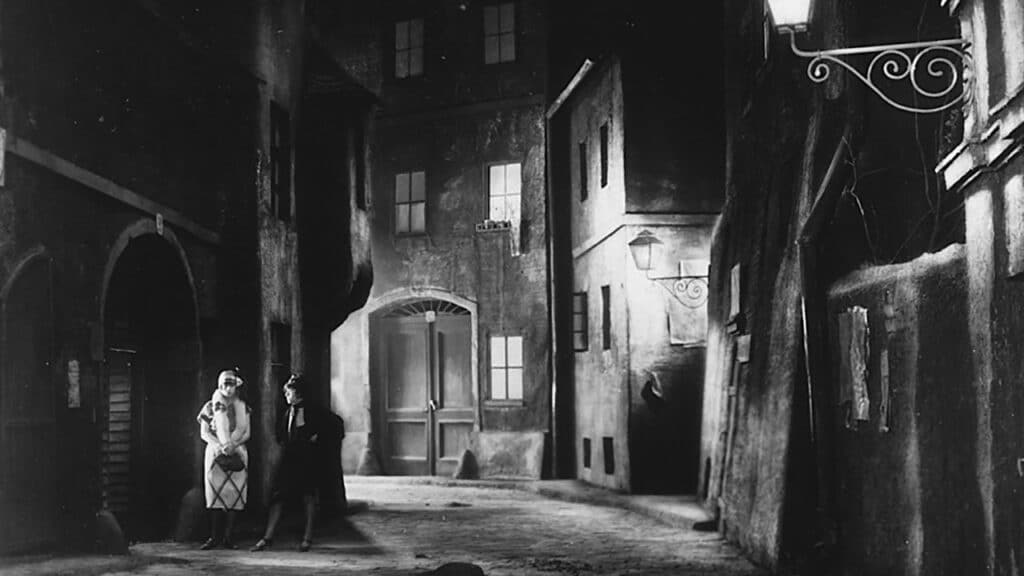
If only we could see it all more clearly. There’s a claim on most of the hard copies you’ll find out there that the film has been restored. It hasn’t. Someone somewhere has (possibly deliberately) confused restoration and reconstruction. This film as we have it has been reconstructed – stitched together from nine different sources by Film Museum München – and that is a heroic feat in itself. The many sources reflect the fate of the film on its initial release – hacked about by censors running scared of the “immoral” material in the film (the censor as usual confusing text with meaning). But also by American distributors, who wanted more Garbo and less Nielsen. It does not appear to have had what, in the digital age, we’d call a restoration – a frame by frame rescanning and cleaning up.
But in spite of it being woolly, scratchy and jittery the image isn’t too bad, and the imperfections often heighten the atmosphere generated by the madly expressionistic set design. Wonky perspectives abound. Everything is vignetted and colour-tinted.
The archaic quality adds something and it suits the atmosphere of Weimarean doomed frivolity which Pabst manages to work up, painting a big and broad picture yet getting touching and subtle performances out of his female leads.
Flirting with the camera, Garbo draws the eye, as usual. Here, her only-slightly-wonky teeth not yet fixed by Hollywood, you can really see what it was all about. Pabst also draws the eye. If you have watched the German TV show Babylon Berlin and wondered where it got its superb production design from, Die freudlose Gasse is the answer. It’s surely the best Weimar moodboard movie there is.
Die freudlose Gasse aka Joyless Street (part of a box set with Der andere Blick) – Watch it/buy it at Amazon
I am an Amazon affiliate
© Steve Morrissey 2025