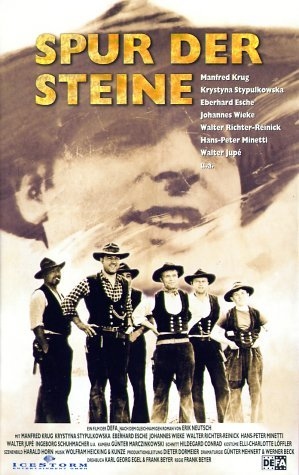
Socialism good, the socialist party bad is the idea driving Trace of Stones, originally Spur der Steine, a film made in the German Democratic Republic in 1966. It was shown a handful of times and then withdrawn, not to be seen again until the fall of the Berlin Wall. Audience unrest, said the authorities. Don’t criticise the Party!
The SED (Sozialistische Einheitspartei Deustschlands aka Socialist Unity Party of Germany) really does get it in the neck in what’s otherwise quite a familiar film, not a long way from the “kitchen sinkers” being made by the likes of Lindsay Anderson in the UK, though director Frank Beyer’s direction is looser, his approach to dialogue freer – it’s almost Altmanesque.
What makes a good party man is the question it asks in the background, in a complex story set on a building site in East Germany, where an SED official, Werner Horrath (Eberhard Esche), has been sent to sort out slack discipline among the workforce. To do this he needs to tame Hannes Balla (Manfred Krug), most charismatic and manly of all the workers, who leads his own clique of “Ballas” who are stealing from the site and selling the stuff off for personal gain.
Two complications. A new engineer on the site in the shape of pretty young Kati Klee (Krystyna Stypułkowska), who will catch the eye of both the courtly and married Horrath and the earthy and belligerent Balla. And the fact that, for all their thievery, Balla and his guys work hard and get things done.
Kati is introduced being warned by one of the management that all the guys on the job will be trying to look up her skirt as she goes about her daily tasks. I wear trousers, she snaps back, which is clearly a shock to all the men present. Socialism made great play about sexual equality, but clearly that memo had gone missing on its way to this site.

What is a man from a political party doing on a building site, you might well ask. That’s something else the film is doing, by making it clear there is a guiding force already organically at work there, in the shape of Balla – Adam Smith’s “invisible hand” of capitalism, if you like – and asking us to adjudicate as it squares one man off against the other. Balla turns out to be a man of more depth than at first appears. And as we catch glimpses of Horrath’s home life with a beautiful wife (Ingeborg Schumacher) and neglected family, sympathies start to shift.
The kitchen sink element is strong – people trapped by class and circumstance – but director Beyer goes through this British manifestation of the French New Wave back to source, using crash edits and overlapping dialogue to keep things moving. Technically this is a very accomplished film, with a performance by Krug at its centre that is fascinating because Balla changes so much during the 140 minutes or so of running time, but plausibly.
Repeatedly the action goes back to a meeting where, after major ructions that count as spoilers, the actions of Horrath, Balla and Klee are all being scrutinised by officials, all keen to toe the Party line. These scenes are the most damning of all – the personal and political are hopelessly intertwined and the hubris of the party’s meddling in what to modern eyes look like personal matters is breathtaking.
It’s is a time capsule from another time and another ideology and interesting on both those levels. The fact that Trace of Stones is also a good story well told is a real bonus.
Trace of Stones – Watch it/buy it at Amazon
I am an Amazon affiliate
© Steve Morrissey 2026