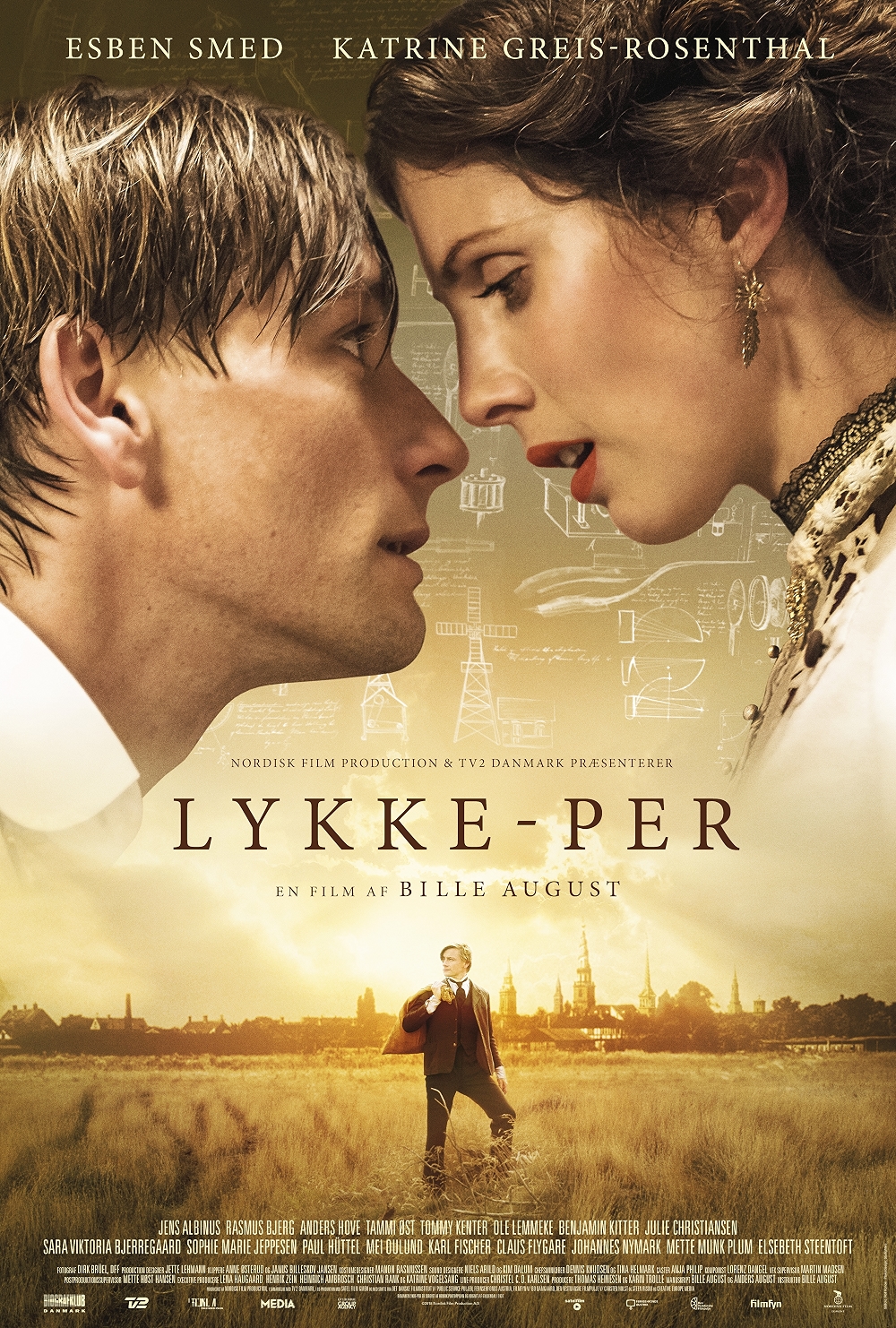
The title isn’t so much ironic as a question. Is Per (Esben Smed), the hero of A Fortunate Man, actually fortunate? Or a hero, for that matter? Danish director Bille August sweats bullets to condense this adaptation of Nobel-Prizewinner Henrik Pontoppidan’s eight-volume novel Lykke-Per down to movie size. At two hours 40 something minutes, it’s a big, sweeping, historical epic of a thing, a carriage-clock movie at bottom posing a simple question: what is the good life?
Pontopiddan’s eight volumes were intended as a compare and contrast to Hans Christian Andersen’s last book, the near-namesake Lykke-Peer, which was a tale of heroic struggle crowned by the ironic death of its lead character at his moment of triumph.
Here, something similar. Lykke-Per – it translates as lucky or happy Peter – is an ambitious, intelligent, confident, handsome and proud young man who runs away from his severely Christian family in Jutland to make his way in the big city. There, he tries to make his way as an engineer but finds his progressive ideas about wind and wave power not getting any traction at all. At the same time he’s fixing his attention on the daughters of a rich Jewish family. Ignoring the routine anti-semitism of Copenhagen high society, first he courts the younger one, Nanny (Julie Christiansen), before suddenly switching tack and going all in on her sister, Jakobe (Katrine Greis-Rosenthal), who is already engaged to the fat and sweaty Eybert (Rasmus Berg). Why the change? It may have something to do with the fact that Jakobe will inherit the old man’s money.
Later, Per will switch allegiances again, and in the film’s final section, echoing Andersen, he will get exactly what he wants only for it all to no longer have any value for him.
Smed, unknown to me when I pressed play, is excellent as Per. He plays the this antihero as urgent, passionate and self-deluding, not a bad man as such, more one who’s easily blown off course. The latest in a long line of European chancers – from Simplicissimus to Barry Lyndon, the Good Soldier Svejk and Felix Krull – he’s as attractive as he is unprincipled. What does it say about us that we like him?

The cast is pretty faultless throughout, though. Greis-Rosenthal and Christiansen as the two daughters, Berg as the unfortunate Eybert, Ole Lemmeke as the girls’ amused, wise, all-seeing uncle, Sara Viktoria Bjerregard as Inger, a pastor’s daughter who will become highly significant in Per’s life as the film hits the home stretch. Similarly, the lush technicals are all superb too. August is best known to English-speaking audiences as the director of films like Pelle the Conqueror and Smilla’s Feeling for Snow, but he hits all the right notes in this high-tone period drama with good looks and a complementary score. Everything just ticks along.
Per’s journey is a particular one – austere religiosity in Jutland to an excess of everything in Copenhagen – but there is a universal aspect to it. We all leave home at a certain point, and at another point we wonder whether we should go back. By the film’s closing moments Per has come to a realisation about himself, but he has hit his moment of triumph in the most supremely ironic way.
The film started life as a four-part mini-series running 55 minutes per episode. This recut loses about an hour of running time overall. I suspect the original TV show has the edge, the extra time just giving more space for everything to breathe, but I haven’t seen it so what do it know? If you didn’t know this had been condensed, you probably wouldn’t guess. The original book is one of the most famous in Danish literature and this film version does it proud.
A Fortunate Man – Watch it/buy it at Amazon
I am an Amazon affiliate
© Steve Morrissey 2026