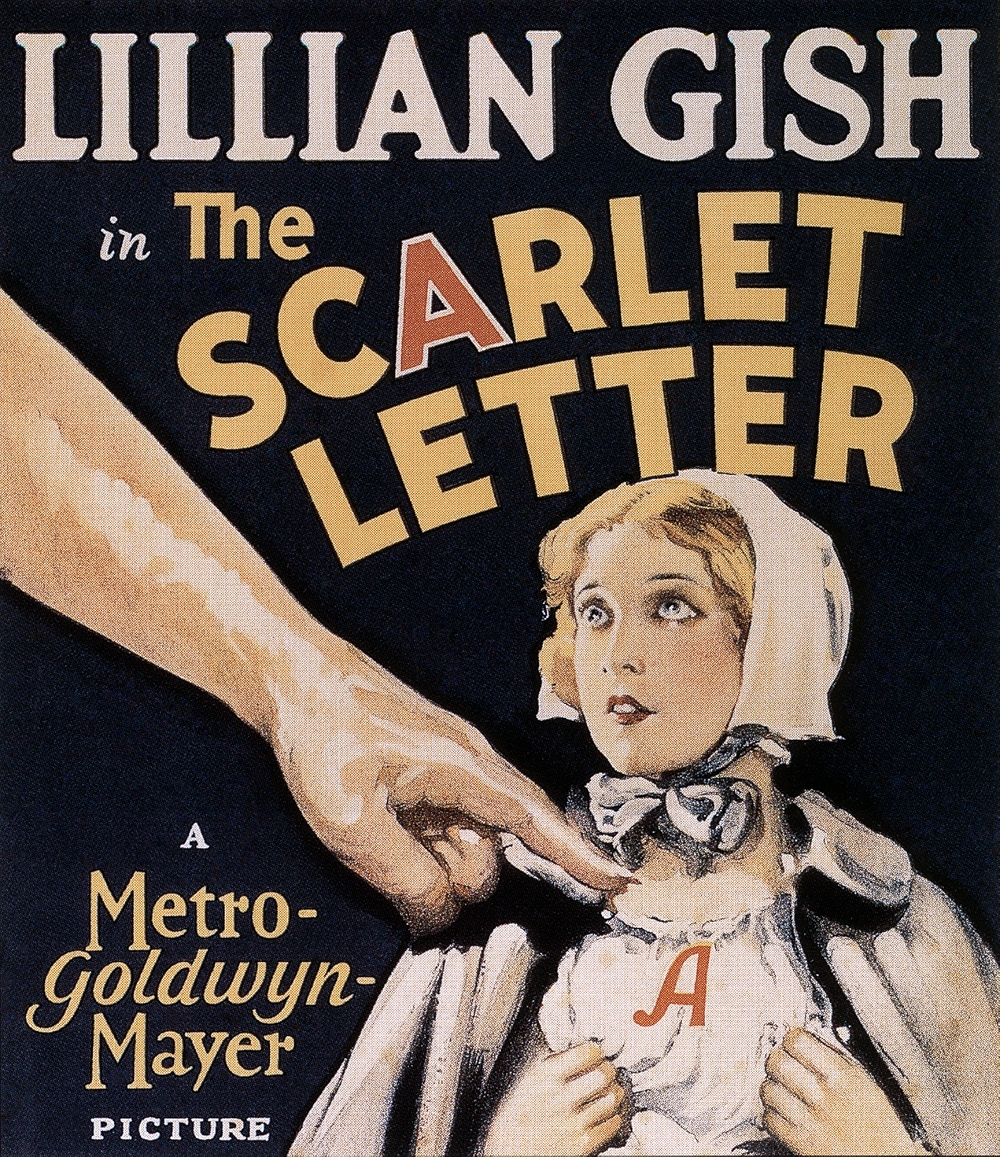
Lillian Gish was at the peak of her fame – “the first lady of the screen,” Vanity Fair were calling her – when she set about making this film in early 1925. Have no doubt, it was she who made The Scarlet Letter, or got it made at any rate. She lobbied the studio to shoot an adaptation of Nathaniel Hawthorne’s novel, got Victor Sjöström hired to direct it and arranged for Lars Hanson, a Swede like Sjöström, to be her co-star.
As much as anything else, the film was designed to shunt Gish’s public image away from the virginal roles that had made her name. How better to do it than playing a lusty young woman who gets pregnant out of wedlock in very Puritan 17th-century colonial America?
The letter in question, is a big red A – for Adultery – which the townsfolk force Hester Prynne (Gish) to wear pinned to her dress when they discover she is in the family way. Compounding her sin, Hester will not name the father, though we know it is Reverend Dimmesdale (Hanson), a much-loved man of the cloth whose piety did not save him from temptation. And so they co-exist in this small town, the shamed adulteress and the pious cleric. She won’t expose him at least partly because Dimmesdale alone, it seems, holds the worst excesses of the mindlessly puritanical townsfolk in check. And he can’t make an honest woman of her because… revelations for the future.
Sjöström was a gifted director much admired by Ingmar Bergman (who cast him in Wild Strawberries towards the end of his life). Two things immediately stand out about his direction here. First, his camera is superbly fluid, in a way that so many cameras in the silent era just weren’t – Sjöström clearly understands film is an entirely different art form from theatre. Second, he has an eye for the allure of Gish, who is portrayed as sexy but innocently, pheromonally so. Not quite an “It” girl – a term that would be popularised the following year by Clara Bow in the movie It.
Gish, for her part, knows what she’s got – the big eyes in particular – and uses it to her advantage in a performance that is touching and tender. We are never out of sympathy with Hester, with regular visits to some of the town’s grotesques, the hideous gossip Mistress Hibbins in particular, designed to shore up the defences of any waverers.
As the reverend, Larson is a handsome man with a fine head of hair. He spoke no English but it didn’t matter because it’s a silent film (Garbo used to visit him on set, apparently, because she was wanted a fellow Swede to talk to). Dimmesdale is a complex character, as is Hester, not ready enough to reveal himself to the townsfolk as a sinner, perhaps, but a good man at bottom.

Sjöström also makes sure we understand just how absurd the puritans could be. In one scene a courting couple are observed talking through a speaking tube, a real device with a mouth/earpiece at each end designed to keep man and woman apart (though it did offer up the opportunity to whisper unchaperonable sweet nothings in a domestic setting). And in the figure of Hibbins, a “wood-pussy” and a “cockroach” according to Giles (Karl Dane), the film’s one bog-standard normal dude, a theological fingerwag at what happens when pious people forget that to err is human, to forgive divine, and impudently start taking on some of god’s work themselves.
It all gets highly melodramatic, particularly as the film winds to a close, with denunciation, revelation, disease and death all piling on top of each other for a climax that’s satisfyingly histrionic.
If only we could see it all better – the image in even the best versions shifts from pretty good to very fuzzy as a decent reel is followed by one in poor shape. It’s a shame because Sjöström’s beautiful lighting is highly evocative. I watched the version that TCM show, which apparently is about as good as any you’ll find (make sure it is the 1926 and not the 1934 version – Amazon confuses them). It comes with a simply instrumented score by Lisa Catarineau and Mark Northam that’s by turns understated, sensitive and dramatic.
Amazingly, this is not the first filmed version of The Scarlet Letter. In fact it was the eighth. Since then it’s been remade several times – you might remember the 1995 version starring Demi Moore and Gary Oldman. The consensus seems to be, though, that this silent version is the best.
The Scarlet Letter – Watch it/buy it at Amazon
I am an Amazon affiliate
© Steve Morrissey 2026