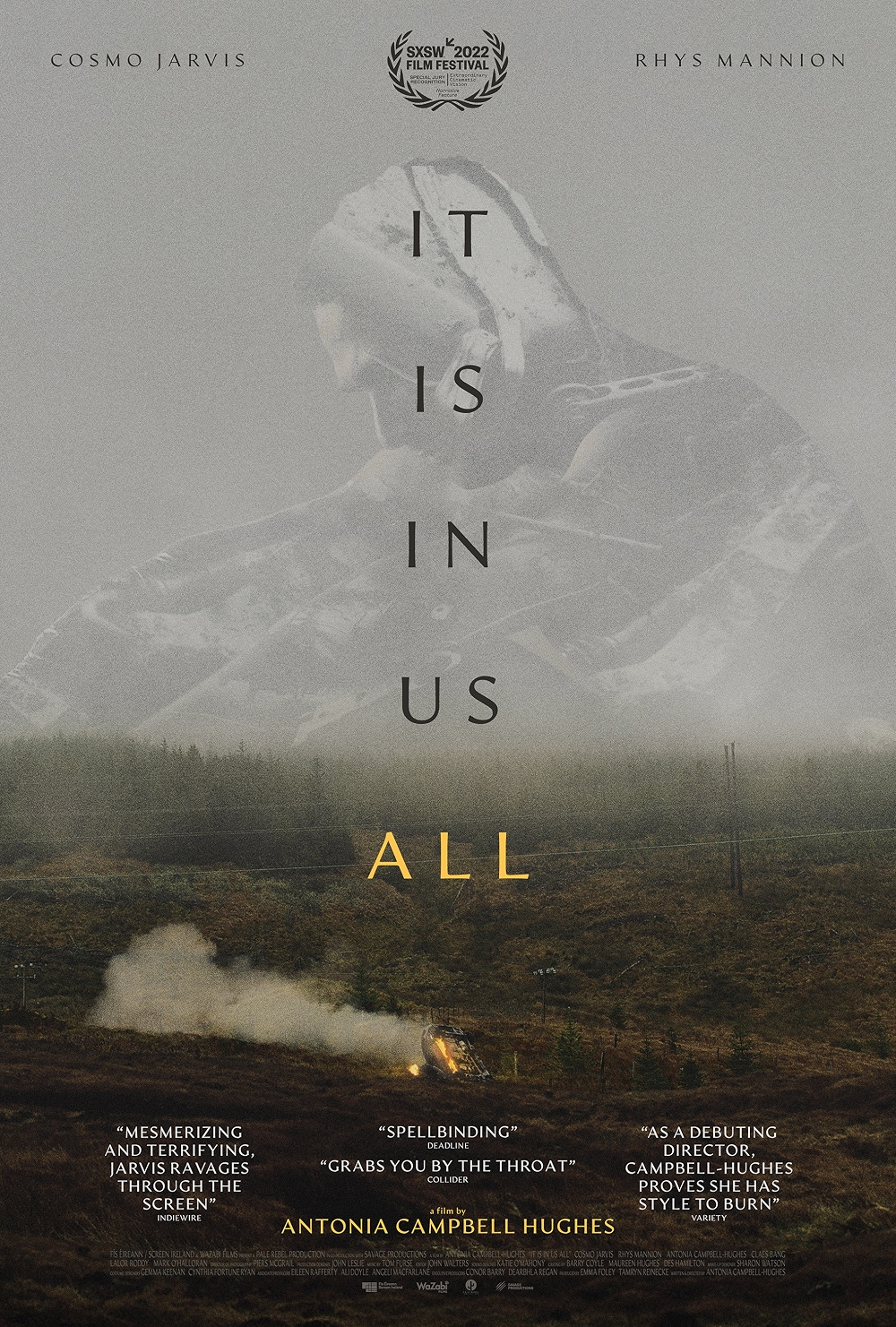
Blood-and soil-ethnicity meets the gothic thriller in Antonia Campbell-Hughes’s directorial debut. It Is in Us All‘s spooky meanings and explanations stay just beyond reach, which is no bad thing though it will infuriate lovers of a tidy parcel.
Now probably better known as the lead in Shogun on TV, Cosmo Jarvis is here pre-fame (though he’d been impressive in his debut, Lady Macbeth) as the second-gen Irish lad who’s heading back to the village where his recently dead mother grew up. Hamish’s aunt Tara, mum’s sister, has just died too, so now he’s going to sort out her house, or just check things out before this portal into the past closes. But en route he is involved in a car accident, wakes up in hospital with a broken arm, cracked ribs and a bang to the head. From here on in it’s anyone’s guess whether anything that happens to him is real or not. Is Hamish suffering from a touch of 1940s deranged-lead syndrome?
The guy in the other car, a teenage lad, died in the accident. It’s this that hovers over the rest of the story, even as Hamish tries to work out whether he is “from here” – a phrase that keeps being uttered in his earshot. Can he go back to his roots or is this a fanciful notion born of hyphenate identities? Is Hamish at bottom (if that means anything) a well-to-do British lad not some wistfully authentic Irishman, plastic or otherwise?
Campbell-Hughes herself turns up, as the dead boy’s red-eyed mother, a haunting banshee presence suggesting AC-H has folk horror in her sights too. Also shoring up the acting roster is Claes Bang as Hamish’s rich expat dad – a citizen of nowhere – who appears only in Skype (Skype!) calls with Hamish to pour water on whatever notions of ethnic rediscovery he might be nurturing. Hellishly impressive is Rhys Mannion in his feature debut, as Evan, the other person in the car of the dead kid. As he goes to extreme lengths to get chummy with Hamish, the question of Evan’s real motivation hangs in the air. And once his faintly feral friends are introduced, things start to wander into The Wicker Man territory – friendly, smiling locals with something dark in the hinterland.

Stories about leaving home and the impossibility of going back are common. As are tales of bereavement. Campbell-Hughes – who also wrote the screenplay – connects both of those with the hypernationalism of the moment, fretting away at the notion of belonging for all its worth, laying out questions rather than offering answers.
Most everybody in this film has lost somebody – a son, a mother, an aunt, a friend – but Hamish, to his way of thinking anyway, has also lost his patrimony. A silly English boy with notions? Or an Irishman cast adrift on the nationless zeitgeist?
It’s a mysterious film bristling with mood, shot with a slightly askew framing and relying probably a bit too much on vibes, but Campbell-Hughes is taking a chance and her film works on its own terms. At the risk of sounding simplistic, I thought it was good – interesting, thoughtful, atmospheric – though I can imagine it’ll be just a touch too lacking in consequence and action for some. Lots of vapour, not much that’s solid.
As I write I’m glad to see that it’s led on to other things – Violence Violence, another written/directed-by project, starring Guy Pearce and Andrea Riseborough, is currently in post-production. And after that there’s Quest for Love, starring Vicky Krieps and Rooney Mara. This bodes well for the future of Campbell-Hughes, a highly distinctive actress who, on this evidence, has become a highly distinctive director too.
It Is in Us All – Watch it/buy it at Amazon
I am an Amazon affiliate
© Steve Morrissey 2026