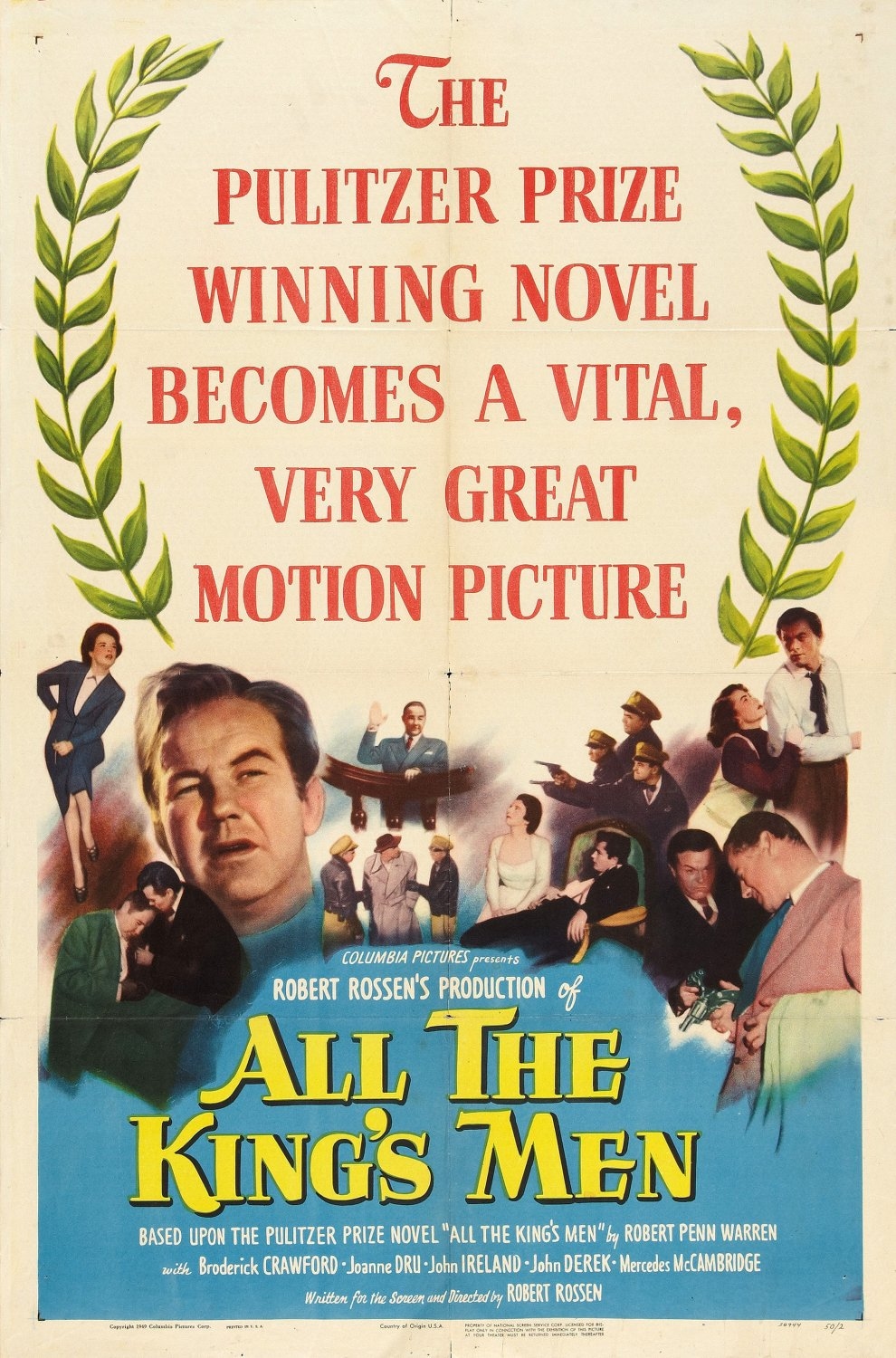
All the King’s Men is, give or take, a potted history of the rise and fall of Huey Long, the populist, Depression-era senator and governor of Louisiana. The names have been changed to protect the innocent/guilty (delete according to political preference), party particulars have been redacted and so have references to any specific state or region. But the ambitious public-works, education and health programmes launched by the stand-in for Long, Willie Stark, give us a flavour of Long that’s undeniable.
Long thought the big state spending of Roosevelt’s New Deal didn’t go anywhere near far enough and wasn’t shy about saying so. Audiences back in 1949 would have known exactly who the film was about, in the same way they’d known who Robert Penn Warren’s Pulitzer-winning novel of the same name was about when they’d read it a couple of years earlier.
Maybe you’ve seen the 2006 remake, starring Sean Penn, Jude Law and Nicole Kidman, but it didn’t impress many critics, or win any Oscars, unlike this original which took home three – Best Picture, Best Actor and Best Supporting Actress.
The acting Oscars seem particularly on the money. Broderick Crawford is all you could want as the self-aggrandising and ultimately diabolical Stark. Broderick was always good at playing characters who were little more than mean meat, so maybe that comes as no surprise. But he is just as convincing in early scenes, when Stark is still just a normal guy. Here, Crawford radiates decency and American can-do as an outraged just-folks citizen propelled into politics by a sense that the corrupt current lot need clearing out. Mercedes McCambridge, too, in her screen debut, works more than just one angle as Stark’s chief of staff, who admires him on the way up, falls for him, and then looks on in horror as the monster she’s helped create sets off on a populist jag, abandoning all his principles – and her – en route. She is particularly good in early scenes as a political fixer who arrives to bury Stark but winds up working for him.
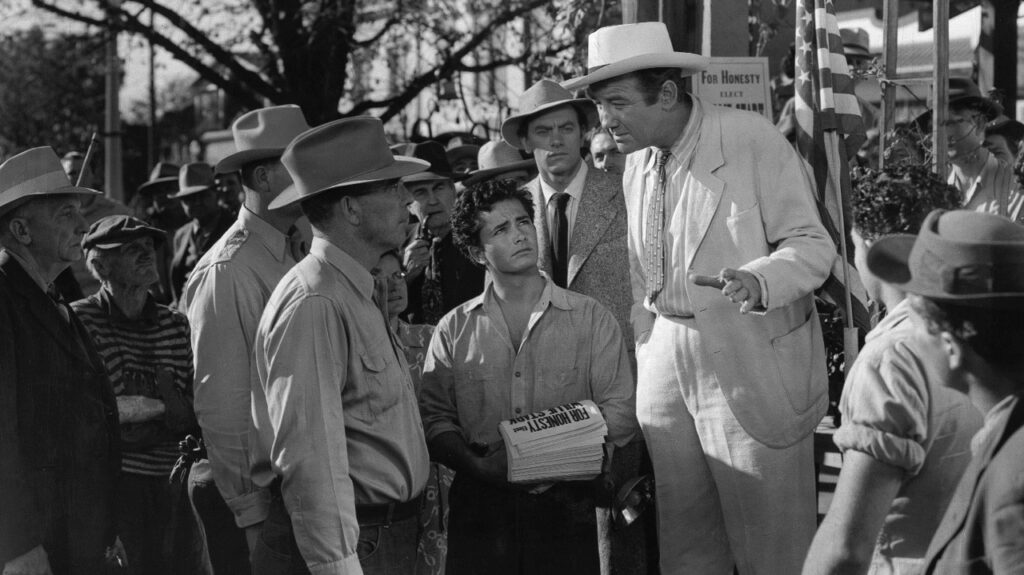
The novel was a much more twin-track affair, and also closely followed the downward progress of Jack Burden. A reporter sent to cover the Stark story, the initially decent Burden’s own morality is compromised by contact with Stark. Burden remains as a defeated voice of conscience in this film, but he’s not much more than that. It’s Stark who’s the focus, not Stark as mediated by Burden, and though John Ireland expends many a calorie trying to keep his character relevant, Burden and his backstory, hopes and desires becomes an increasing irrelevance. A burden, in fact.
Partly a lament for the impotence of idealism, All the King’s Men is better as a portrait of a corrupt individual than the process of corruption itself. We see the moment when a light goes on in the still-decent Stark’s head – “I know how to win,” he tells Burden after having lost his first run for public office – but the many tiny steps that lead the once-saintly Stark to the dark side are largely rushed over and the film’s not all that interested in whether Long actually got anything positive done (he did).
Maybe the subtleties got lost in the edit. Director Robert Rossen couldn’t get the movie he’d shot down to less than four hours and in desperation turned to Robert Parrish, a favourite of John Ford, to help him wrangle the movie into shape. Entering scenes late and leaving them early, Parrish’s super-tight cutting ensures that this film flies along, even if useful detail has probably been lost along the way.
Contemporary relevance? Loads. Particularly the late scenes where Stark weaponises the courts and public opinion and gets the rabble out on the streets because he’s in legal and political hot water.
Audiences at the time knew where this was all heading, and there is a cautionary aspect to it all. No spoilers: it does not end well, for anybody.
All the King’s Men – Watch it/buy it at Amazon
I am an Amazon affiliate
© Steve Morrissey 2025